National Parks · California
Yosemite National Park
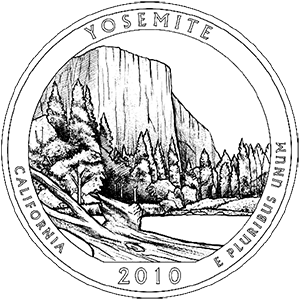
National Park Service source material · single source. Source dates and reuse information are available beside each field.
Check the official park website for current access, conditions and visitor information.
Introduction
Background: 1
Not just a great valley, but a shrine to human foresight, the strength of granite, the power of glaciers, the persistence of life, and the tranquility of the High Sierra. First protected in 1864, Yosemite National Park is best known for its waterfalls, but within its nearly 1,200 square miles, you can find deep valleys, grand meadows, ancient giant sequoias, a vast wilderness area, and much more.
Geography
Designation: 4
National Park
State or territory: 5
California
Park Map - Yosemite National Park: 6
Map scope: Yosemite National Park
Map of Yosemite National Park in California. Represented in green, the park’s left edge is stepped and the rest of its border irregularly ruffled. Dozens of sites, lakes, rivers, peaks, valleys, and other features are labeled.
History and culture
People: 7
The history of people in Yosemite goes back thousands of years. American Indians traveled and used this area since Ice Age glaciers receded providing an environment for plants, animals, and people to survive. Their descendents remain a part of Yosemite’s history to the present day.
In 1849, the discovery of gold in California meant new groups of people arriving in California. Competition for land and resources brought many of these groups into conflict, and, often, into violent confrontations. The first non-native group to enter Yosemite was the Mariposa Battalion, a Euro-American militia formed to drive the native Ahwahneechee people onto reservations. After the Mariposa Indian War came to a close, Yosemite was now open to settlement and speculation.
Through the work of illustrators, authors, painters, and photographers, word spread of the magnificent valley in the heart of the Sierra Nevada and giant trees. Many pioneers became tourist operators, building hotels and inns and starting stagecoach companies to bring the interested early tourists on the long journey to Yosemite. By 1864, the value of Yosemite was recognized by the federal government when Abraham Lincoln signed the Yosemite Grant, placing Yosemite under the protection of the state of California.
The growth of the national park and the surrounding areas has seen a large cast of characters. Some are famous worldwide, like John Muir and Ansel Adams, while others are significant at a smaller scale.
Individual and group contributions to Yosemite abound and help shape how we learn about and experience the park today.
Places: 8
A “place” can be defined in a number of ways. It can be a spot on a map, a building, a structure, or anywhere that is filled with human meaning. History is written on the landscape through human structures and cultural landscapes. Yosemite National Park is steward to more than 60 properties on the National Register of Historic Places, a list of historic properties that have regional and/or national significance. Yosemite is also the guardian of six National Historic Landmarks.
In general, a historic property can be any structure, group of structures (called a district), or a cultural landscape that is more than fifty years old. Something that makes Yosemite’s historic structures special is that they are some of the earliest examples of national park rustic-style architecture (sometimes referred to as “parkitecture” ) Many of our buildings were designed to fit into the natural landscape, starting a trend for design throughout the National Park Service.
The National Park Service defines a cultural landscape as, “...places within U.S. national parks that have a significance in American history and authenticity to a historic time period.” A cultural landscape can be a human modified ecosystem as well as constructed features.
Yosemite: Then and Now: 9
Yosemite National Park plays a significant role in the imagination, culture, and history of California and the United States. It is a land of contrasts, with its thundering waterfalls, soaring granite cliffs, serene meadows, and the largest trees on earth. Yosemite is also a wellspring of human aspiration. It is the birthplace of the national park movement, a muse for writers, painters, and photographers, and a natural resource that has fueled the growth of California and the Western United States.
Our goal with Yosemite: Then and Now is to tell the park’s story by matching beautiful and fascinating archival photographs with photos from today. Join us as we reveal the hidden history of familiar locations. The galleries of this collection are set up thematically and mostly chronologically, from the earliest explorers in the 1850s to mask-wearing tourists visiting in 2020.
Click on the titles below to go to each gallery. And please check back periodically as we are building this collection over time.
After the Mariposa Battalion became the first known European Americans to enter Yosemite Valley in 1851, doors opened for intrepid tourists and promoters to exploit the extraordinary natural wonder of Yosemite Valley and the Mariposa Grove of Giant Sequoias. Painters and photographers like Thomas Ayres, Albert Bierstadt, Thomas Hill, Charles Leander Weed, and Carleton Watkins provided imagery as evidence needed for Congress and President Lincoln to establish the original Yosemite Grant in 1864. Promoters Walworth and Hite, James Hutchings, and George Leidig found the imagery useful to encourage visitation to the newly protected lands.
Promoters established rough accommodations as early as 1857 to house tourists and scientists, such as Clarence King and Charles Hoffmann of the Geological Survey of California. The state of California built the Stoneman House in 1887 in an attempt to provide finer accommodations than previously afforded. John Degnan and his wife established a bakery in 1884 that eventually became the store and restaurant present today. The Currys, former teachers who provided camping tours during their summer vacation, arrived in 1899. Their venture evolved into the Curry Village of today.
For tourists to get to Yosemite before the automobile, they sailed from San Francisco to Stockton, boarded a stage for a rough, dusty ride to Mariposa or Coulterville, then rode with their luggage up various horse trails. The Mann Toll Horse Trail opened in 1856. Riders traveled 45 miles from Mariposa to Wawona, then followed old Indian routes into the valley floor near Bridalveil Fall. There are now roughly 800 miles of trail in Yosemite. John Conway, described by John Muir as “the master trail builder of the Valley,” configured the Yosemite Falls Trail with its 60 switchbacks, the Chilnualna Falls Trail near Wawona, and the Four Mile Trail from Yosemite Valley to Glacier Point.
In 1903, President Theodore Roosevelt visited Yosemite and was guided by naturalist John Muir. The two men spent three memorable nights camping first under the outstretched arms of the Grizzly Giant in the Mariposa Grove, then in a snowstorm atop five feet of snow near Sentinel Dome, and finally in a meadow near the base of Bridalveil Falls. Their conversations and shared joy with the beauty and magnificence of Yosemite led Roosevelt to expand federal protection of Yosemite, and it inspired him to sign into existence five national parks, 18 national monuments, 55 national bird sanctuaries and wildlife refuges, and 150 national forests.
California’s growth after the gold rush and the completion of the transcontinental railway accelerated demand for natural resources from the Sierra Nevada mountains. The city of San Francisco, in particular, reached into the Sierra initially for wood to house its expanding population. After the 1906 earthquake and fire exposed the vulnerability of the city’s water supply, San Francisco moved aggressively to tap the fresh water flowing from Yosemite’s highest alpine peaks through the Hetch Hetchy Valley.
As the population grew and word of Yosemite’s magnificence spread, tourists came from across the globe to see its wonders for themselves. Tunnels were carved through giant sequoias. Politicians, artists, Olympians, soldiers, and everyday travelers made the pilgrimage to pose in front of the grand waterfalls and granite vistas.
To accommodate the rapidly expanding number of visitors, infrastructure was built to service and house them. A variety of lodging was established from the rugged tent cabins of Camp Curry to the stately grandeur of The Ahwahnee. Sensitive meadow habitats were paved and trees removed for roads, parking lots, stores, restaurants, and ski runs. Even some hiking trails were paved.
The first automobile bumped its way into Yosemite Valley in 1900, dramatically expanding access for tourists. Roads were improved, Tioga Pass opened to cars in 1919, and in the same year, the first “aeroplane” landed in the Valley. Highway 140 opened in 1927 providing all-year access to the park through the Merced River canyon. Visitation increased from about 5,500 in 1906 when Yosemite Valley and the Mariposa Grove were incorporated into Yosemite National Park, to 210,000 visitors in 1925, to 490,000 in 1927 after Highway 140 opened, to over a million in 1960, two million in 1970, three million in 1987, and four million in 1996. Visitation reached a high of 5.2 million in 2016.
Artists have been drawn to capture the magnificence of Yosemite since humans first set foot on the land, from the American Indian basketweavers to the plein air artists of today. They paint the grandeur of the massive granite cliffs and thundering waterfalls as well as the constantly shifting incandescence of this graceful land. In this section, we attempt to provide a perspective on the artist’s eye, to see what they see.
Photographer’s Note: To photograph some of these artists’ views, it required lengthy and rugged hikes, carrying only a camera and tripod. Imagine doing a similar hike, without a trail, carrying a canvas, easel, and painting supplies, dealing with wind, blowing dust, and insects.
Archeology: 10
It allows archeologists to uncover stories that may be forgotten or overwritten by a dominant narrative. The archeological record helps provide a picture of lifeways where written history may not exist.
Archeology is a non-renewable resource. Once this record is disturbed, information and connections to our shared human heritage is lost forever.
Archeological resources hold religious and cultural significance to descendant communities. These resources are a physical record of their ancestral connections to time and place.
The public benefits from protecting and learning from the archeological record. The stories uncovered from studying archeology can bring a unique perspective to our current times and help us make choices for the future.
Survey. Archeologists are specially trained to recognize human impacts on a landscape. This can include assessing and monitoring threats and disturbances (e.g., construction, restoration, fire management, visitor activities, natural processes). When they find an archeological site, they thoroughly document and map the resource for protection and future research.
Monitor. Archeologists are involved in reviewing and monitoring all ground-disturbing projects in the park to make sure that archeological sites are not directly or indirectly damaged. Working with local American Indian representatives, archeologists can evaluate a project area and determine whether proposed activities will have impacts on resources and cultural landscapes.
Subsurface Testing and Excavations. Using systemic techniques, archeologists can find materials buried in layers of soil. Some archeological sites in Yosemite Valley are more than six feet deep! Systematic excavations allow archeologists to reconstruct layers of history in the human past.
Research. Like any other kind of scientist, archeologists form hypotheses and collect data to draw conclusions. For example, archeologists use x-ray technology to study obsidian flakes and map where the stones came from originally to recognize trade routes and other travel. Using a technique called obsidian hydration dating, archeologists can even discover how long ago a stone tool was made! Their work can be combined with the research of geologists, soil scientists, vegetation ecologists, anthropologists, and historians to create a portrait of the past.
Educate. Archeology isn’t just at a site, in a lab, or a museum. Yosemite’s archeologists work with park rangers and the public to teach about cultural resource stewardship and our shared heritage.
Create Partnerships. Archeologists work with many different groups of people. Archeologists provide critical input to ensure compliance with preservation laws and consultation with Tribes, agencies, and the public. All projects involving ground disturbance must be reviewed by archeologists to ensure that impacts are avoided, minimized, and mitigated. Descendants of Yosemite’s people can share oral histories of where people lived and the types of things they did, providing valuable clues of where to look next.
Archeology is represented through artifacts, features, ecofacts, sites, districts, and landscapes.
Artifacts: An artifact is a single portable item that has historical value, usually over 50 years old. It is not only artifacts themselves that are important but the locations of artifacts relative to one another, which is referred to as archeological context. Examples include projectile points, pestles, cans, and ceramic or glass fragments.
Features: A feature has historical value and cannot be moved by hand from its location. We assume they were formed in the location where they can be found today. Examples include hearths, milling surfaces, tree blazes, trash middens, wall segments, and rock art.
Ecofacts: Ecofacts are ecological evidence associated human activities. These could include pollens remaining from plants that were in the area when the activities occurred.
Sites: A site is a location that contains the physical evidence of past human behavior that allows for its interpretation. It can be a collection of interrelated features and/or artifacts that are in physical proximity to each other. A site could be a mining camp, a precontact activity area for processing food or tools, or a historic hotel and its grounds.
Districts: An archeological district includes archeological resources that relate to one geographically. An example would be the archeological sites in distinct areas like Wawona, Yosemite Valley, Tuolumne Meadows, El Portal, or Foresta.
Landscapes: A landscape includes not just interconnected archeological sites, but the natural features and intangible resources that give a place its meaning.
Cultural resource management addresses the protection, preservation, and management of cultural resources like archeological sites. Oftentimes, this includes mitigating impacts to resources during construction work or potentially destructive human and environmental forces like water erosion or visitation. Most archeology in the United States (and in Yosemite) is conducted under cultural resource management statute and regulation, particularly that of the National Historic Preservation Act of 1966, as amended (NHPA). Section 106 of the National Historic Preservation Act requires that federal agencies take into account the effect their undertakings have on properties listed in or eligible for listing in the National Register of Historic Places.
Context is the most important aspect of an artifact, feature, or site. It is the connection between the physical setting, location, and cultural association of the resource. There are also chronological, historical, cultural, and social contexts that archeologists apply in their analysis.
The interrelationship of archeological resources and how they are situated on the landscape is often more important than the objects themselves. Removal of artifacts from their location destroys essential information needed to understand who was here and how they lived.
Context imbues archeological resources with significance and meaning. Without context, the meaning and significance of an archeological resource is lost.
Cultural landscapes are historically significant places that show evidence of human interaction with the physical environment. Given that national parks encompass areas rich with cultural and natural resources, examining the cultural landscapes present can be a useful tool for understanding connections between people and place. Examples of cultural landscapes within Yosemite’s boundaries include The Ahwahnee hotel and its grounds, the Mariposa Grove, the Hetch Hetchy cultural landscape, and the many layered occupations of Yosemite Valley.
With the growing popularity of metal detecting, and the possibility of discovering treasures, one automatically thinks of exploring historical sites. However, federal law prohibits the possession and use of metal detectors in National Parks (36 Code of Federal Regulations 2.1(a)(7)).
In addition to metal detecting, federal law also prohibits relic hunting, digging for artifacts, and removing artifacts or historical objects. These acts are illegal and can lead to confiscation of equipment, arrest, and prosecution as a felony under federal law. Penalties may include fines of up to $10,000 and possible prison time.
36 Code of Federal Regulations 2.1(a)(7) - the possessing or use of a metal detector magnetometer, side scan sonar, other metal detecting device or subbottom profiler is prohibited.
Archeological Resource Protection Act 1979 - All natural, cultural, and archeological resources are protected and may not be removed or disturbed.
If you find an artifact while hiking, you will feel immediately connected to the continuum of human history in Yosemite! Please look but don't touch. If artifacts are moved even a few feet, we can lose valuable contextual information. You may take photos of artifacts that you find within the park, but please keep all locational information to yourself if you decide to post pictures on social media.
If possible, please record the location and take a picture (if you know how, take a GPS coordinate of where you found it). Let Yosemite National Park know about an object by emailing us .
If you find an artifact, please leave it where you found it. You may come across historic artifacts that look similar to modern trash (like rusty cans or bottles). However, many of these artifacts are old enough to be historic and are protected by law. Learn more about how to tell the difference between trash and an artifact.
If you find an artifact or grouping of artifacts that you think we should know about, please collect the following information and email us .
Mark the location on a map and write description of location, types of artifacts, how many, what you think they are, condition, and any safety issues
Generally, we consider something historic if it is potentially eligible for listing in the National Register, which means that it must be at least 50 years old. Properties less than 50 years of age must be exceptionally important to be considered eligible for listing. Federal and state laws protect archeological site location information to prevent unauthorized collection, vandalism, or other human-caused disturbances.
When interacting with an archeology site, please remember that these are places that are important to people, including Tribal communities, and represent physical connections to their ancestral heritage. Tread softly, do not take anything, and do not visit heritage resources that Tribes do not wish to have visitors at. Even the crumbs from your picnic lunch could attract tunnelling rodents causing unintentional damage to the resources below.
Yosemite consults under relevant law and policy with seven traditionally associated American Indian Tribes. Five are federally recognized, and two are actively seeking recognition. Federally recognized tribes include North Fork Rancheria of Mono Indians of California, Tuolumne Band of Me-Wuk Indians, Picayune Rancheria of the Chukchansi Indians, Bridgeport Paiute Indian Colony, and Bishop Paiute Tribe. Mono Lake Kootzadika'a Tribe and Southern Sierra Miwuk Nation are seeking recognition and have recognized association, demonstrated interest, and enduring connections with ancestral homelands in Yosemite. The federally recognized tribes and state historic preservation officer support the park’s consultation relationship with the non-recognized tribes per NHPA 800.3(f).
For more than 40 years, the park has worked with traditionally associated American Indian Tribes through formal consultation. The park supports the Tribes in continuing annual cultural and community events in the park. Tribal members serve as subject matter specialists, reviewing and commenting on proposed projects in the park and participating as members of project core teams, prescribed fire and fuels management, interpretive programs, and various building and infrastructure rehabilitation projects. Tribes are engaged in stewardship, research, and education through bi-weekly co-stewardship meetings, quarterly government-to-government meetings, providing expertise for NPS staff training, and providing leadership through tribal monitoring on construction projects.
To meet the 2021 Tribal Homelands Initiative and 2021 Secretarial Order 3403, park staff solicited feedback from Tribes and have clarified the following objectives:
Viewpoints of traditionally associated tribes are represented in management and planning, throughout project lifespans.
Members of these tribes have access to ancestral homelands for stronger cultural connections and traditional stewardship.
Tribal members have control of their own stories, and the public has access to accurate information about tribal connections to Yosemite, both current and historical.
Many American Indian tribes and tribelets have historic connections to the Yosemite area throughout the 10,000 or more years of human history. These groups may be defined from one another by languages and dialects, cultural practices, or by geographic regions. Tribes and tribelets continue to be connected by marriage, trade, and collaborative inter-tribal events and activities.
The Indian Cultural Program of Yosemite encourages the usage of "First People of Yosemite" when referring to all indigenous people who have called the area their home since time immemorial.
Law, policy, and unratified treaties identify legal relationships between the federal government and “American Indian Tribes” as well as sovereign “Tribal Nations.”
The term Ahwahneechee is what one group of people who were living in Yosemite Valley called themselves when the first non-Indians entered the area. This term likely means “People of the Gaping Mouth Valley.”
Yohhe'meti (Southern Miwok) or Yos.s.e'meti (Central Miwok) originally referred to the Indian tribe that lived in Yosemite Valley. Yosemite means literally “those who kill” (Yos, “to kill,” the modifier e, “one who,” and the plural suffix -meti). It was used by the surrounding Miwok tribes. The Yosemite people were referred to as killers by these surrounding tribes, who feared them.
Archeology in Yosemite has shifted from an earlier focus on scientific discovery (typically in the form of research-based excavations) to a more inclusive strategy that focuses on non-invasive approaches and collaboration with interested communities. With the onset of historic preservation laws, much of the archeological work in Yosemite is conducted to determine the significance and integrity of a site, to avoid, minimize, or mitigate impacts to archeology sites, and to determine how to best protect them in the future.
Local Tribal tradition and oral history say that the people of the Yosemite area were created here and have been here since time immemorial. Archeologists have uncovered material evidence that suggests that people were hunting in the Yosemite region nearly 10,000 years ago.
Human settlement and habitation patterns have always been affected by a variety of environmental changes. Early global warming between 8,000 and 4,500 years ago caused the tree line to move higher up the mountains. Oaks and chaparral expanded and diversified. There is less evidence of human habitation during this period in the archeological record and it is thought that Sierra Nevada residents migrated to the Central Valley. Conditions were more accommodating at lower elevations, and the Central Valley was a vast wetland brimming with resources during this time. Between 4,000 and 1,000 years ago, temperatures cooled and there is evidence of groups moving in greater numbers into the Sierra Nevada. During this phase there was an increase in trading throughout California. Shell beads from coastal regions as well as obsidian from the volcanoes east of the Sierra Nevada have been dated to this phase. Radiocarbon dates show that the Yosemite region has been occupied more or less continuously from this period onward.
The earliest inhabitants of the Yosemite region were most likely seasonal hunting parties, who left behind stone spearpoints and scraping tools. During this time, populations were likely small and settlements ephemeral. Lifeways changed to a heavier reliance on seed foods, and the diverse economy included intricate trade networks to the east and west of Yosemite.
Later in time, hunting technology shifted from use of spearpoints and darts to use of bows and arrows. The material culture left behind from this later period shows the shift from large dart points to smaller arrow points. By at least 1,500 years ago, people processed acorn as a staple food. You may see granite outcrops or boulders containing small, smooth cups near creeks and meadows. These are pounding rock or mortar rocks, used to pound acorn meal into a high-protein flour. Groups conducted systematic prescribed burns to maintain oak, willow, grass and other useful plant crops.
The local economy was very diverse and included an intricate trade network. Most stone tools were made from obsidian, a volcanic glass (usually black in color). Obsidian does not occur naturally in Yosemite; all the obsidian used here was traded in or transported from the east side of the Sierra Nevada. Other trade items included acorns, baskets, raw obsidian material, finished obsidian tools, dog pups, salt, and shell ornaments.
The California Gold Rush of 1849 changed native lifeways forever. Populations had already been decimated by European diseases. The influx of miners and traders led to conflict with Indians over land and resources, and to the “discovery” of Yosemite Valley by European Americans in 1851. Historical archeological resources in Yosemite include remains of early homesteads, mining and logging operations, tourist and National Park Service activities, and remnants of other more recent land uses.
A great cultural and ethnic diversity has always existed here. Many different tribelets speaking different languages and practicing their own unique cultural traditions were living in the Yosemite region when the first European Americans set foot on this landscape. African American Buffalo Soldiers working for the US cavalry were some of the first rangers in the park. Basque sheepherders moved through the meadows of the high country and hundreds of Italian and Chinese laborers built the first roads into Yosemite Valley. Today, diverse populations in Yosemite continue to shape and be shaped by this ever-changing landscape.
Approximately 2,500 archeology sites have been documented throughout the nearly 1,200 square miles of Yosemite National Park. These sites occupy a large date range, from about 10,000 years ago to just 50 years ago and range from precontact milling features to remains of homesteads and orchards. Much of Yosemite has not been surveyed for cultural resources, and the potential for finding a new site grows higher around water features like streams and rivers.
Descendent communities have ancestral connections with the land within and around Yosemite National Park. They are the original stewards of the land and retain a rich continuous history and cultural connection with the landscape and its resources. There are many ways that Tribal communities interact with park operations and the heritage resources present. Examples include project consultation, construction monitoring in culturally sensitive areas, gathering plans, tending of black oak groves, prescribed burning, and much more.
Wahhoga is a pre-contact and historic village site that is highly significant to tribes traditionally affiliated with Yosemite National Park. Wahhoga is the location of New Village, occupied from 1931 to 1969, representing the most-recently occupied native village in Yosemite Valley.
New Village occupants were removed from Yosemite Valley in 1969, but the 1980 General Management Plan (GMP) identified the need to redevelop this location for use by New Village residents, their descendants, and others in Yosemite’s tribal community.
Tribal use of this location for traditional, cultural, and educational purposes has been in National Park Service plans for over 40 years. A 2018 agreement among the NPS and the American Indian Council of Mariposa County (AICMC) allows tribal-led development and management of the site.
Archeologists are involved in annual large scale Yosemite events like Facelift and Horsetail Fall. Facelift is a parkwide trash clean up event that is organized by the park in conjunction with the Yosemite Climbing Association. Sometimes, items from historical archeology sites get mistaken for modern trash and are collected at cleanup events. Horsetail Fall as it is backlit by the setting sun on some days in February draws large crowds each year. Archeologists like to get involved in events like these to bring attention to archeological resources within Yosemite that may not be so obvious to the typical park visitor. When large crowds gather, their presence can impact archeological sites through forces like soil compaction and waste accumulation. Our presence at these events is to educate the public, park staff, and volunteers about the nature and importance of our archeological resources.
Collaboration between Yosemite’s different resource managers and interested communities has increased in recent years as the park has pursued interdisciplinary approaches. Connections between nature and culture are increasingly being emphasized. When archeology is considered along with other forms of ecological and ethnographic knowledge, a more complete picture of the past can be understood and protected from potential disturbances. A great example of cultural and natural joint resource management is the black oak tribal stewardship project where black oak trees are planted, pruned, and tended in Yosemite Valley. This project is a collaboration between the park and its affiliated tribes with the goal of restoring black oak habitat and traditional stewardship.
Stories: 11
The granite cliffs and domes of Yosemite have been witness to human lives for thousands of years. The landscape itself inspired and influenced the events that occurred over time. Yosemite has been a home, a battleground of human conflict and ideas, a destination, a place of recovery, and more.
Exploring these stories gives us new insight into what has made Yosemite National Park into the place it is today.
People have lived in modern-day Yosemite National Park for at least 8,000 years . Little is known about these earliest inhabitants. Today and for the last several centuries, Yosemite is home to many tribes. Before its modern name, Yosemite Indians called Yosemite Valley “Ahwahnee,” meaning “gaping mouth-like place.” Numerous tribes gathered in Tuolumne Meadows in the summer to trade, take advantage of food sources, and escape the summer heat of the lowlands. Evidence suggests tribes seasonally occupied many areas across Yosemite such as the Hetch Hetchy Valley, Wawona, and Crane Flat.
The California Gold Rush of 1849 brought thousands of non-Indian miners to the Sierra Nevada . Many miners were ruthless in their search for gold, and thousands of Native people were killed by outsiders or died of starvation. Yosemite Valley was first entered by non-Indians in 1851 by the Mariposa Battalion, a state-sponsored militia. The battalion made two attempts to remove the Native people to the Fresno River Reservation, but those attempts, along with a U.S. Army punitive expedition in 1852, were ultimately unsuccessful in removing the Indian people from the Yosemite region.
As non-Indians began to settle in the Valley, some surviving Indians left Yosemite Valley, dispersing in nearby communities. Other Indians stayed close by and adapted, taking jobs as road laborers, guides, housekeepers, and artisans who sold goods to tourists.
Within a few years of the first outsiders entering Yosemite Valley and the displacement of its native residents, fortune seekers began to flock to the area. Most weren’t seeking gold, instead coming in search of riches, solitude, or both. James Hutchings , who later became one of Yosemite’s earliest European American residents, led the first known tourist party through Yosemite Valley in 1855.
In 1856, the Lower Hotel was the first lodging built for tourism in Yosemite Valley, offering extremely modest, barn-like accommodations. Enterprising new residents constructed bridges and operated ferries across the Merced River, charging travelers a fee to use them. Numerous non-Indian residents established pre-emption claims in Yosemite Valley, hoping to acquire land that had been dispossessed from American Indians. These residents planted orchards and grazed their stock in meadows, rapidly altering Yosemite Valley’s ecological, cultural, and scenic qualities.
In the mid-19 th century, the concept of a national park did not yet exist. Nevertheless, early conservationists believed that Yosemite Valley and the Mariposa Grove of Giant Sequoias needed formal protection to prevent these remarkable landscapes from being destroyed by commercial interests.
Advocates including steamship Captain Israel Ward Raymond and Senator John Conness worked to persuade Congress to enact these protections. At the same time, journalists and artists played a key role in conveying the grandeur of Yosemite to a broader national audience. The groundswell of advocacy proved successful when President Abraham Lincoln signed an act protecting the Yosemite Grant in 1864. This watershed legislation granted to the State of California Yosemite Valley and the Mariposa Grove of Giant Sequoias under the condition they remain protected for public enjoyment—the first time the US government protected public land for its scenic value.
Shortly after, the newly established board of commissioners for the Yosemite Grant designated Galen Clark , another early advocate of the Yosemite Grant, to be the park’s first formally appointed guardian. Clark served several non-consecutive terms, helping to protect the park for over twenty years.
The enactment of the Yosemite Grant sealed Yosemite’s fate as a tourist destination. Local entrepreneurs quickly caught on to the opportunity, expanding visitor services quickly .In the early days of Yosemite tourism, reaching Yosemite Valley required a grueling, multi-day journey on horseback. To make the journey faster and more comfortable, local businessmen funded the development of stage roads, though even this improvement in travel remained very dusty and dangerous. The journey required highly skilled reinsman such as the acclaimed driver George Monroe to safely carry visitors to their destination.
The first road to reach Yosemite Valley, the Coulterville Road, was completed in June 1874, followed by the Big Oak Flat Road just one month later. The Wawona Road opened to traffic in 1875 after Chinese laborers worked to complete the road through a harsh winter season. Later, the Yosemite Valley Railroad, completed in 1907, marked another leap forward in visitor access. These methods of travel were gradually rendered obsolete by the invention and widespread adoption of the automobile.
After stage roads reached Yosemite Valley, a bevy of hotels, restaurants, photography studios, and other services multiplied to serve the nascent tourist economy, often leading to bitter rivalries between concessioners. More modest levels of development reached other areas of modern-day Yosemite, such as artist Thomas Hill’s studio and the Wawona Hotel, both located near the Mariposa Grove of Giant Sequoias, another popular destination.
Some of Yosemite Valley’s earliest enterprises still operate today. Irish immigrant Bridget Degnan began baking and selling bread to residents and visitors in the 1880s. Degnan’s Kitchen remained family-owned until 1972 and continues to serve visitors today.
Former schoolteachers David and Jennie Curry founded Camp Curry in 1899, offering low-budget accommodations and activities to visitors. Their initially small operation of tent cabins in the east corner of Yosemite Valley grew considerably over the years and continues as Curry Village today.
Numerous private interests identified the opportunity for trails to serve both practical and sightseeing purposes. Among them, John Conway designed and constructed several of the park’s earliest tourist trails in the late 19 th century, including the Yosemite Falls Trail, Chilnualna Falls trail, and the original Four Mile Trail.
While the tourism economy burgeoned in Yosemite Valley, most of the land now encompassed by Yosemite National Park was not yet legally protected.
As outsiders and government authorities continued to disrupt American Indian ways of life and remove Indians to reservations, homesteaders and stockmen sought new uses for the land across the high country, mid-elevation meadows, and forests. Cattlemen and sheepmen led their animals to graze throughout many areas of modern-day Yosemite. Homesteaders often abandoned their claims relatively quickly due to the challenges of the remote, mountainous location. Tuolumne Meadows and the surrounding high country became particularly popular summer grazing destinations for sheepherders, many of whom were Basque.
In the 1880s, prospectors built mines in the high country, expecting to plunder the mountains for silver. To support these developing mines, crews of both Chinese and white laborers quickly built the Great Sierra Wagon Road across Yosemite’s high country. This road wound through the mountains along a similar route as present-day Tioga Road. A few years later, it became clear that these mines would not be profitable, and they were abandoned. Stephen Mather, the first director of the National Park Service, and his associates later acquired the road for $15,000 using their own funds. Congress accepted the title transfer of the road to the National Park Service in 1915.
Early conservationists recognized that effective preservation of Yosemite Valley’s majestic cliffs and waterfalls necessitated protection of nearby areas as well. State Engineer William Hammond Hall first formally recommended protection of the watershed above Yosemite Valley in a report published after his 1881 visit to the area. John Muir became one of Yosemite’s most famous advocates, voicing his support for the expansion of Yosemite’s borders and designation as a national park. His and others’ activism led to U.S. Congress passing a bill designating Yosemite as the nation’s third national park in 1890. This legislation massively expanded the protected land, encompassing most of the upper reaches of the Merced River and Tuolumne River watersheds.
At that time, the National Park Service had not been established, and thus there was not yet consistent, unified administration of the nation’s small network of national parks. In the interim, the U.S. Army served as the guardians of the park. Many troops, including the all-Black regiment known as the Buffalo Soldiers, patrolled on horseback, curbing unwanted and illegal activities in the park such as wildlife poaching, illegal grazing, wildfire, and theft.
In 1905, Congress redrew the boundaries of Yosemite National Park once again. The new boundaries traced the upper basin of the Merced and Tuolumne Rivers along the park’s northern and eastern boundaries. However, this change significantly reduced Yosemite’s area compared to its 1890 boundaries, in part due to pressures from mining, logging, and grazing interests. In 1906, management of Yosemite Valley and the Mariposa Grove shifted from the State of California to the federal government.
The fight to protect Yosemite soon faced another battle. The City of San Francisco had long been seeking a new water supply for the city, eyeing the pristine mountain waters of the Tuolumne River in the Hetch Hetchy Valley . The proposal to construct a dam and impound water within a national park set off fierce debate; Hetch Hetchy was a tangible manifestation of the competing values of preservation and use. Ultimately, Congress passed the Raker Act in 1913, authorizing construction of O’Shaughnessy Dam. Since its completion in 1923, the Hetch Hetchy Reservoir continues to provide drinking water and hydroelectric power for millions of residents in the San Francisco Bay Area today.
The Hetch Hetchy controversy laid bare that without robust, centralized bureaucratic backing, the nation’s growing national park system would remain vulnerable to competing interests. In 1916, Congress passed an act establishing the National Park Service.
In the early days of the National Park Service, park administrators went to work outfitting the parks with infrastructure sufficient to support visitation and administration. In the 1920s, new construction proliferated particularly quickly in Yosemite Valley.
The Rangers' Club , built in 1920 as a home for seasonal rangers, was the first structure built in the newly established National Park Service Rustic architecture style. Architects designed and built Yosemite Village and its nearby employee housing as a new hub of administration and visitor services. Yosemite concessioners built The Ahwahnee in 1927, a large, resort-style hotel intended to attract wealthy visitors.
When the economy plummeted into the Great Depression, the parks benefited from government labor programs, allowing park development to continue despite nationwide economic turmoil. In the 1930s and early 1940s, the Civilian Conservation Corps completed projects around Yosemite such as construction of the Arch Rock Entrance, Glacier Point overlook, Ostrander Ski Hut, and many more.
This spree of park development came to a halt during World War II, when funding and visitation to all national parks dropped precipitously. For over two years, The Ahwahnee temporarily became a naval convalescent hospital where medical staff treated thousands of recovering soldiers. Across Yosemite, low budgets and chronic understaffing led to infrastructure falling into disrepair as years of war ticked by.
After the conclusion of World War II, nationwide economic prosperity and an appetite for modernizing made its way to the parks, revitalizing infrastructure and visitation after a years-long lull.
After World War II, President Dwight Eisenhower passed a bill funding Mission 66 , an ambitious, billion-dollar project to revitalize facilities, infrastructure, and staffing in the national parks. As visitation rose rapidly, infrastructure and park staffing levels were in urgent need of modernization to meet the needs of the growing crowds.
Mission 66 funded dozens of projects throughout Yosemite , including new and revitalized campgrounds, new employee housing, modernized utilities infrastructure, reconstruction of key segments of Tioga Road and Big Oak Flat Road, and many others. Park concessioners also funded new, modern buildings during Mission 66, including Degnan’s Kitchen, the Village Store complex, and Yosemite Valley Lodge. Collectively, these efforts streamlined and improved visitor experiences through increased staffing, better roads, expanded accommodations, and more readily available park information.
For much of its early history, Yosemite and other national parks were managed with a “people first” philosophy, meaning that the comfort, convenience, and enjoyment of park visitors was at the forefront of decision-making. Sometimes, this caused harm to the natural world, such as the killing of certain predators or the long-standing fire suppression policy.
The late 20 th century to the modern day have brought significant changes in park management practices to more ecologically sound practices. Scientific evidence and traditional knowledge now play a more important role in park management decisions. Visitation patterns and ways of experiencing Yosemite have changed, too.
In the mid-20 th century, rock climbing was not yet a mainstream sport. The walls of Yosemite became an incubator where new styles and best practices for climbing were born. Early climbers set their sights on Yosemite Valley, launching the sport into a period of rapid growth in culture, techniques, and athletic achievement. In the 1940s and ‘50s, prominent athletes such as John Salathé, Royal Robbins, and Warren Harding pioneered numerous first ascents of Yosemite Valley’s iconic big wall climbs, such as Sentinel Rock, Half Dome, and El Capitan.
Beginning in the 1950s and for several decades after, climbers camped in Camp 4 for long periods, often with little to no money or belongings, devoting their time and money to training and attempting new, difficult climbing routes and techniques. In 2003, Camp 4 was listed on the National Register of Historic Places for its significance in the development of modern rock climbing. Today, Yosemite’s towering granite walls remain an epicenter of rock climbing culture for both recreational and professional athletes.
Much like the free-spirited rock climbers, the 1960s and 70s brought another new type of visitor to Yosemite: hippies and youth of the countercultural movement. Park officials initially viewed this type of visitor as disruptive and undesirable. On July 4, 1970, tensions erupted during the Stoneman Riot, where authorities stormed scenic Stoneman Meadow below Half Dome, a preferred social destination for youth, arresting hundreds of visitors. In the months following the riots, authorities continued to target young hippies, turning visitors away at entrance stations based on their appearance and sweeping campgrounds in the middle of the night to oust youth. Hippies and their allies pushed back, asserting their right to enjoy national parks peacefully. As negative press and public outcry mounted, National Park Service director George Hartzog intervened, replacing Yosemite’s superintendent and personally visiting the park to help solve the ongoing tensions. In the summer of 1971, a year after the explosive riots broke out, Yosemite authorities shifted their stance, establishing new campgrounds, policies, and even ranger programming to engage youth.
Amid the deep cultural divides of the 1970s, these painful moments of conflict on the Valley floor led Yosemite and the National Park Service to rethink its previously narrow approach, embracing the ever-changing needs and goals of increasingly diverse visitors.
The famous Camp Curry Firefall, a dazzling nightly display where workers pushed hot coals over Glacier Point after dark, ended in 1968. National Park Service director George Hartzog mandated the end of the long-standing tradition due to the unnatural nature of the attraction in addition to severe traffic congestion. The end of the Firefall was emblematic of the broader sea change in park management philosophies.
The role of fire in Yosemite changed in more profound ways shortly after. For thousands of years, lightning-caused wildfires burned freely, and Yosemite Indians actively managed the land by intentionally starting low-intensity fires. When European Americans violently removed Yosemite Indians and claimed administrative control over Yosemite, the newcomers implemented a major shift to total fire suppression. Despite being a fire-adapted ecosystem, fire suppression was the prevailing practice in Yosemite for over one hundred years, finally ending in the 1970s. The legacy of fire suppression caused significant alterations in habitat and vegetation of the area still evident today. Modern fire and forest management policies seek to restore the natural role of fire in maintaining healthy ecosystems in Yosemite.
Much of California was once part of grizzly bears’ native range, including Yosemite. The last known grizzly bear in the park was killed in 1895. Even though Yosemite was a national park at the time, regulations in that era did not mandate protection for wildlife; large predators were considered undesirable and large numbers of them were killed.
Biologists Joseph Grinnell and Tracy Storer performed some of the earliest wildlife surveys of Yosemite National Park in the 1910s, which they published in their book Animal Life in the Yosemite . Through their research, these visionary scientists emphasized the importance of managing national parks as wildlife refuges in addition to their mandate for public enjoyment. In the 1920s and 30s, Grinnell’s student George Meléndez Wright continued this legacy in his work in Yosemite, where he taught, wrote about the area’s natural history, and conducted wildlife surveys. Wright went on to help found the National Park Service’s Wildlife Division in 1934 and advocate for groundbreaking wildlife management policies in his seminal text, Fauna No. 1 . Policies conferring protection to native wildlife took decades to change, in part due to the advocacy of these early wildlife biologists and followed by their ideological successor Aldo Starker Leopold in the 1960s.
Conflict between humans and the remaining large wildlife, especially black bears, has been a long-standing challenge, especially as Yosemite became an increasingly popular tourist destination. Practices like open garbage dumps and even bear-feeding shows in the early and mid-20 th century worsened matters. These human-bear conflicts led to the destruction of property and even human injuries. Improvements to human-bear management policies in Yosemite over more recent decades have led to massive decreases in human-bear conflicts, improving both human safety and wildlife welfare.
Many other animals have benefitted from modern conservation initiatives. After being extirpated from Yosemite in the 1940s, peregrine falcons began to make a comeback in the late 20 th century thanks to nationwide rehabilitation efforts. When peregrine falcons began returning to Yosemite’s cliffs, avid rock climbers partnered with wildlife biologists to monitor and protect these birds’ sensitive nest sites. This ongoing program has led to a remarkable recovery to the peregrine falcon population.
Today, rare wildlife such as wolverines and California condors are occasionally seen passing through the area. Even though not all species who visit make a home here, these non-human visitors find a temporary haven in Yosemite’s vast wilderness.
On the heels of Mission 66’s postwar modernization efforts, Yosemite administrators embarked on a long effort to create a general park management plan. With aging infrastructure, traffic congestion, and ever-growing visitation, park planning was becoming increasingly complex. After nearly a decade of planning and gathering input from tens of thousands of visitors, Yosemite National Park rolled out the 1980 General Management Plan. This documented outlined an ambitious plan to remove cars and non-essential administrative functions from Yosemite Valley.
While aspects of this plan were heavily modified or never fully came to fruition due to a host of obstacles, some key changes implemented from this plan include the free shuttle system in Yosemite Valley and the relocation of many utilities and administrative functions to El Portal, outside the park boundary, reclaiming valuable space in Yosemite Valley.
Alongside these changes, the 1980s also brought significant advancement in natural resource conservation. Parking lot construction plans were axed to protect habitat for the endangered great grey owl. Wildlife biologists reintroduced Sierra Nevada bighorn sheep to their native range in the park. Critically, the passage of the California Wilderness Act in 1984 designated 89% of the park as legally protected wilderness as defined in the Wilderness Act of 1964. This percentage has grown even higher through additional designations in the years since. Congressionally designated wilderness means that these areas will remain free from roads and most other human-made infrastructure or interference. This legislation protects the wildlife, vegetation, and watersheds that are vital to California’s ecosystems and human residents.
As both visitation patterns change and our understanding of our environment evolves, park management strategies continue to change to keep pace. Building on the work of the 1980 General Management Plan, the park created the Merced Wild and Scenic River Final Comprehensive Management Plan between 2000 and 2014. Likewise, the Tuolumne Wild and Scenic River Final Comprehensive Management Plan was developed between 2006 and 2014. Both plans were the result of lengthy collaborative processes involving tribal consultation, scientific data, substantial public input, and more. The management strategies in these plans seek to improve hydrologic function within the river corridors and improve scenic qualities of these invaluable watersheds.
Just like fire, rockfall, and weather cause Yosemite to change a little bit each day, so too does the human history of Yosemite continue to be written.
Yosemite's Women: 12
Women have played an important—though often hidden—part in Yosemite. In the 1800s, women were expected to play a traditional role in the private world of the family and the home. With the birth of the railroad and as the Gold Rush drew people to California in the late 1800s, pioneering women found ways to broaden traditional roles. Clothing reforms, such as the advent of "bloomers," allowed women to participate in outdoor pursuits, while women writing about their adventures in the West inspired the imagination of others. Some women expanded traditional roles out of an adventurous spirit while others branched out from the necessity of supporting the family. In the West, women's domestic skills sometimes became the basis for a profitable business. The following Yosemite concessioners, adventurers, rangers, naturalists, cultural demonstrators, and artists are some of the pioneering women that helped expand women's roles.
Bridget Degnan moved to the United States from Ireland with her husband John, settling in Yosemite Valley in 1884. They raised eight children while John worked as a laborer for the state. Bridget added to the family's income by selling bread she baked daily for 12 ½¢ a loaf. Demand for her bread increased steadily as more visitors traveled to Yosemite Valley. In 1900, the Degnans ordered a large brick oven that could hold over 100 loaves of bread. This oven is on display in the Pioneer History Center at Wawona. Her bread enterprise kept expanding as visitors would ask for something else to eat or drink, so she set up a small restaurant in the dining room of their old house, and later, a grocery store. Their original home was in the vicinity of the present-day Yosemite Valley Lodge, and later, at the site of old Yosemite Village.
Jennie Foster Curry moved to Yosemite in 1899 with her husband David Curry. She was a college graduate, which was unusual for a woman at the time. Her husband and she ran a tent camp at the base of Glacier Point. In its first season, Camp Curry grew to 25 tents and 290 guests registered at the rustic resort. Jennie made beds, packed box lunches, and helped plan additional guest services. When David died in 1917, "Mother" Curry carried on the camp and oversaw expansions, continuing Yosemite Park and Curry Company leases from the government with the help of her children. By 1922, Camp Curry had grown to 650 tents, 60 rooms in cottages, a cafeteria, a bakery, an ice plant, a candy kitchen, soda fountain, a studio, laundry, bathhouses, pool, auditorium, bowling alley, pool hall, a post office, and a store.
Stella, Bertha and Mabel Sweet and friend Maybel Davis ascended Mt. Lyell, the highest mountain in the park, in 1896. They were the third group of women to climb Mt. Lyell and the first group to descend into Tuolumne Canyon. Dressed in leggings, bloomers and wide-brimmed hats, these four adventurous women took a shortcut down by sliding down the glacier to descend at "a mile a minute." The photograph on the left was captured by their brother, and the San Francisco Chronicle wrote about them.
Sally Dutcher became the first woman to climb Half Dome in October 1875, accompanied by George Anderson and Galen Clark. She worked as an assistant to photographer Carleton Watkins in his gallery.
Kitty Tatch was a maid and waitress at the Sentinel Hotel in the late 1890s and early 1900s. Dressed in long wide skirts identifying her clearly as a woman, she danced and did high kicks at Overhanging Rock, 3,000 feet above the Valley, on Glacier Point with her friend Katherine Hazelston as George Fiske photographed them. (View famous photograph.) These pictures were later made into postcards, autographed by Tatch, and sold for years.
In a more modern context, Liz Robbins became the first woman to ascend the Northwest face of Half Dome in 1967 with her husband, Royal Robbins. In 1973, Bev Johnson and Sybille Hectell completed the first all female ascent of El Capitan.
Clare Marie Hodges was the first woman ranger in Yosemite and one of the National Park Service rangers . She began teaching in the Yosemite Valley School in 1916. During World War I, Hodges heard about the difficulty the park was having finding men to work as rangers due to the demands of the war. In the spring of 1918, she applied to the superintendent, Washington B. Lewis, and said, "Probably you'll laugh at me, but I want to be a ranger." He responded, "I beat you to it, young lady. It's been on my mind for some time to put a woman on one of these patrols." Her job consisted of taking the gate receipts from Tuolumne Meadows to park headquarters, an overnight ride on horseback.
Enid Michael came to Yosemite Valley in 1916 when she married Charles Michael, Yosemite's assistant postmaster. An ardent naturalist-botanist, Enid was appointed a seasonal ranger in 1921, serving in that position for 20 years. As a temporary park ranger making $80 a month, her duties included lecturing at museums, giving nature walks, and collecting and preparing plant specimens. By 1929, she had collected and mounted 1,000 plant specimens as well as recording visits by 130 bird species. Her most significant accomplishments were the creation of a wildflower garden behind the Yosemite Museum and writing 537 articles—the largest body of writing on Yosemite by any author.
Maggie Howard was a Paiute born at Mono Lake, and she spent much of her life in Yosemite Valley. She was one of the first American Indian women to do cultural demonstrations. She worked at the Yosemite Museum from 1929-1942 demonstrating acorn preparation and basket weaving, a tradition that continued with succeeding cultural demonstrators, Lucy Telles and Julia Parker .
The work of female artists inspired other women to visit Yosemite and the West. British author Therese Yelverton penned an 1871 novel about her early Sierra experience called Zanita: A Tale of the Yo-Semite . Constance Gordon-Cummings completed 50 watercolors and drawings and staged an exhibition of her work during a three-month stay in 1878. Her book, Granite Crags of California , published in 1886, included a travel narrative about Yosemite; Mary Winslow , one of the first female traveling photographers, documented Yosemite's landscape in 1895; and Jesse Benton Fremont wrote Far West Sketches in which she described her visits to Yosemite Valley. Fremont was the wife of John C. Fremont and daughter of Thomas Hart Benton, important figures in Western American history, yet she still distinguished herself as a notable author and political activist in her own right.
Information about women is frequently difficult to research because until recently, legal paperwork and property generally was registered under their husband's name.
Chinese Immigrants in Yosemite National Park: 13
Chinese people moved to California during the Gold Rush, but by 1850 the Foreign Miners Tax forced many Chinese to search for work outside the mines. Chinese workers, some immigrants and some American-born, began arriving in the Yosemite area around this time. Some worked in nearby timber camps and in road construction. Resilient and skilled, they soon found work, and a home, in Yosemite. Here, Chinese filled a growing need for essential work such as cooking, farming, cleaning, ranching, and road building. Before Yosemite was designated a national park, Chinese people were putting their considerable craftsmanship into action by working on intricate stonework for the Tioga Road and roads around Wawona. As tourism developed in the park, Chinese Americans were integral to the new services being provided.
At the Wawona Hotel, the Washburn family hired over twenty Chinese workers each summer. These workers grew a produce garden, operated the laundry, and staffed the kitchen. The Washburn family, including Henry’s grandniece Wawona Washburn, made friends with these community members, overcoming language barriers and cultural differences.
The laundry building, and the bunkhouse where Chinese workers lived, were situated downhill from the hotel. It is likely early visitors didn’t see much of the Chinese workers who washed linens, grew food, and prepared meals.
Born in China in 1848, Ah You came to California at the age of 21. After working various jobs in San Francisco and the San Joaquin Valley, he arrived in the Yosemite area.
In 1886, Henry Washburn (whose family owned the Wawona Hotel) heard of Ah You's amazing cooking skills and offered him the position of head chef. While Ah You and his fellow Chinese workers were sought after for their hard work and talent, they were kept out of view and out of mind for most visitors.
Ah You ran the Wawona Hotel's kitchen until 1910 and then remained on staff, finally departing in 1933 (47 years later!) when a change in hotel ownership resulted in the dismissal of all Chinese employees. However, the Washburn family maintained a home in Merced for their former staff, and personally attended Ah You's funeral when he passed away in his 90s.
Several presidents and countless celebrities dined in the opulent Wawona Hotel dining room, which at its peak served 450 guests each night. For almost half a century, Ah You and many other Chinese cooks prepared elegant food for their diners. A lunch menu from 1918 offered stuffed lamb, beef meat pie, steak, and dessert offerings including apple pie and sago pudding with lemon sauce. If you had been a waitress here during the late 1800s and early 1900s, you might have heard your table orders "acknowledged more often than not by translation into Chinese language."
Born to Chinese immigrants in Nevada, Tie Sing spent most of his career cooking for the geologists and mapmakers of the U.S. Geological Survey during the late 1800s. In the early 1900s, word of his backcountry feasts reached Stephen T. Mather, assistant secretary of the Interior. Sing was hired to cook for Mather’s wilderness adventures in Yosemite and Sequoia National Parks with a group of hand-picked influential leaders during the summer of 1915 and 1916. Sing’s acclaimed feasts earned him wide admiration and contributed to Mather and the group’s success in convincing Congress to form the National Park Service one year after their first wilderness trip together in 1916.
In 1899, the US Geological Survey named a 10,552 foot peak along Yosemite’s southeastern boundary after Chef Tie Sing. It memorializes him as a contributor to numerous mountain expeditions and for his renowned culinary expertise.Today, Yosemite National Park and the Chinese Historical Society of Southern California host regular Yosemite pilgrimages to honor early Chinese contributions in the park. Attendees range from descendants of early Chinese immigrants, to visitors interested in learning more about the park’s Chinese history.
At the end of 1874, Henry Washburn and associates took on the construction of a toll road from what is now Wawona to Yosemite Valley, contracting with a firm that hired mostly Chinese immigrants. Working through the snowy winter of early 1875, using only hand-picks, shovels, axes, wheelbarrows, and blasting powder, they completed the 23 mile-long (37 km) Wawona Road in only 4 1/2 months!
In 1882 and 1883, a crew of mostly Chinese workers built the 56-mile (90 km) Great Sierra Wagon Road, most of which is now Tioga Road. The crew worked in rugged terrain on foot, without machinery, using dangerous blasting powder to clear the route, and hand tools to build retaining walls. According to one report, 250 Chinese and 90 European American laborers completed the road in just 130 days.
With the exploding population of California miners and other newcomers, Chinese immigrants filled a growing need for washing and ironing, as well as other labor-intensive jobs previously mentioned. Long hours, moving heavy laundry loads, and standing next to hot stoves made for exhausting work. By 1880, 75% of all laundries in California were Chinese owned. Amidst this success, discrimination also grew. In 1882, the Chinese Exclusion Act prevented Chinese laborers from entering the country. Extensions of the Chinese Exclusion Act in 1892 and 1902, and many other restrictive laws, led to a significant decline in Chinese immigration until these laws ended in 1943.
In Yosemite, the Chinese Laundry building located in Wawona was constructed in 1917 to serve the Wawona Hotel, replacing an earlier, smaller Chinese laundry. While the building was new, the employees were not; head laundrymen Ah Yee and Ah Wee worked for years prior at the hotel. From 1918 to 1933, Chinese workers cleaned linens, towels, and clothing for hotel guests here. During busy summers, up to five hotel employees labored in this workshop, keeping up with high demand. They boiled water on wood-burning stoves, stirred steaming vats of laundry with large wooden paddles, and pressed sheets and garments flat with hot, heavy irons that were also heated on wood stoves. Later, the building went on to be the center for laundry for other hotels in the area, but then eventually went unused.
In the 1950s, the National Park Service converted the Chinese Laundry building into a carriage shop, where original and replica wagons and stages were restored. Later the building was used for general storage of miscellaneous items and mostly went unused and unoticed. Today, the building is part of the Yosemite History Center ; a collection of historic buildings in Wawona that share different stories of how Yosemite was developed. The Chinese Laundry was restored in 2019 by the National Park Service, with the financial support of the Yosemite Conservancy, and highlights a previously forgotten story in Yosemite’s rich and diverse history. It now houses interactive displays and exhibits that celebrate the Chinese workers who helped make Yosemite what it is today.
In addition to interpreting the history of Chinese people in Yosemite, another goal of the project in addition to restoring the building itself, was to recreate certain aspects in the interior as they would have been in the early 1900s. Physically, park historic architects fixed up dilapatated parts of the building and returned it to its natural state. Inside, there is an old iron stove which would have been used to boil water for cleaning clothes, period clothing is hung across a laundry line, and interactive exhibits allow visitors to become more immersed with the history of the building and the Chinese immigrant story. There are hands-on displays, a calligraphy brush and ink and a Chinese seal to stamp Chinese characters that spell out "Yosemite" on paper. The goal is for visitors to have a greater opportunity to learn more about the heritage and practices of the time.
Basque Sheepherders in Yosemite: 14
After miners, merchants, and newspapers spread word about abundant gold in the Sierra Nevada in 1848, the population in California surged with fortune seekers. The economy burgeoned as new jobs arose across industries to support California’s many new residents. This growth brought a massive increase in the demand for food and clothing.
In the early days of the California Gold Rush, cattle ranching in Southern California was the primary livestock industry. After a severe drought from 1863 to 1864, cattle mortality devastated ranchers and left meat in short supply. In response, the sheepherding industry grew sharply, outpacing the cattle industry due to sheep’s superior tolerance of drought. In search of more water and forage, stockmen trailed their flocks north into the Sierra Nevada, including modern-day Yosemite National Park. Around the same time, the Civil War created a temporary increase in demand for wool, further bolstering the sheep industry.
With increasing demand for meat and textiles came an increasing need for more labor to tend the animals. The American open range sheepherding industry was born.
The Basques are an ethnic group whose homelands are the Pyrenees mountains in Europe, straddling northern Spain and southern France. Like many immigrants in the 19 th century, Basques came to the United States looking for economic opportunity. Some came from Basque Country in Europe, while others immigrated from Basque communities in the Argentinian Pampas, where sheepherding was also a common vocation in the 19 th century. Most herders who worked in the Yosemite area immigrated from Iparralde, the northern region of Basque Country within present-day France. Basques weren’t the only sheepherders who brought their flocks to graze in Yosemite. Portuguese, Chilean, Mexican, and Scottish immigrants also worked as sheepherders in the area.
Sheepherding required no initial investment and no knowledge of the English language, making it an appealing line of work for immigrants seeking economic mobility. Businessmen, often also Basque immigrants, typically owned the sheep and employed the herders who tended to flocks of up to one thousand ewes and lambs at a time. Owners and herders alike would often recruit their friends and family to join their herding enterprise, forging strong communities of Basque immigrants.
Basque communities across the American West often centered around Basque-owned boardinghouses which served as hubs of culture, community, and logistics. Usually run by Basque women, sheepherders relied on these establishments for practical concerns like storage space, help with setting up appointments, and a permanent mailing address as well as social needs like a place to speak their native language, play traditional games, and celebrate major life events. Sheepherders that spent summers in Yosemite’s mountains would have found the nearest Basque boardinghouses in Fresno and Bakersfield.
Herders were usually young, unmarried men who would endure several seasons of difficult working conditions with the goal of saving money. They would use their savings either to send back to their family in Europe, return to Europe themselves in better financial standing, or settle in the United States. Some entrepreneurial herders would take their wages in ewes, eventually working toward owning enough animals to establish their own flock and further grow their earning potential.
Far from an easy path to prosperity, the lifestyle of an open range sheepherder was extremely challenging.
In open range sheepherding, sometimes called tramp sheepherding, bands of sheep and their shepherd were nomadic, roaming through remote places to find forage for their flocks to graze. Sheepmen spent summers in the wilderness alone with only the company of their sheep and a herding dog. During this time in history, there were no laws restricting the grazing of stock on public land, nor was there any fee for doing so.
Sheepherders worked in incredibly remote, mountainous areas with many environmental dangers, from rattlesnake bites to severe weather to perilous terrain. Trails were minimal or nonexistent, and sheepherders instead had to rely on their animals and their own instincts to find safe passage to their next destination. If a herder became ill or injured, receiving medical care was extremely unlikely. With so many hazards, it’s no surprise that sometimes sheepherders died on the job.
Besides the physical challenges, the work was also psychologically strenuous. Open range sheepherders lived in remote areas for months at a time, camping with only basic supplies. Generally, their only contact with other humans during the summer herding season was a camp tender who brought supplies every two or three weeks.
While the idea of wilderness solitude tending to sheep may seem pastoral and romantic, the reality was that the psychological toll of severe isolation drove many herders to mental health crises. The Basques called this phenomenon becoming “sagebrushed” or “sheeped.” When workers became affected by the isolation, they often went to Basque-owned boardinghouses to convalesce.
Sheepherders in California generally spent winters in the Central Valley or the east side of the Sierra Nevada. As the weather warmed each year, they would migrate upslope into high elevation meadows and forests, a pattern called transhumance.
Tree carving evidence shows that sheepherders used many remote corners of the park, such as Spiller Canyon, Virginia Canyon, and Big Meadow Creek. Sheepherding in northern Yosemite was particularly common, but in drought years, herders even drove their sheep to the upper reaches of the Merced River watershed. Meadows were particularly appealing grazing destinations due to their abundant vegetation. In the summer of 1870, estimates suggest as many as 15,000 sheep grazed in Tuolumne Meadows.
Like many immigrants and minority groups, Basques were the target of xenophobia and racism. Basque sheepherders had little opportunity to practice English while isolated in the mountains. Because of this language barrier, they often spent more time in their own communities. The mystery and seclusion made sheepherders an easy target to malign as eccentric or even insane. In 1891, acting superintendent A. E. Wood noted that the sheepherders who worked in the area were “hated by the inhabitants of these regions with a hatred that surpasses belief.” Criticism also extended to the practice of sheepherding itself. Despite once working as a sheepherder himself, John Muir famously decried the impact of sheep in the high country by calling the sheep “hoofed locusts.”
Despite derision from outsiders and grueling working conditions, Basques developed a strong reputation as the archetypical sheepherders of the American West. The motivation of achieving economic mobility along with strong, supportive local Basque communities made sheepherding a viable vocation for decades.
Open range sheepherders had virtually no supplies other than food, shelter, and basic tools. Most of the time, tending to their flocks required little more than being present with the animals. To combat the bleak combination of solitude and boredom, sheepherders filled their time carving trees, a practice that became both an art form and a means of communication. These historic carvings are known as arborglyphs.
During this era, people of many ethnicities and backgrounds carved arborglyphs. Early tourists sometimes created tree carvings during their travels. Trail builders used carved trees to mark new routes. Even Yosemite’s army soldiers left many arborglyphs while patrolling the park.
Almost all arborglyphs by sheepherders across the American West were carved into aspen trees. However, since Yosemite has very few aspens, most arborglyphs in Yosemite were carved in lodgepole pine trees instead.
The subject of sheepherder carvings varied considerably, including political statements, simple names and dates, religious iconography, complaints, explicit content, and even jokes. In many cases, the content and intent of carvings are not clear, perhaps known only to the creator themselves.
Sheepherders often had preferred locations to which they would return year after year. Some carved the years they grazed an area both to document their time there and to serve as an informal claim to reduce potential territory disputes with other herders.
Carving trees was a way to not only pass the time, but also to feel connected to other humans when social contact was so sparse. With a tree as their medium, the lonely sheepherder could make their presence feel real and remembered. Few formal records exist documenting the comings and goings of sheepherders across the Sierra Nevada. Instead, arborglyphs are often the only evidence of grazing activity in some areas.
The oldest known arborglyph in Yosemite was carved in 1875. In the 1980s and 90s, rangers meticulously documented hundreds of historic arborglyphs remaining in the Yosemite Wilderness. Many carvings, like initials or drawings, cannot be attributed to any specific nationality or person. There are very few carvings in Yosemite that can be positively confirmed as Basque-carved.
Undoubtedly, many carvings were never documented before the trees died or were destroyed. These marked trees may have never been seen by another set of human eyes before they disappeared.
Arborglyphs have passed into history in Yosemite in more ways than one. Since these carvings were created, laws and ethics around tree carvings have evolved considerably. Today, tree carving for any reason is prohibited. Defacing the park’s trees or other natural resources is illegal and punishable by a fine and jail time. Leave trees and other natural resources as you found them.
In 1890, Yosemite became a national park. Prior to this, only Yosemite Valley and the Mariposa Grove of Giant Sequoias were legally protected as nature preserves. The new national park covered 1,500 square miles, including Tuolumne Meadows and large swaths of Yosemite’s high country. With these new protections, grazing stock in these areas became illegal.
At that time, there was no central governing body for the parks because the National Park Service was not yet established. Instead, the park was protected by the United States Army, including the Buffalo Soldiers . Cavalrymen and mounted infantry patrolled the park, protecting against poaching, trespassing, and other illegal activity. The army learned that sheepherders were still grazing their animals even after the practice became illegal. They began ousting the trespassers in 1892. The army pursued the sheepherders and their flocks throughout the high country, attempting to drive them out over remote mountain passes with mixed success. To disincentivize trespassing, the army developed a practice of escorting sheepherders out of one side of the park while sending their flock out a different side.
While many sheepherders were successfully ejected from the park, historic evidence suggests that park officials’ claims of the extent of this success were overstated. Sheepherders had a key advantage over the army: experience. Many had spent numerous summers in the area, learning the terrain, routes, and hidden spots. The soldiers, on the other hand, often were new to the area and unfamiliar with how to move through the mountainous land. Sheepherders also leveraged social networks to outmaneuver the army. Word of mouth, signal fires, and notes left on trees alerted fellow sheepmen in the area to army activity, helping each other evade penalties.
For years, tensions waged between the army and the elusive herders. In the absence of many written records, arborglyphs are sometimes the only remaining evidence of sheepherder activity in the park during this transitional period. By 1906, reports of sheep trespassing into Yosemite’s borders had diminished. Most Basque sheepmen dispersed across communities in the Great Basin, where open range sheepherding remained viable.
At the same time, cattle ranching was becoming entrenched in the intermountain west. Feuds between ranchers and sheepmen intensified in the early 20 th century. The Taylor Grazing Act of 1934 effectively put an end to the long-standing practice of open range sheepherding as well as imposed fees on public lands grazing for all stockmen. As cattle ranching became the predominant livestock industry in the American West, partially due to political maneuvering by the cattle industry, sheepherding receded to a niche vocation carried on mostly by Basques across the Great Basin. While the livestock industry has changed in many ways over the years, some Basques continue the tradition of raising sheep in the American West today.
As our understanding of grazing has progressed, modern ecological evidence suggests that many landscapes across the Sierra Nevada, including Yosemite’s high-elevation meadows, were negatively impacted by grazing in the late 19 th century and into the early 20 th century. Today, grazing remains generally illegal in national parks. Other human factors, such as decades of fire suppression in the 20 th century and climate change, have further hampered meadow recovery. As attitudes and regulations have changed about land management, along with restoration projects, the ecological functions and natural beauty of these areas are returning.
Immigrant communities played a foundational role in shaping California’s economy in the 19 th and 20 th centuries. Over time, Basques gained a reputation as the preeminent sheepherders of the American West. Because of their willingness to endure difficult work and form strong communities, sheepmen met the basic needs of feeding and clothing a growing population during a pivotal time.
Benson, Harry. “Report of the Acting Superintendent of the Yosemite National Park.” Report, Yosemite National Park, 1905.
Caine, Joseph E. “Report of the Acting Superintendents of the Yosemite National Park.” Report, Yosemite National Park, 1899.
Douglass, William A and Bilbao, Jon. Amerikanuak: Basques in the New World. Reno: University of Nevada Press, 1975.
Echeverría, Jerónima. “Basque ‘Tramp Herders’ on Forbidden Ground: Early Grazing Controversies in California's National Reserves.” Locus 4, no. 1 (1991): 41-58.
Echeverría, Jerónima. “California-ko Ostatuak: A History of California's Basque Hotels.” Doctoral dissertation, University of North Texas, 1988.
Garikano, Asun. Far Western Basque Country. Reno: University of Nevada Center for Basque Studies, 2017.
Greene, Linda W. Yosemite: The Park and Its Resources . Denver: Government Printing Office, 1987.
Lane, Richard H and Douglass, William A. Basque Sheepherders of the American West: A Photographic Documentary. Reno: University of Nevada Press, 1985.
Mallea-Olaetxe, J. Speaking through the Aspens: Basque Tree Carvings in California and Nevada. Reno: University of Nevada Press, 2000.
Sierra Nevada Ecosystem Project. “Final Report to Congress, vol. II, Assessments and Scientific Basis for Management Options.” Report, Davis: University of California, Centers for Water and Wildland Resources, 1996.
Sierra Nevada Ecosystem Project. “Final Report to Congress, vol. III, Assessments, Commissioned Reports, and Background Information.” Report, Davis: University of California, Centers for Water and Wildland Resources, 1996.
Snyder, James B. “Wilderness Historic Resources Survey 1988 Season Report.” Report, Yosemite National Park, 1989.
Snyder, James B. “Wilderness Historic Resources Survey 1989 Season Report.” Report, Yosemite National Park, 1990.
Snyder, James B. “Wilderness Historic Resources Survey Report on the 1990 and 1991 Seasons with 1992 Plans.” Report, Yosemite National Park, 1992.
Snyder, James B. “Wilderness Historic Resources Survey Report on the 1992 Season.” Report, Yosemite National Park, 1993.
Snyder, James B. “Wilderness Historic Resources Survey Report on the 1993 Season.” Report, Yosemite National Park, 1994.
Snyder, James B. “Wilderness Historic Resources Survey Summary Report on the 1994 Season.” Report, Yosemite National Park, 1995.
Snyder, James B. “Wilderness Historic Resources Survey Summary Report on the 1995 Season.” Report, Yosemite National Park, 1996.
Wood, Abram. “Report of the Acting Superintendent of the Yosemite National Park.” Report, Yosemite National Park, 1891.
Wood, Abram. “Report of the Acting Superintendent of the Yosemite National Park.” Report, Yosemite National Park, 1892.
Wood, Abram. “Report of the Acting Superintendent of the Yosemite National Park.” Report, Yosemite National Park, 1893.
Galen Clark: 15
Born in Shipton, Canada East (now Quebec) in 1814, Clark developed a passion for Yosemite when he first visited the area in 1855 as part of a 17-member pioneer tourist party. After suffering a lung hemorrhage and quitting his job as a packer at the Mariposa Ditch Company, he decided to either find a cure or end his days in the mountain air. Settling at the meadowlands of Wawona in 1857, Clark built a log cabin near a river ford and trail that provided access to both the Mariposa Grove of Big Trees and Yosemite Valley. The road from Wawona-an Indian word believed to mean big tree-was considered the most scenic since it included the famed view of old Inspiration Point. Clark's rest stop, soon known as Clark's Station, furnished visitors with meals, shelter, and a place to graze their horses. There, Clark engaged his guests on a variety of topics from fauna and flora to American Indian history and geology.
Within five years, Clark ascended to a critical role in the development of what would eventually become Yosemite National Park. In 1864, President Abraham Lincoln signed the Act of Congress transferring Yosemite Valley and the Mariposa Grove to the State of California as a grant reserved from settlement. Terms of the act required that the "State shall accept the Grant upon the express conditions that the premises shall be held for public use, resort and recreation; [and] shall be inalienable for all time." The grant was locally administered by a guardian representing an eight-man board of commissioners. Their first choice for the new position was Galen Clark. Throughout the next 24 years, commissioners came and went but the popular and effective Clark was retained as guardian.
However, as an entrepreneur he proved to be less successful. To keep his stage stop at Wawona afloat he was compelled to borrow money and take out a mortgage. Unable to clear the debt, he sold out to the road-building Washburn brothers in 1874. The site was eventually developed into the Wawona Hotel complex that continues to serve Yosemite visitors today.
Despite failing as a businessman, Clark never lost his reputation for hospitality and generosity to weary travelers. “He kindly furnished us with flour and a little sugar and tea, and my companion, who complained of the be-numbing poverty of a strictly vegetarian diet, gladly accepted Mr. Clark’s offer of a piece of bear that had just been killed,” wrote John Muir in The Yosemite .
Muir met Clark at his Wawona ranch during the legendary botanist’s first visit to Yosemite. Over the years, the two outdoorsmen made many wilderness sojourns together in which Clark scrambled through thick chaparral brush in the easiest way. On one 1872 trip, Clark helped set stakes in an ice field on the slopes of Mount Maclure as part of Muir’s glacial research. Deemed the best mountaineer that Muir ever met, Clark sought few comforts when outdoors. He was even rather careless about selecting a bed for the night. “He would lie down anywhere on any ground, rough or smooth, without taking pains even to remove cobbles or sharp-angled rocks protruding through the grass or gravel,” Muir wrote.
Clark accompanied Ralph Waldo Emerson , along with Muir, during the poet’s 1871 visit to the Mariposa Grove. Clark proudly pointed out a lower branch on the Grizzly Giant that was 6 feet, 7 inches in diameter—as big as the base of any tree trunk Emerson might see in New England. Emerson was given permission to name a sequoia, which he called the Samoset Tree, after the first American Indian to contact the Pilgrims. Another sequoia was named after Clark. Reportedly, it was the first Big Tree seen by him when he entered the Mariposa Grove in 1857.
In 1880, changes in state politics temporarily ended Clark’s guardianship. A new state constitution brought in a new board of commissioners who promptly replaced him with James Hutchings . After nine tumultuous years and three guardian failures, 75-year-old Clark was reappointed to his old post in 1889. Finally, in 1897, conceding that a younger man was needed for the job, he “retired”; however, even in retirement Clark kept busy in Yosemite working as a tourist camp manager and guide.
On March 24, 1910, a few days before his 96th birthday, Clark died at his daughter’s home in Oakland, California. Decades earlier he had chosen his final resting place not far from Yosemite Falls. He dug his own grave, planted seedling sequoias from the Mariposa Grove sequoias and selected a granite marker. Today, visitors can stand at Galen Clark’s gravesite in the Valley Cemetery and marvel at the growth of those sequoias amidst the expanse of his conservation efforts.
View several of Galen Clark's books online through the American Libraries Internet Archive.
John Muir: 16
John Muir has inspired Yosemite’s travelers to see under the surface through his poetic imagery: “Climb the mountains and get their good tidings. Nature’s peace will flow into you as sunshine into trees.” Muir, who came to California seeking the solitude of nature, decided to stay—dabbling as a glaciologist, a wilderness activist, and a writer who published persuasive ecological articles with a quill made from a golden eagle feather found on Yosemite’s Mount Hoffmann.
Born in Scotland in 1838, Muir immigrated to Wisconsin with his family when he was 11 years old. Life on the homestead did not inspire him, and Muir soon found employment in a factory. The change proved to be inspiring but in an entirely unexpected way. After he was nearly blinded by an industrial accident, Muir found himself driven to learn everything he could about a world unaltered by man or machine. He briefly studied natural sciences at the University of Wisconsin but, ultimately, chose to spend his lifetime enrolled in what he called the “University of Wilderness.”
Muir first visited Yosemite in 1868. He was so impressed with his week’s visit that he decided to return the following year, finding work as a ranch hand, as he settled in the area. The next year, he landed a shepherd job for $30 per month that suited him fine. While Muir guided a flock of 2,000 sheep to the Tuolumne Meadows in the High Sierra, he studied the flora and fauna and sketched the mountain scenery. (His experiences and illustrations were later published in My First Summer in the Sierra .) After a stint as a shepherd, Muir found regular work at a newly constructed sawmill alongside the present-day Lower Yosemite Fall trail in the Valley. During the two years he worked at the mill owned by James Mason Hutchings , Muir started building his own Yosemite Creek cabin, if only so he could hear the sound of the water as he slept. Muir’s newfound prominence as a Yosemite spokesman bothered Hutchings, who fancied himself the definitive authority on the subject. Tempers flared, and Muir quit in 1871.
In September 1871, two months after leaving the sawmill, Muir wrote his first article for publication on glaciers, published in the New York Tribune . His ability to cultivate connections with literary, scientific, and artistic celebrities rapidly enhanced Muir’s reputation as a naturalist. Botanists Asa Gray and Albert Kellogg, artist William Kieth, poetess Ina Coolbrith, editors Charles Warren Stoddard and Henry George, writer Jeanne Carr , educators J.B. McChesney and John Swett, and photographer J.J. Reilly all became early confidants.
Throughout the 1870s, the popularity of Muir’s newspaper publications grew steadily. The prolific writer became particularly concerned about natural landscape preservation. Published in the Sacramento Record-Union in 1876, “In God’s First Temples: How Shall We Preserve Our Forests?” chided California legislators for standing by while the state’s woodlands were recklessly depleted. During the 1880s, he focused his attention on the destruction of natural resources in areas surrounding the state-administered Yosemite Grant, set aside in 1864. Muir was alarmed at the extensive damage livestock animals caused to the delicate High Sierra ecosystems, especially the “hoofed locusts” he had so carefully guarded a few years earlier.
In 1889, Muir took Robert Underwood Johnson, editor of Century Magazine , to Tuolumne Meadows so he could see how sheep were damaging the land. Muir convinced Johnson that the area could only be saved if it was incorporated into a national park. Johnson’s publication of Muir’s exposés sparked a bill in the U.S. Congress that proposed creating a new federally administered park surrounding the old Yosemite Grant. Yosemite National Park became a reality in 1890.
While in the midst of his environmental efforts that turned political, Muir’s match-making friend, Jeanne Carr, insisted that the bachelor find a mate. Muir married Louisa Strentzel in 1880. Nine years his junior, “Louie” was the 32-year-old daughter of a notable Polish horticulturist and fruit ranch owner in Martinez, California. After his marriage, Muir’s visits to Yosemite became less frequent, but Muir returned with his wife to Yosemite in 1884. Louie’s fear of bears and her difficulty climbing at Muir’s pace, however, made her first trip to Yosemite her last.
The wedded Muir continued to pursue his scientific study with fervor, and just three months after his marriage, he traveled to Alaska as a correspondent for the San Francisco Bulletin and again the following year with the Bulletin team to look for the lost naval exploration ship USS Jeanette . Continuing adventures out of state, Muir achieved an historic ascent of Mount Rainier in Washington in 1888 and numerous journeys to Alaska.
The last 25 years of Muir’s life were consumed with constant travel, writing, and oversight of the Sierra Club—for which he served as president from its creation in 1892. He lobbied successfully for the creation of Yosemite Park in 1890 and then asked for additional protections when he toured President Theodore Roosevelt in the park in 1903. Muir’s persuasive words to Roosevelt and state authorities led to the return of Yosemite Grant to the federal government in 1906. His published writings were also instrumental in the creation of Grand Canyon and Sequoia national parks.
At the end of his life, Muir and the Sierra Club fought a bitter and ultimately unsuccessful crusade against construction of the O’Shaughnessy Dam in the Hetch Hetchy Valley in Yosemite National Park. This was reportedly the first major battle of the environmental movement. On Christmas Eve, 1914—just more than a year after Congress authorized the dam’s construction—Muir died. Even though he died in a Los Angeles hospital, the great wanderer had remained active and on the move until the last few months of his life.
Although Muir only truly lived in Yosemite for a few years, from 1868 to 1874, his short time in the Sierra changed him forever more. Muir has inspired us to protect natural areas not for their beauty alone but also for their ecological importance. In The Yosemite , published in 1912, he wrote: “But no temple made with hands can compare with Yosemite. Every rock in its wall seems to glow with life.”
“ Ere dawn had kissed the level valley floor / He climbed to summits through the sleeping wood / By the inerrant guide of forest lore, / And found companionship in solitude / He feared no beast and by no beast was feared / And none was startled when his shape appeared .” -- Excerpted from the poem, “With Muir in Yosemite,” by Robert Underwood Johnson (as printed in the 1938 Yosemite Nature Notes, 17)
George Meléndez Wright: 17
Although his career lasted less than a decade, George Meléndez Wright’s many contributions to the National Park Service are as valuable today as they were a century ago.
George Wright was born June 20, 1904 in San Francisco into a successful family; his father was a ship's captain and his mother's family held great political clout in her home country of El Salvador where two of Wright’s uncles had served as president. After losing both of his parents at a young age, his great aunt helped to raise him in the San Francisco area. Wright became an avid wildlife enthusiast early on, often hiking in the hills of the San Francisco Bay Area. His love of natural history led him to become a Boy Scout instructor during his teens, the President of the Audobon Club in high school, and later, to major in forestry at the University of California, Berkeley. During his college years, Wright often explored Yosemite’s backcountry as well as other parks on the west coast and helped lead students as a guide for the Sierra Club during the summer of 1922.
Wright spent a lot of time in national parks, keeping detailed notes and observations about wildlife and other natural resources. In 1927, Wright became assistant park naturalist in Yosemite National Park and was the first Hispanic person to occupy a professional role in the National Park Service. His contributions to the park were many: he regularly wrote natural history articles for Yosemite Nature Notes, and was a teacher of field classes in the park. Additionally, Wright also aided the development of the Yosemite Museum.
While assuming these roles, it was soon clear to Wright that wildlife management would become the focus of his National Park Service career. Wright noticed mismanagement of wildlife while living in Yosemite Valley; the abundance of deer, scarcity of mountain lions, presence of Tule elk, and the feeding of black bears for entertainment. Due to the sheer lack of staff devoted to wildlife, he took it upon himself to address the problems.
In 1928, Wright set out to establish a wildlife biology plan for the National Park Service (NPS). Despite being a newcomer to the NPS, Wright managed to gain permission for his project by personally assuming all costs, including travel, equipment, and staff salaries. Using more than half of his inheritance from his father, Wright solely funded his endeavor until July of 1931, when funding for wildlife biology became a regular portion of the National Park Service’s budget.
Joined by his colleagues Joseph Dixon and Ben Thompson, Wright compiled their enormous body of field research into a report, Fauna No. 1. After a second survey, Wright and Thompson compiled and published Fauna No. 2.
Fauna No. 1 became the authoritative text on wildlife management in the parks for over 30 years. It included recommendations well ahead of its time, such as the use of bear-proof lockers to reduce human-bear conflict, a practice that would ultimately be adopted decades later.
During the initial seasons of his wildlife surveys, Wright became aware of the frequent killings of predators in national parks across the nation—often witnessing park employees shoot and trap coyotes, eagles, and even badgers. Wright documented these issues and made the case for a service-wide wildlife division.
In 1933, National Park Service Director Horace Albright established the Wildlife Division of the National Park Service, naming Wright the first division chief. From then until his untimely passing a few years later, Wright led the Wildlife Division at the headquarters in Washington, D.C. In 1934, President Franklin D. Roosevelt appointed him to head the National Resources Board. He spent the next two years traveling to areas and researching areas where new national parks could be established, such as Everglades National Park.
Many of Wright’s ideas are easy to take for granted as fundamentals of conservation biology, but they were bold and unprecedented in the 1920s and 1930s. Although many of his policies were not fully embraced until decades after his death, he was a visionary whose ideals are still reflected in modern-day park management approaches nearly 100 years later.
In 1936, while traveling from newly established Big Bend National Park in Texas to Tucson, Arizona, an oncoming vehicle collided with Wright’s vehicle, killing his passenger immediately, and Wright the following morning. At just 31, he left a lasting legacy in the National Park Service as well as the broader wildlife biologist community. After the loss of his strong leadership, the Wildlife Division struggled to obtain funding, adequate staffing, and political clout within the National Park Service for many years, with few wildlife biologists on staff and very limited research projects. The environmental movement of the 1960s saw the beginnings of a sea change within the National Park Service’s scientific endeavors, which gradually expanded in size and scope in the following decades, picking up where Wright’s legacy left off decades prior.
Wright is honored with mountains named after him in both Denali National Park & Preserve as well as Big Bend National Park.
George Monroe: 18
Before the advent of automobile travel, getting to and from Yosemite Valley meant climbing into a stage for a dangerous and dusty ride. Stages were open-air wagons with rows of seats for passengers, a team of about six horses to power it, and a skilled stage driver handling the reins.
Stages were a dangerous and dusty way of traveling. The unpaved roads leading in and out of Yosemite Valley were not only narrow, but filled with tortuous curves, dangerous drop-offs, and steep grades. Injuries, property damages, and even death were common. Stage drivers had to be highly skilled at handling their team of horses to prevent accidents.
In the late 1800s, George Monroe emerged as the most accomplished and skilled stage driver ever to take the reins in Yosemite National Park.
George Frazier Monroe was born in 1847 to a family of free Black Americans. He spent his first few years of life in Georgia with his parents, Louis and Mary, at a time when most Black Americans were enslaved.
During the Gold Rush, Louis Monroe left the family home to seek better economic opportunity for his family, moving to Calaveras County in California in 1852. Two years later, Mary Monroe made the long journey from Georgia to California to join him. While Louis and Mary sorted out their new life, young George was in the care of Mary’s beloved brother, George Millen. The two Georges lived in Washington, D.C. while Louis and Mary settled in California. During this time, George Millen enrolled George Monroe in school, an extremely rare opportunity for a young Black child in the 1850s.Mary and Louis ultimately settled in Mariposa, California. Once they had established their new home, George, who was approximately 7 years old at the time, made the journey from the east coast to Mariposa with his uncle. As the years progressed, the Monroe family became well-established and well-respected members of their new community.
As a Black family living during the Civil War era, the Monroes had to navigate significant political and social challenges. Despite facing racism and an uncertain future of their civil rights, Louis and Mary actively worked to build a better life for themselves and their son.
Mary owned and managed 160 acres of property at Pea Ridge, a few miles outside Mariposa, which the family acquired through the Homestead Act. Through more pre-emption claims over the years, the Monroe family grew their ranch to 480 acres.
Meanwhile, Louis owned a barber shop in downtown Mariposa, the Pine Tree Tonsorial Saloon. He became involved in the California State Convention of Colored Citizens and advocated for the civil rights of Black Americans during the Reconstruction era. After the passage of the 15 th Amendment in 1870, he was the first Black man to register to vote in Mariposa County.
In the 1860s, tourism to Yosemite Valley and the Mariposa Grove of Giant Sequoias was beginning to take root. The tourist economy included the nearby town of Mariposa, where George lived. Seeing the opportunity, local businessman Henry Washburn started a livery, offering one of the first stage services for Yosemite-bound visitors. This business would eventually be known as the Yosemite Stage & Turnpike Company.
In 1867, George became one of Washburn’s first employees. A young adult at the time, George began working as a guide, transporting travelers in the area by carriage and saddle train. In 1869, Washburn started running stages, with George as one of the drivers.
Early in his career, George drove stages between Merced, Mariposa, modern-day Wawona (then known as Clark’s Station), and Yosemite Valley. Drivers worked long days managing the needs of their passengers and tending to their many horses. After a few hours of sleep in an employee bunkhouse, they awoke to do it all over again. Driving was a grueling profession that required not only skill with horses, but also endurance, focus, and attention to detail.
George’s talent as a stage driver quickly became clear to everyone around him. He was known for his gentle demeanor and the strong bond he had with his horses. His horses recognized the sound of his voice and quickly responded to his commands. Drivers would switch horses frequently throughout a route to ensure the animals were well-rested, and as a result, one stage driver would need to work with 30 or more horses. The time, effort, and emotional intelligence to train and earn the trust of so many animals required strong character. As a result, during the entirety of his twenty-year career, his stages never got into an accident.
George’s employer and owner of the transportation business, Henry Washburn, spoke of him highly:
“After an experience of nearly forty years, and having had as many as fifty regular drivers some seasons, I have never known another such an all-round reinsman as George Monroe. Just as there are the greatest of soldiers and sailors, artists and mechanics at times, so there are greater stage drivers than their fellows and George Monroe was the greatest of all.
He was a wonder in every way. He had names for all his horses, and they all knew their names. Sometimes he spoke sharply to one or more of them, but generally he addressed them pleasantly. He seldom or never used the whip, except to crack it over their heads. Metaphorically, he spoke daggers, but used none."
George’s driving reputation preceded him, and visitors would often request George as their driver. One travel journal remarked on George’s demeanor: “His gentleness and kindness were only exceeded by his skill, of which we soon became both proud and grateful.”
By the mid-1870s, only a few years into his career, George was hand-picked to drive all of the most high-profile visitors into Yosemite Valley due to his track record of safety and punctuality. Some of George’s most famous passengers include U.S. Presidents Ulysses S. Grant, Rutherford B. Hayes, and James A. Garfield, along with many other famous artists, royalty, politicians, and journalists of the day. Journalist Ben C. Truman noted about George: “Probably no man, living or dead, has ever driven so many illustrious people.”
As his career grew, George moved to Yosemite Valley in 1879. In his leisure time, George was often seen out riding and caring for his horse, a sorrel mare named Lady Lightfoot, including participating in horse races around Yosemite Valley.
Tragically, after an illustrious twenty-year career, George’s life ended abruptly. He became seriously injured while riding an ill-tempered mule. Understanding the severity of his injuries, he asked to be taken to his parents’ ranch. Soon after arriving with his family, George died on November 22, 1886 at the age of 39.
In Yosemite National Park today, two locations are named in honor of George Monroe. Monroe Meadows is located off Glacier Point Road, at the base of Badger Pass Ski Area. Fort Monroe is a small clearing in the forest east of modern-day Wawona road. Contrary to its name, there is no fort or structure in this area. Both areas are near the route where George would drive his stages countless times over the course of his career.
While stages are now a nostalgic part of Yosemite’s history, they were used during a pivotal chapter. During that era, setting aside nature preserves for public enjoyment was a new idea. Stage drivers like George Monroe transported influential artists, journalists, and politicians to Yosemite, who in turn had broader influence to advocate for the long-term protection of Yosemite. As a result, this growing appreciation for public lands led to the permanent establishment of Yosemite and many other places as national parks.
As a Black man, George did not have full rights as a citizen of the United States until he was 19. He received little education due to his race, and undoubtedly experienced frequent bigotry and discrimination. Despite this, he was so well-respected that he drove three U.S. Presidents to Yosemite, including Ulysses S. Grant, who fought for the human rights of Black Americans like the Monroe family. In spite of racial discrimination and his untimely death, George rose to the top of a demanding and dangerous profession.
Bopp, Tom. Yosemite Stage Driver: The Life and Times of George Monroe and His Family. Self-published, YosemiteMusic, 2023.
Reasons, George and Patrick, Sain. “George Monroe—Stagecoach Wizard.” Evening Star (Washington, DC), March 21, 1970.
Thomas Hill: 19
Born in Birmingham, England, in 1829, Thomas Hill moved to the United States at the age of 15 and enrolled in the Pennsylvania Academy of Fine Arts nine years later. He later visited the White Mountains of New Hampshire and became acquainted with the landscape painters of the Hudson River School. In 1858, he had his first exhibition of thirty oil paintings in Boston. In 1861, Hill and his family moved to California, where he set up a studio in San Francisco. He made his first documented trip to Yosemite in 1865, with travel companions painter Virgil Williams and photographer Carleton Watkins.
At thirty-six, Hill returned to San Francisco and painted California scenes, including several Yosemite views. He was successful, and sold both landscapes and portraits during the boom times following the completion of the Union Pacific Railroad and the discovery of silver in Nevada. But Hill, restless and ambitious, soon felt he needed more training if he was to grow as an artist and, leaving his family behind, traveled to Europe in 1866. The ten months Hill spent in Europe were undoubtedly important to the developing artist. He studied with Paul Meyerheim in Paris, who encouraged him to focus on landscape painting. Hill was exposed to the Barbizon School, which placed emphasis on naturalistic landscape painting as opposed to artificially romanticized exaggeration. While in France, he continued to work on paintings of California, including Yosemite.
Returning to the United States in 1867, Hill opened a studio in Boston, where he spent the next several years painting, exhibiting, and raising a family.
In 1872, Thomas Hill moved back to San Francisco with his wife Charlotte Hawkes and their nine children. Here, amid the beauty and grandeur of the California landscape, he thrived and became an important part of the growing California art scene. During the late 1870s, Hill became increasingly popular as a landscape painter, particularly of Yosemite subjects. After a sketching tour in the spring of 1879, he returned with over 30 oil sketches, quickly turning several into larger paintings.
Hill’s Studio in Wawona, near the Mariposa Grove of Giant Sequoias , was finished by January 1884. In the 1880s, he separated from his wife, and spent less time in San Francisco and Oakland.
Increasingly, he found happiness and success in Yosemite. By 1886, Hill settled at Wawona spending summers there and winters in nearby Raymond, CA. Hill’s work at Wawona was prolific and modestly profitable—in three years he sold 163 paintings. He seemed to enjoy the relaxed lifestyle and easy popularity as Wawona’s resident artist. As with many artists, his fortunes fluctuated with the erratic art market. After 1880, Hill’s popularity declined and it became increasingly difficult for him to sell paintings. Despite suffering a stroke in 1896, he continued to paint, but his sales slowed and his travels were limited. As late as 1906, it was reported that he was “still at work and his easel is set up at a very early hour each morning.” Thomas Hill died on June 30, 1908, in Raymond, California.
Thomas Hill's studio, on the grounds of the Wawona Hotel, became the Wawona Visitor Center in 2009. With support from Yosemite Conservancy , the National Park Service renovated the interior and added exhibits about Hill and other painters.
Therese Yelverton: 20
Nineteenth-century author Maria Thérèse Longworth Yelverton, aka Viscountess Avonmore, chose to describe Yosemite’s grandeur with emotional prose rather than the usual mere facts and figures. Like other early female writers of her time, Yelverton used her creativity with a pen as an outlet for expressing her innermost feelings about female emancipation, spiritual freedom, and high spirited adventure. Yelverton produced a moderately successful historical novel about Yosemite, as part of her international literary resume, while dealing with the scandal of an unsuccessful marriage to a British peer.
Not many have heard of Yelverton today, but a century and a half ago, the British author was a household name. In 1861, newspapers across the world followed the spectacular court proceedings she initiated in Ireland against her bigamist husband Henry—the soon-to-be Viscount Avonmore. The jilted Mrs. Yelverton became the star of the most “extraordinary trial of the time” that decided the legality of Catholic-Protestant marriages in Britain. She was ultimately vindicated in the newspapers and in court (she lost on appeal) but, as a consequence, she was left impoverished. To support herself, Yelverton resorted to writing.
The 33-year-old novelist arrived in Yosemite in 1870 riding astride her horse: she was “convinced that side-saddles were diabolical inventions of the tyrant man, to drag woman lopsided through the world.” Yelverton spent the summer at the Hutchings House, and James Hutchings , himself a budding journalist and author, was delighted to have a celebrity boarding at his humble hotel. Yelverton befriended his wife, Elvira, and their children. The self-styled “Viscountess” was particularly fascinated with naturalist John Muir and Florence, the Hutchings’ oldest child and the first known non-American Indian child born in Yosemite. Yelverton kept copious notes of her observations of the scenery and personalities she encountered.
She turned those notes into fiction in an 1871 novel titled Daughters of Ahwahnee (later renamed Zanita: A Tale of the Yo-Semite ). Moved to capture her thoughts on paper, Yelverton wrote 250 pages in four weeks, with some of the manuscript being read by Muir himself. Muir and little Flo became models for the main characters in Yelverton’s story of nature’s wonders mingled with human blunders. Flo was portrayed as an untamable child of nature. Yelverton once said of Flo: “It seemed pitiful that a face so young and so beautiful should not enjoy more of the joyousness of youth; yet hers was a temperament constituted for suffering—a disposition that was always chafed and restless.” Muir became the character Kenmuir, a rugged, religious naturalist who proselytized the meaning of nature before a waterfall: “These are the Lord’s fountains. These are the reservoirs whence He pours his floods to cheer the earth, to refresh man and beast, to lave every sedge and tiny moss.”
After her summer in Yosemite, Yelverton stayed in San Francisco to write for the Overland Monthly and the San Francisco Daily Evening Bulletin . She thrilled readers with descriptions of her harrowing experience leaving Yosemite alone on horseback and nearly dying in an unexpected snowstorm. The footloose author eventually resumed her world travels; however, she never returned to Yosemite or saw John Muir again. From Hong Kong, she wrote to him: “I never see a beautiful place or a fine combination of nature without thinking of you and wishing you were here to appreciate it with me.” Thérèse Yelverton—Viscountess Avonmore—died in South Africa in 1881 at the age of 49.
Nineteenth-century female authors, like Yelverton, publicized their experiences in the stunning wilds of Yosemite, and in so doing they challenged other women to do the same. Their writings have proven to be invaluable for those wishing to study the origins and development of Yosemite National Park.
Ansel Adams: 21
When photographer Ansel Adams looked through his camera lens, he saw more than Yosemite's rocks, trees, and rivers. He saw art. Hues of wildness surfaced in this great American photographer's stunning black-and-white prints. And for most of his life, Yosemite National Park was Adams' chief source of inspiration.
Born in San Francisco in 1902, Adams was the grandson of a wealthy timber baron. Unfortunately, most of the family fortune was lost in the 1906 earthquake and the national banking panic the following year. An only child, Adams was raised by his older parents and live-in aunt. He lived a fairly normal childhood until the eighth grade when his father recognized that Ansel was having difficulty fitting in at school. A shy introvert with big ears and a deformed nose, young Ansel may have also suffered from a hyperactive disorder or dyslexia. Whatever the cause, the elder Adams determined that it would be more productive if his socially awkward son was tutored at home. He initiated a classical education plan for Ansel that included piano lessons and studying Greek.
While sick in bed with a cold one day at age 14, Ansel read a book that would eventually change his life. James Mason Hutchings ' 496-page In the Heart of the Sierras caught Adams' imagination, and he soon managed to convince his parents to vacation in Yosemite National Park. By this time, he already had developed a love of nature, walking amid sand dunes outside his home near the picturesque Golden Gate. Equipped with a simple Kodak Brownie camera his parents gave him in 1916, the young Yosemite visitor tramped through the park's mountains, snapping the first images of what would become a lifetime of incredible artistic productivity.
Nature, and Yosemite in particular, served as a place of healing for Adams who survived the deadly Spanish influenza in 1919. That same year, he joined the Sierra Club and then spent six summers accompanying High Sierra tour groups as trip photographer. He'd place the Half Dome cable system up each season, beginning with the cables' first appearance in 1919, so hikers could ascend the straight-up granite slope. For several years, Adams was caretaker of the Sierra Club's LeConte Memorial Lodge (now known as the Yosemite Conservation Heritage Center) in Yosemite Valley. He was deeply influenced by the organization's environmental credo, and his first published photographs appeared in the Club's 1922 Bulletin.
In 1927, Adams received critical acclaim for his startling image of a Yosemite landmark. Shot in fading light with a red filter, " Monolith, the Face of Half Dome " yielded an image that was almost surreal. Before he tripped the shutter, Adams had visualized already what the developed image would look like: "a brooding form, with deep shadows and a distant sharp white peak against a dark sky." For the rest of his career, Adams would be associated with this masterpiece and the techniques he used to produce it. Despite this success as a photographer, Adams lived in two professional worlds, functioning for years as both a photographer and a classical pianist, which he had been schooled to become from a young age.
Adams married Virginia Best in 1928 after a long courtship. At the time, Virginia was an aspiring singer, and Ansel, the concert pianist shared her love of music. She also happened to be the daughter of landscape painter Harry Cassie Best. Best's Studio in Yosemite Valley was a convenient place for Adams to display his photography, and seven years after their marriage, Virginia inherited the business. The couple had two children, Michael and Anne, who grew up in the Valley. The children eventually also became involved in the family business, renamed it The Ansel Adams Gallery and passed it onto their children.
Adams worked throughout his life as a commercial photographer, taking assignments from the National Park Service and companies such as Kodak, Zeiss, IBM, AT&T, and Life and Fortune magazines. During the 1930s, the park's concessionaire, Yosemite Park and Curry Company, hired Adams to photograph skiing, ice skating and sledding events for publication in its winter tourism promotions. And, before the U.S. Navy temporarily converted The Ahwahnee hotel into a hospital in 1943, the YP&C Co. paid Adams to complete an extensive photographic inventory of the structure.
With other nationally known photographers like Edward Weston in an exclusive Group f/64 club, Adams defined photography as a pure art form rather than a derivative of other art forms. The great American artist's darkroom techniques-through dodging and burning-allowed him to see the image in his mind's eye as a final print. "That's the drama, the expertise of what he could accomplish that no one else was able to do," said Michael Adams, Ansel's son who is a retired physician of Carmel, California. His father, he added, would have embraced today's easily manipulated photo techniques: "I think that he would have loved digital."
As Adams matured, his black-and-white images became associated with polarized political issues. With the Sierra Club, he advocated in 1936 for the establishment of Kings Canyon as a national park. His images of the Kings and Kern rivers were used effectively in Washington D.C. during Congressional discussions that ultimately yeilded the 1940 legislation founding Kings Canyon National Park . In 1943, Adams boldly photo-documented Manzanar, a Japanese-American internment camp at his own expense, refusing government funding.
Adams died in 1984 in Monterey, California. Shortly after his death, the Minarets Wilderness south of Yosemite National Park was renamed the Ansel Adams Wilderness in his honor. The following year an 11,760-foot peak on the edge of Yosemite was named Mount Ansel Adams. Perhaps the most fitting honor was given by his friend, President Jimmy Carter, in 1980 when Adams received the Presidential Medal of Freedom: "Drawn to the beauty of nature's monuments, he is regarded by environmentalists as a monument himself, and by photographers as a national institution. It is through his foresight and fortitude that so much of America has been saved for future Americans."
Alinder, Mary Street, 1996. Ansel Adams: A Biography. New York: Henry Holt & Company, Inc..
Hutchings: 22
James and Elvira Hutchings offered a soft bed to Yosemite’s earliest travelers. The pioneer couple owned and operated a busy Valley hotel, the Hutchings House, beginning in 1864, for more than a decade. Their primitive hostelry was one of nine that first offered accommodations to tourists—standing as the very foundation of tourism in Yosemite. The Hutchings connection to Yosemite, however, predated their hotel by several years.
Englishman James Mason Hutchings—an enterprising carpenter, gold miner, and journalist—first visited Yosemite in 1855. Having heard of the Mariposa Battalion’s encounter with a waterfall “nearly a thousand feet high,” Hutchings hired two American Indian guides to take him to the site. When he returned, he reported his experience in the newspapers as a “luxurious scenic banqueting.” To further whet the curious appetites of readers, he began publishing the Hutchings’ California Magazine and became the authoritative voice regarding Yosemite. The premier edition contained the first published illustrations of Yosemite Valley, and the total 60 issues, published from 1856 to 1861, succeeded in turning Yosemite into an overnight sensation.
In 1859, on another journalistic sojourn into Yosemite, Hutchings checked into a newly-opened but crude two-story Valley inn called the Upper Hotel. As time went on, he thought about the lucrative financial potential of becoming an inn owner in such a remote but alluring location, but he knew the success of any serious tourism venture would depend on improved access to the Valley. That point was rather dramatically impressed upon Hutchings during the winter of 1862 when he attempted a late-season trip into Yosemite with Galen Clark and James Lamon. Storms and deep snow drifts turned back his traveling companions, but Hutchings forged ahead alone. His harrowing adventure furnished more grist for his publications.
Hutchings and his wife, Elvira, whom he married in 1860, acquired the Upper Hotel in Yosemite for $400 and renamed it the Hutchings House in 1864. The structure and its furnishings were indeed primitive. Hutchings at least added glass panes to windows that were nothing more than open frames, and simple fern-stuffed mattresses and sheet partitions provided sojourners with modest comfort and little privacy. Two years later, the large Big Tree Room, functioning as a kitchen/sitting room, was added that incorporated a 175-foot-tall live incense-cedar tree growing in the middle of the room and up through the roof.
The women of the Hutchings House—Elvira and her mother Florantha T. Sproat – were responsible for the day-to-day inn operations like cooking, waiting tables, and other basic needs. Elvira involved her two daughters, Florence and Gertrude, in the daily chores but not her son William, who had a spinal deformation. Husband James, unfortunately, was more interested in promoting his own legendary status than looking after visitors, and the gregarious owner did not even ensure dining guests were furnished with silverware! In actuality, the mother-in-law carried the load of the hotel business because Elvira, a painter, became preoccupied with studying music, botany, and other intellectual matters.
While operating the hotel, the Hutchings met a shabbily dressed sheepherder who had arrived in the area looking for work in 1869. James Hutchings hired the 31-year-old Scotsman named John Muir to build and operate his sawmill. Muir finally quit two years later as tension grew between the two men. Each viewed himself as the official Yosemite spokesman. Hutchings had been writing about Yosemite for nearly two decades, and he was jealous of Muir’s public attention. When Hutchings later completed his famous 496-page Yosemite tome, In the Heart of the Sierras , not one named reference was made to Muir.
Legal problems plagued the Hutchings House operation during the decade it operated. Two months after the Hutchings purchased the hotel, President Abraham Lincoln signed the Act of Congress transferring Yosemite Valley and the Mariposa Grove to the State of California as a grant reserved from settlement. The grant’s administrators subsequently maintained that the family’s claim to the property was not valid and insisted that the couple sign a lease for the hotel. The Hutchings mounted a bitter publicity campaign and legal battle that dragged on until 1874 when they received a $24,000 settlement from the state legislature. The Hutchings were also offered a lease to continue operating the hotel but chose instead to move their family (and money) to the mother-in-law’s home in San Francisco. Shortly afterward, James and Elvira divorced, yet James and the children continued to live with the indomitable mother-in-law.
Ironically, changes in state politics brought James Hutchings back to live in Yosemite. The California Constitutional Convention of 1878-79 terminated the grant’s long-standing administrators. The new commissioners, in turn, removed the first guardian, Galen Clark, and in 1880, they appointed James Hutchings in the post; however, his “tactless, imperious attitude” seems to have endeared him to few. Exactly four years after he was appointed, he was discharged and left Yosemite.
Snows: 23
It’s uncertain when the New England couple left Vermont for California, but it’s known that F. Albert Snow operated the Washington Hotel in Groveland, California, in the 1860s. After the Act of Congress in 1864 to set aside Yosemite Valley and the Mariposa Grove to the State of California as a grant, Albert considered a business move. In 1869, he sought permission from the grant’s board of commissioners to construct a hotel at the base of Nevada Fall and to build a toll trail from the end of the existing Vernal Fall Trail up to Nevada Fall. His savvy timing took advantage of increased visitation to the area after the completion of the transcontinental railroad; the park counted more than 1,200 visitors that one year.
Rugged Albert blazed a horse trail, zigzagging from Register Rock on the Vernal Fall Trail up to Clark Point to the flat between Vernal and Nevada falls, and loaded mules to haul heavy building materials needed to construct a simple hotel in a complicated location.
The first guests to the one-story lodging, initially named the Alpine House, signed the register on April 28, 1870. The Alpine House was principally a lunch stop by foot or by horse, as the two falls—Vernal and Nevada—were a must-see for Yosemite visitors. Some travelers stayed overnight before or after hiking to Glacier Point. At the inn, guests took in unobstructed views of Nevada Fall from the hotel’s veranda while they took in plenty of refreshment. Early travelers wrote in the hotel register of their tasty experience dining on Emily’s elderberry pies, doughnuts, baked apples, bread and baked beans. They also mentioned the easily-accessible liquor: “Be sure to try the Snow water” and “No person here obliged to commit burglary to obtain a drink.” (Also validated by the rubble of broken bottles on the rocky flat found throughout the years.)
Pioneer women, like Emily, supported their husband’s lodging ventures by preparing meals for guests. The slender Emily wore a tidy floor-length dress with little white collar and pulled-back hair as prim as an old maid, yet she offered humorous quips. She told visitors, “You folks would hardly think of it, but there was 11 feet of snow here all summer.” When asked how that was possible, she replied, “Well, my husband is near 6 feet tall, and I’m a little over 5. Ain’t that 11?”
A year after the hotel opened, an expansion doubled the size of the Alpine House. This 1871 addition was shaken into disrepair by an 1872 earthquake, however, east of the park, causing the structure to jump two inches to the east. But, after another expansion by 1875, the Alpine House became known as La Casa Nevada. The hotel included the 12-room original building, 10-bedroom chalet, woodshed, icehouse, log cabin and stable.
James Mason Hutchings praised his hard-working Valley neighbors in his 1886 book, In the Heart of the Sierras : “Snow’s La Casa Nevada has become deservedly famous all over the world, not only for its excellent lunches and general good cheer, but from the quiet, unassuming attentions of mine host, and the piquant pleasantries of Mrs. Snow. … And, although they do not know whether the number to lunch will be five or fifty-five, they almost always seem to have an abundance of everything relishable.”
Summers for the Snows meant working La Casa Nevada while winters meant a move to Groveland, near their daughter Maria who married an area rancher named Colwell Owens Drew. As winters let loose, the Snows returned to their Yosemite cliff hotel in April of each year, accompanied by a mule train bringing more foodstuffs and spirits.
Forced by advancing age, the Snows, however, gave up La Casa Nevada in the fall of 1889. Emily died within weeks that year, and Albert died in 1891.
La Casa Nevada continued loosely as a lodging facility for the next two years, run by D.F. Baxter. Granted the 1890 and 1891 lease, Baxter quietly relinquished it. For the remains of the decade, La Casa Nevada’s front desk received no guests except for the few visitors who entered to sign the register as their support for the failing facility. (That register, a three-volume recording, has become one of the most prized possessions of the Yosemite Museum collection.) An accidental fire, in 1900, burned down the decaying hotel, and the structure’s remaining wood was used as firewood by passersby. Today’s passersby must imagine the intimate hotel in its picturesque spot, reverting to a quiet wilderness but still resounding with the beauty that once attracted the Snows.
The Degnan Family: 24
Bridget and John Degnan immigrated to California from Ireland in 1884 to build a life in the picturesque Yosemite Valley. Arriving with an infant son in their arms, the resourceful Irish couple sought out work to provide for their family. John worked steadily as a road and trail laborer for the park administrators, but it was Bridget who became the family’s breadwinner, of sorts. Her baking skills not only nourished her family of 10 but also an entire community for more than 50 years.
A devout Catholic with a thick Irish brogue, Bridget built her successful bakery with her faith, much patience, and perhaps a little Irish luck, too. When the couple first arrived in Yosemite, their living quarters were in an end of a barn near the present site of the Yosemite Valley Lodge. Bridget industriously carried water for the household from Yosemite Creek in five-gallon oil cans and baked bread in a small portable oven over the burning coals of a fireplace. Life was challenging for Bridget, who was afraid of American Indians and homesick for Ireland. She recounted that she cried for several years following her arrival at Yosemite Valley.
In 1898, John Degnan built a new one-story house for his wife and eight children with four bedrooms and two baths in Old Yosemite Village, near where the Yosemite Chapel sits today.
Demand for Bridget’s bread increased steadily as travel to Yosemite grew. Her use of a larger portable oven, capable of producing 50 loaves a day, allowed Bridget to expand her production and her family’s income, selling each loaf for 12½ cents. Her bread became a staple for both hungry travelers and local residents: the busy bakery frequently sold out by the end of the day.
The bakery in the front of the house expanded as visitors asked for a glass of milk, a sandwich or something else to eat or drink; a small restaurant cafe was set up in the dining room of the house.
In 1900, to accommodate growing demand for bread, the Degnans added a bakery to the back of their Yosemite Valley house and moved their business there. Around this time, the Degnans ordered a large brick Dutch oven that could bake more than 100 loaves of bread at a time. Eventually, the couple even added a small grocery store.
“I was so busy making bread and raising my children I did not have time to consider whether I was successful or not. I only knew that God’s will would be done.” -- Bridget Degnan in The Augonaut
Praising God for their success, the Degnans wanted to instill their spiritual values in their children, establishing regular Catholic services in the Valley. Although their son Alfred died during childhood, their surviving seven children all attended the Yosemite Valley School and later graduated from college. Profits from the Degnans’ restaurant funded both their children’s college education and a 50 th wedding anniversary trip to Ireland for John and Bridget.
John and Bridget died in 1943 and 1940, respectively, leaving the growing business to their descendants to continue their legacy. In 1958, during the major park infrastructure project known as Mission 66, the Degnans’ operation constructed a new modern A-frame building in Yosemite Village to house the business. Degnan’s Kitchen remained a family-run, independent park concessioner until the Yosemite Park & Curry Company purchased the business in 1974. The family’s decision to sell was forced, in part, due to bankruptcy. The expenses associated with construction and moving into a new building had been too much for the small business.
In the end, an entrepreneurial venture by a determined couple grew into an iconic, long-standing concession catering to Yosemite’s tourists since 1884. Even today, tourists can walk through the doors of Degnan’s Kitchen in Yosemite Valley to eat their fill of sandwiches that come with a few bites of Yosemite history.
Visitors can see the historic Degnan’s bakery, once attached to the back of the family’s 1898 home, in the Yosemite History Center . Located in the southern part of the park at Wawona, this site contains many significant buildings from Yosemite’s history. The Degnan’s bakery and large brick oven was moved to the History Center in the 1980s where it remains today.
Yosemite Museum: 25
In May of 1922, a collection of American Indian baskets valued at between $10,000 and $15,000 was donated to the museum. This donation intensified the desire for a new museum building, specifically a "fire proof" structure to protect the growing and valuable collections. The entire first floor is constructed of concrete to create a "fireproof" vault for the collections which was considered adequate by the standards of the time. Construction for the museum building began in 1924, was completed in April 1925, and was opened to the public on May 29, 1926.
The Yosemite Museum was designed by architect Herbert Maier in the newly emerging National Park Service Rustic Style. Though few realize it, the Yosemite Museum was the first building constructed as a museum in the national park system, and its educational initiatives served as a model for parks nationwide. The partnership created to fund the museum is also significant. The Yosemite Museum Association was formed to handle the funds for building construction in 1923. This association was the first non-profit cooperating association for the National Park Service, serving as a model for the associations that now exist for parks nationwide. This association later became the Yosemite Natural History Association, then the Yosemite Association and now is the Yosemite Conservancy , a continuing park partner.
The National Park Service Rustic Style became a cornerstone of the National Park Service’s belief that buildings should blend in with their natural surroundings and that natural settings could influence architecture. Indigenous building material, such as native rocks, logs, and shakes (wood shingles), were utilized for all visible exterior parts. The architectural philosophy was that “(rustic style) gives the feeling of having been executed by pioneer craftsmen with limited hand tools. It thus achieves sympathy with natural surroundings and with the past.” The Yosemite Museum is exemplary of rustic style. It was constructed in the heart of an emerging village center, in which all buildings were to have a unified architectural theme. Museum architect Herbert Maier described the relationship between the Museum and its natural surroundings by saying, “The elevation of the museum stresses the horizontal—that seemed the logic of the situation…to attempt altitudinal impressiveness here in a building would have meant entering into a competition with the cliffs.” Maier went on to design many structures that are considered exemplary rustic style. In 1933, Maier was hired by the National Park Service as the regional director for the Civilian Conservation Corps (CCC) work in state parks. In this capacity, Maier helped develop guidebooks to assist state park designers in using rustic design principles. These books were widely distributed and influenced design of park structures nationwide at a time when hundreds of new parks were developed with CCC labor.
The Yosemite Museum plan was designed to encourage visitors to view the exhibits chronologically, beginning with geological exhibits describing the formation of Yosemite Valley and proceeding through time to the horse-drawn stages that brought early visitors to the park.
The geology room occupied the first exhibit space to the right as visitors entered the foyer. From there, a U-shaped path of travel led visitors through to the natural history exhibits, the life zone room, and the Indian room, then out the back door to the stages and wildflower exhibits that were located on the covered rear porch.
While the museum and its exhibits served as a model for other parks to follow, the building also served as an incubator for developing ideas about the role of parks in education. The Yosemite Field School of Natural History, founded by Dr. Harold C. Bryant, was headquartered at the Museum. This Field School embodied the principle of parks as a place for education and study. It was the first such field school for the National Park Service (NPS) and provided seven weeks of intensive study for nature guides. Ansel Hall, the information ranger who had first conceived of a larger, fireproof museum to house Yosemite's displays, and Dr. Bryant went on to play leading roles in applying these education concepts developed at Yosemite nationally within the National Park Service.
The museum was also a catalyst for the creation of a cooperating partnership with the Yosemite Natural History Association, later to become Yosemite Association, and then the Yosemite Conservancy in 2010. Among other projects and publications designed to stimulate naturalist activities, the association published Yosemite Nature Notes , maintained the Yosemite Research Library, and helped support the Yosemite Field School of Natural History, as well as the Junior Nature School. This cooperative partnership continues to this day with many innovations, including the initiation of the first NPS outdoor educational courses, and the creation of a fundraising entity called the Yosemite Fund, the first modern fundraising program of its kind in the national park system, that joined with the Yosemite Association to merge into the Yosemite Conservancy in 2010.
Over the years, the interior of this building has been modified to accommodate staff and storage needs. Discussions have been ongoing with a desire to address renovation and, where necessary, expansion of the museum to house the exhibits, museum storage, work spaces, library and archives.
Yosemite Chapel: 26
The Yosemite Chapel, located in Yosemite Valley, became listed on the National Register of Historic Places in 1973 based on its “simple architecture” that was representative of “a particularly fine example of the early chapels constructed in the Sierra Nevada Mountains.”
In the spring of 1878, the California State Commissioners of the Yosemite Grant received an application “from the Rev. J.K. McLean and others, representing an association known as the Sunday School Union, for permission to erect in the Yosemite Valley a chapel, which should be used for undenominational purposes.” The application was granted, and a “handsome, tasteful building” was erected the following year near where the present Four Mile trailhead is located today.
The chapel, which is the oldest structure in Yosemite Valley, was designed by Charles Geddes, an accomplished church architect from San Francisco. Geddes’ son-in-law, Samuel Thomson—with whom he collaborated on other church projects—is believed to have been the project's contractor.
Designed in a "New England style" to seat 250 people, the chapel originally consisted of only one room, 26-by-50 feet long, with inside stud walls and rafters left exposed. Eventually an addition was added to the back of the church. By 1901, the surrounding “Lower Village” had nearly disappeared, so the chapel was relocated to its present location in the Old Village. In 1965 some interior restoration was completed, and the foundation was raised 3 feet to help protect the structure from periodic flooding. In spite of these efforts, the chapel sustained damage during the 1997 flood and required further restoration.
With a few minor exceptions, the Yosemite Chapel has been the park’s sole church facility since its construction 130 years ago. Purportedly, Yosemite Chapel services began June 7, 1879. When the Ahwahnee Hotel was dedicated in August 1926, plans were unveiled for a much larger church to be built a short distance from the hotel. The plans were, however, eventually downgraded to an outdoor facility, the Church Bowl, that supplemented the pastoral needs of Valley residents and visitors for several years. Two servicemen’s chapels were temporarily improvised in the U.S. Navy Hospital at the Ahwahnee Hotel during WWII, one of them in the hotel bar. For several months during 1943 and 1944 when the Yosemite Chapel was between pastors, the Navy chapels provided the only religious services in the Valley.
Rangers' Club: 27
The Rangers' Club is a two-story, wood-framed structure located in Yosemite Valley across from the Valley Administration Building. Stephen T. Mather , the first director of the National Park Service, employed park rangers to guide tourists and protect the park from poachers. In 1920, Mather hired architect Charles Sumner to construct a home for members of his newly organized ranger force, and it was dedicated later that year. It includes dormitories for unmarried rangers. Mather paid for the building out of his own pocket for $39,380 (excluding furniture). It was designated a National Historic Landmark in 1985 for significance in the development of the National Park Service Rustic architecture style and is still in use today as a home for seasonal rangers.
The Rangers’ Club was constructed in the newly emerging National Park Service Rustic Style. This style of architecture became a cornerstone of the National Park Service’s belief that buildings should blend with their natural surroundings and that natural settings should influence architecture. In the design, Mather mandated that, “…particular attention must be devoted always to the harmonizing of these improvements with the landscape.”
Sumner designed a large, rustic, modified chalet with wood shingles and steeply pitched roofs. Instead of leaving simple corners, every edge of the building was defined with heavy log pilasters, strengthening the connection between the building and surrounding forest edges. The steep roofs shed the winter snows and emphasized the structure's verticality—an homage to the surrounding mountains. Corner wood pilasters projected 3 feet up through the roof further emphasizing the verticality.
The natural materials further harmonized the building with its setting. On the interior the common spaces were treated with an Arts-and-Crafts warmth—stout wood furnishings, dark wood paneling, built-in bookcases, and exposed beams. The building suggested a sense of wilderness, the frontier, and alpine traditions.
The Rangers’ Club was built before the advent of modern seismic codes that protect buildings from earthquakes. In order to properly protect the historic building, the National Park Service implemented seismic strengthening for the building in early 2008. This work was conducted primarily in the crawlspace, where an extensive network of new concrete foundation walls was constructed inside the existing stone foundation. These walls provide added stability for the structure without detracting from the historic appearance of the building. On the interior, selected walls were strengthened by carefully removing wall finishes, adding structural support inside the walls and tying the walls to the new foundations. Wall finishes were then restored by installing plaster to match the appearance of the original plaster and reinstalling historic wainscoting and moldings.
Design for seismic strengthening of the chimneys has been completed. In 2009, a Historic Structures Report (HSR) will be prepared for the Rangers’ Club. This will include researching the history of the building, assessing its current condition and historic integrity and provide treatment recommendations to guide future restoration and rehabilitation of this valuable historic resource.
Golden Crown Mine: 28
As early as 1860, prospectors explored Mono Pass in search of gold and silver deposits. Here, among the glacially carved granite and craggy peaks of the Sierra crest, these hardy men discovered silver deposits and went to work in hopes of fortune. The Golden Crown Mine was established in 1879 by Orlando Fuller during the Tioga silver boom that also produced Bennettville and the Great Sierra Mine near Tioga Pass. Significant wealth was predicted, but around 1890, the mines were abandoned. Although the period of active mining in the areas of Tioga Pass and Mono Pass was brief, a few good examples of mining structures remain. Five log cabins mark the location of the Golden Crown and Ella Bloss mines. The Golden Crown Mine is located at Mono Pass, on the boundary of Yosemite National Park at 11,000 feett elevation.
The site of the Golden Crown Mine is just off the indigenous trade and travel route. It is also the route used by Lieutenent Tredwell Moore when pursuing the fleeing Indians in 1852. The Golden Crown Mine is illustrative of the high-altitude mining camps that once existed all along the main crest of the Sierra Nevada, and relates to the economic development in the west. The presence of extractive industries like mining in the Sierra was associated with growing population in the west, and it demonstrates the ways in which the Yosemite region became tied to local, regional, and national economies through industry and transportation. The mine complex is unusually intact, and is the best preserved mining site in Yosemite. The park has initiated the preliminary stages of formally determining the mine ruins eligible for the National Register of Historic Places.
The cabins are increasingly fragile reminders historic mining activities along the Sierra crest. The National Park Service is educating the public about the history and significance of the Golden Crown Mine to engage the public in helping to protect and preserve this valuable resource. The NPS has nominated the site to the National Register of Historic Places, and has been conducting field visits and research to inventory and study the site. Plans have been proposed to help stabilize the site in the next few years.
Explorers and Recorders: 29
Click and drag the circle at the center of the photos left and right to compare the then and now images.
History & Culture: 30
At first glance, Yosemite’s natural wonders are easy to observe. Sights around the park are iconic in the human experience of national parks. Beyond the rocks, plants, and animals, is a story about people in Yosemite written on that very same landscape. It tells a story of different cultures (sometimes working together, sometimes in violent clashes) creating the place we call Yosemite National Park and defining how we experience it. Yosemite’s rich human history tells a story of conflict, dreams, diversity, hardships, adventures, and preservation of one of the first national parks.
Nature
Ecology: 31
Yosemite’s 747,956 acres (1,169 square miles), nearly 95 percent of which are designated Wilderness, are home to hundreds of wildlife species, and over a thousand plant species. Designated a World Heritage Site in 1984, Yosemite is known for its granite cliffs, waterfalls, clear streams, giant sequoia groves and biological diversity. Two Wild & Scenic Rivers, the Tuolumne and Merced rivers, begin in the park and flow west to the Central Valley. The park is a scientific laboratory of hydrology, geology and glaciology, amongst other sciences.
The native plants of Yosemite National Park are a significant part of the exquisite beauty and biological diversity of the park.
Yosemite National Park supports more than 400 species of vertebrates including fish, amphibians, reptiles, birds, and mammals.
Fire managers use three tools to mimic fire's natural function in the ecosystem: prescribed fire, mechanical thinning, and wildfire.
What does it mean to conserve and protect a place during a time of large-scale environmental change?
Restoration projects seek to restore the natural balance of the park; you can see work in our meadows, wetlands, forests, and riverbanks.
Yosemite is a scientific laboratory of hydrology, geology and glaciology, amongst other sciences.
Social science methods provides us with tools to understand how visitor behavior and characteristics affect park resources.
Birds: 32
Yosemite provides birds with 750,000 acres of unusually diverse habitats. An astounding 262 species of birds have been documented in Yosemite, including 165 resident and migratory species. Of note, 46 species have been recorded at least four times, and another 53 species have been recorded fewer than four times. Yosemite's newest birds on record: White-face ibis in April 2011 in Yosemite Valley, and the Scott's oriole in May 2011 in Poopenaunt Valley. (Hear the nasal "jeenk jeenk" of a Scott's oriole .)
The key to the park's exceptional bird diversity is its extreme elevation gradient and corresponding habitat diversity from 2,000 feet to more than 13,000 feet. Accordingly, climate varies dramatically from the mild winters and hot dry summers in the foothills up to harsh long winters and short summers in alpine areas. Because birds are inextricably tied to the passage of seasons, species occupying different elevations follow radically different annual schedules.
Bird enthusiasts visiting Yosemite National Park will see and experience different bird behaviors depending on the time of year and habitat. During the winter, it is a treat to watch John Muir’s favorite bird, the American dipper, as it plunges underneath ice in its search for aquatic insects and minnows; or a flock of gregarious mountain chickadees and red-breasted nuthatches as they mob a tiny northern pygmy-owl. During spring and fall, large numbers of migrating birds can be seen and heard as they flock through the vegetation, busily foraging on insects, seeds, berries, or other birds to build their fat supplies to supply themselves with fuel for their long journeys. Spring in Yosemite is especially exciting, when neotropical migrant flocks of warblers, vireos, flycatchers, and tanagers with brightly colored feathers and melodic songs grace the landscape.
Good odds exist that you'll spot birds if you come prepared. Bring a bird guide, notebook, and pair of binoculars. Take the time to observe even the most common birds, such as Steller's jay, American robin, or dark-eyed junco, and note the subtle nuances in a bird's flight pattern or vocalization. Listen for the bird's song or call--long trills or short chips--made to attract a mate, declare a territory, identify family members, or announce the presence of a predator. The complexity of songs is something ornithologists are yet to unravel because it appears that different species learn to vocalize in surprisingly different ways. Some know songs at birth; some require tutoring; and some improvise to build their repertoire. And, the more time you spend observing, the greater chance you have of seeing more rare birds, like the pine grosbeak, sooty grouse, or black-backed woodpecker.
In Yosemite, there are many opportunities to go birding . Join a Yosemite Conservancy birdwatching outing, led by an expert birder, who usually includes visits to some of the park's best birding hotspots. Or, check the Yosemite Guide for program offerings. Each year we have an annual Christmas Bird Count as another option to go birding in the park. If you join a group of bird enthusiasts for the first time, plan to take your time because birders are not a fast-moving group. A group of birders can spend hours in a small section of a meadow identifying birds. In the summer, patience can pay off when a songbird carrying food to a nest leaves you spellbound by the sight of tiny little babies with gaping wide-open mouths accepting a food-delivery. Most songbirds need two weeks to incubate their young and another two weeks before the young are ready to leave the nest. To add to the park's scientific study of birds, alert the Yosemite National Park ornithologist of any unusual sightings or observed behaviors. E-mail Yosemite bird sightings with location details. Or, fill out a Wildlife Observation Card [38 kb PDF] to report sightings to the park.
The peregrine falcon thrives in Yosemite Valley, but this remarkable bird was temporarily extirpated from much of its native range, including Yosemite where it disappeared for decades, leading to its listing as an endangered species in the early 1970s. Because of the remarkable, collaborative efforts of Yosemite climbers, UCSC Predatory Bird Research Group, and NPS biologists, with generous funding from the Yosemite Conservancy, the story of Yosemite’s peregrine falcon is one of hope.
Throughout the park, unique soundscapes can be found within the beautiful landscapes. Open your eyes and ears to the birdsongs of Yosemite.
Plants: 33
The native plants of Yosemite National Park are a significant part of the exquisite beauty and biological diversity of the park. Move up or down in elevation and feel as though you are in another park. Vegetation changes from oak woodlands to chaparral scrublands to lower montane to upper montane to subalpine to alpine. Those who step into the alpine zone can see krummholz whitebark pines and perhaps a western juniper or mountain hemlock. Scientists study many individual plants, including the black oak, to understand its future challenges. The combination of climate, topography, moisture, and soils influence the distribution of plant communities across an elevation gradient from 1,800 feet (549 m) to over 13,000 feet (3,900 m). Vegetation zones range from scrub and chaparral communities at lower elevations, to subalpine forests and alpine meadows at the higher elevations. There are 800 miles of trails in Yosemite, which provide access for exploring the different vegetation zones.
The lowest elevations in Yosemite are found on the western boundary of the park at the El Portal Administrative Site, which is at approximately 1,800 feet (549 m). This is the foothill-woodland zone, an area that is hot and dry in the summer with very little or no snow in the winter. Plants within this zone include chamise, ceanothus, manzanita, blue oak, interior live oak, and gray pine. These plant communities can also be found near Hetch Hetchy reservoir.
Beginning near the 3,000 foot (900 m) elevation, the hot, dry summers and cool, moist winters of the Mediterranean climate give rise to the lower montane forest zone. The accumulation of several feet of snow during the winter is not uncommon and can stay on the ground for several months. The diversity of tree species found in this zone make this a beautiful and interesting forest to explore. The lower montane forests are found along the western boundary of the park and include trees such as California black oak, ponderosa pine, incense-cedar, and white fir. Yosemite’s giant sequoia groves including the Mariposa, Merced, and the Tuolumne Groves are also found within this vegetation zone. The lower montane forest encompasses 166,000 acres (87,200 ha) and can be seen in Yosemite Valley and along the Wawona, Hetch Hetchy, and Big Oak Flat Roads.
The upper montane forest begins at higher elevations near 6,000 feet (1800 m), where the montane climate is characterized by short, moist, cool summers and cold, wet winters. Snow begins to fall in November and may accumulate to depths up to six feet and remain until June. Pure stands of red fir and lodgepole pine are typical of this forest. Jeffrey pine, which has bark that smells like vanilla, and the picturesque western juniper can also be found in this zone. Beautiful wildflowers bloom in meadows from June through August. Upper montane forests encompass 216,000 acres (87,000 ha) and may be viewed from the Tioga Road east of Crane Flat and in areas north and south of Yosemite Valley, such as along the Glacier Point Road.
The upper montane forest is replaced by the subalpine forest near 8,000 feet (2450 m), where the climate is cooler with an even shorter growing season due to long, cold, and snowy winters. Accumulations of three to nine feet of snow are typical. The western white pine, mountain hemlock, and lodgepole pine are found in this forest with many subalpine meadows that flower from July through August. This zone can be seen from the Tuolumne Meadows area east to Tioga Pass and encompasses 297,000 acres (120,000 ha).
The alpine zone of Yosemite begins near the 9,500 foot (2,900 m) elevation and is easily distinguished as it is above tree line. No trees grow in this zone due to the harsh climatic conditions. Short, cool summers with long, cold, and snowy winters are typical at these elevations. Many exposed granitic outcroppings, talus slopes, and boulder fields limit the amount of vegetation that grows here. The herbaceous plants need to flower and produce their seeds quickly during the short, frost-free period of summer. This zone covers 54,362 acres (22,000 ha) in Yosemite and is only viewed up close by hiking or climbing into the high elevations of Yosemite's wilderness.
Park botanists, in 2010-2012, will be conducting a botanical inventory of the park's sky-island floras--which are specialized plant communities that occupy dry, cold plateaus at the crest of the Sierra Nevada from Yosemite south to Sequoia-Kings Canyon. These plants are highly vulnerable to drying and warming predicted by many climate forecast models. With this type of data, park managers can determine resource protection strategies.
See a Yosemite National Park botanist in the "Study the Scientist" video series describe his job (4 minutes 23 seconds).
Animals: 34
Yosemite's approximately 90 mammal species, and their behaviors, are truly fascinating to observe safely and responsibly.
Yosemite is home to a small variety of amphibians; eleven native and one-non-native species can be found here.
Yosemite contains a high diversity of reptiles; you can find 22 species, including one turtle, seven lizards, one skink and 13 snakes here.
Native fish are only found in the lower elevations of Yosemite. Non-native fish (primarily trout) have been introduced throughout the park.
From a bug’s eye view, Yosemite is a good home for creeping, crawling, buzzing creatures to live, breed, and feed.
Yosemite National Park supports more than 400 species of vertebrates including fish, amphibians, reptiles, birds, and mammals. The high diversity of species is the result of diverse habitats in Yosemite that are largely intact. The park’s rich habitats range from thick foothill chaparral to conifer forests to expanses of alpine rock. Animals feel at home in each location.
In Yosemite Valley, you'll find species that depend upon meadow habitat. Predators, in turn, are attracted to these areas. The interface between meadow and forest is also favored by many animal species because of the proximity of open areas for foraging, and cover for protection. Overall, the park's widespread coniferous forests—with a relatively mild climate and a mixture of plant species—provide a lush habitat for animals to live. At higher elevations, fewer wildlife species tend to be found due, in part, to the lower complexity of the forest. Above treeline, the climate becomes harsh with a short growing season.
Despite the richness of high-quality habitats in Yosemite, approximately 40 species have a special status under California endangered species legislation. Three species—grizzly bear, California red-legged frog, and foothill yellow-legged frog—are believed to be extirpated in the park within recent history. Serious threats to Yosemite's wildlife and the ecosystems they occupy include loss of a natural fire regime, non-native species, air pollution, habitat fragmentation, and climate change. On a more local basis, factors such as the availability of human food and occurrence of roadkills negatively affect wildlife species.
Natural Features & Ecosystems: 35
Yosemite is a classic example of a glaciated landscape, where glaciers have carved the smooth domes of Tuolumne Meadows, the jagged high country peaks, and the dramatic walls of Yosemite Valley. This scenery was the basis for Yosemite's preservation as a national park. Granite , because of its durability and strength, preserves these bold forms. While glaciers have retreated from all but the highest peaks, Yosemite’s iconic cliffs continue to be shaped today by rockfall and other erosive processes.
Yosemite is famous for its waterfalls, particularly the 2,425-foot Yosemite Falls—one of North America’s tallest. However, water shapes this landscape in myriad other ways. Winter snowpack is a major driver of the park’s hydrologic system, so it is carefully measured at 13 different courses with records dating back to 1931. Spring floods reshape the land during a natural house-cleaning that scours river channels and redistributes rock, soil, silt, and sand. Dry summers, especially at the lowest elevations, force plants to adapt to a lack of water and the presence of fire.
Geography is both a natural and a cultural science, just as Yosemite is a site of incredible natural beauty as well as a rich cultural history. Mapping reveals the relationship people have with the spaces they inhabit. Complex mapping software, called geographic information systems, allows park scientists to carefully map and analyze Yosemite's 750,000 acres. By understanding where rockfalls occur most often or how fire behaves in these forests, scientists can assess management needs and protect the park and the people within it. Projections of climate change effects, for instance, reveal why wildlife and plants are moving higher in elevation to find suitable habitat.
Watch a Yosemite Nature Notes 10-minute video on Yosemite maps that portrays the physical and cultural landscape of the park.
Wilderness is a place unchanged by people: a place of solitude, a place of peace, a place of adventure and learning. Here, you will find no cars, no roads, no electricity, and no modern conveniences. Nearly 95 percent of Yosemite is congressionally designated wilderness, which, "in contrast with those areas where man and his own works dominate the landscape, is an area where the earth and its community of life are untrammeled by man, where man himself is a visitor who does not remain."
Visual, interactive information about current weather, stream flow, fires, and air quality conditions; all on one site!
Environmental Issues: 36
Yosemite National Park’s environment is healthy in many ways, yet Yosemite can be affected by environmental issues. Some of these, like climate change, are especially challenging because they originate outside the park. The list below documents how Yosemite scientists approach some of these issues.
Ongoing scientific research abounds at Yosemite, from declining animal species studies and invasive plant removal strategies to human carrying capacity issues. Yosemite's Division of Resources Management and Science, frequently hosts scientific symposiums for the public and other scientific presentations which are presented at monthly forums . In addition, the division processes hundreds of research permits every year for its staff and outside interests.
Invasive species have a negative impact on natural resources nationwide, including in Yosemite National Park. Non-native animal species, like the New Zealand mud snail, concern park scientists because this species can completely cover a river streambed, thereby altering the ecosystem. Plant species, like Himalayan blackberry, can form impenetrable thickets that replace native vegetation. Park botanists work to detect and prevent invasive plants, also referred to as noxious weeds, that cause ecological or economic damage. It is much easier to prevent the spread of invasive species than to try to eradicate them once they are introduced.
Global climate change is impacting Yosemite. Worldwide emissions of greenhouse gases trap heat in the atmosphere, leading to rapid warming observed across the western US. Scientists project that average temperatures in the park may rise by 6.7–10.3°F between 2000 and 2100. This trend is already impacting glaciers, snowpack, waterfalls, wildfire activity, forest health, and ecosystems throughout the park. As we witness shifts in natural systems, park scientists are working to document and understand these changes to support ongoing management decisions. Ultimately, climate change challenges us to consider what it means to conserve a place during a time of large-scale environmental change.
The acoustic environment of any area is made up of natural and human sounds. Cultural and historic sounds, like the rhythm of a horse-drawn wagon, are components, too. Sounds are an integral part of visitors' Yosemite experience. Listening to water flow or wildlife vocalize can be degraded by inappropriate sounds or sound levels. It's possible that increased noise may disrupt wildlife behavior, particularly in mating, locating prey, and complex communication methods. For these reasons, the unique enjoyment of sounds in a national park setting makes the soundscape worthy of protection.
A natural lightscape, such as a dark night sky, is an environment that has not been disturbed by light or air pollution. In Yosemite, dark night skies have natural, cultural, and scenic importance. Animals, especially nocturnal ones, depend on darkness to hunt, conceal their location, navigate, and reproduce. Plants can be affected by artificial light because it disrupts their natural cycles. Many Yosemite visitors come to experience this worldwide vanishing resource. To study the topic, the National Park Service devised a system to measure sky brightness, and even remote parks like Yosemite face stray light pollution, particularly from the San Joaquin Valley.
Looking out from Yosemite's Inspiration Point offers a breath-taking scenic view. Views like this one, seen by explorers like James Mason Hutchings and John Muir, are part of the history that inspired the protection of the park in the late 1800s. Restoration projects prevent unnatural growth-vegetation encroachment-in open areas to retain the historic views for which Yosemite is known. Yosemite scientists aim to restore the park's historic scenic vistas using sound cultural and ecological practices and processes. A new multi-year project will identify historic and current park vistas using previous vista studies, historical records, GIS data, and site visits. The park's goal is to incorporate viewshed and vista management into applicable planning efforts.
Fire has many faces. It is a phenomenon that is both fascinating and dangerous. In Yosemite, it is something that we manage carefully and continue to learn more about. Yosemite has an extensive fire history. Historically, fire was often seen as a negative force, but in recent years it has been realized that the benefits of fire in forests are numerous. Yosemite's fire management program is designed to protect life, property, and natural and cultural resources, while ensuring the continuation of fire as a natural process. Fire managers use three tools to mimic fire's natural function in the ecosystem: prescribed fire, mechanical thinning, and wildland fire use. While visiting Yosemite, you may see evidence of any of these practices.
Natural Resource Statistics: 37
If you count the length of the spectacular waterfalls to the height of the majestic mountains, Yosemite’s natural resources add up to be quite impressive to the 3.7 million annual visitors taking in the view.
Mammals: Approximately 90 species Birds: More than 150 regularly occurring species Amphibians: 12 species Reptiles: 22 species Fish: 6 native species Federal Endangered Species: 2 (Sierra Nevada bighorn sheep and Sierra Nevada yellow-legged frog) State Endangered Species: 4 (Sierra Nevada bighorn sheep, willow flycatcher, great gray owl, and bald eagle) Federal Threatened Species: 3 (Valley elderberry longhorn beetle, California red-legged frog, Yosemite toad) State Threatened Species: 2 (Sierra Nevada red fox and California wolverine) Learn about Yosemite's animals .
Flowering plants: Approximately 1,500 species Trees: 35 species Meadows: 36,620 acres Learn about Yosemite's plants and wildflowers .
Bridalveil Fall: 620 feet Ribbon Fall: 1,612 feet Vernal Fall: 317 feet Nevada Fall: 594 feet Illilouette Fall: 370 feet Silver Strand Fall: 1,170 feet Sentinel Fall: 2,000 feet Horsetail Fall: 1,000 feet More: Plan to hike some of Yosemite's waterfalls.
El Capitan: 7,569 feet and 3,593 feet from the base North Dome: 7,542 feet and 3,562 feet from base Sentinel Rock: 7,038 feet and 3,068 feet from base Glacier Point: 7,214 feet and 3,214 feet from base Yosemite Point: 6,936 feet and 2,970 feet from base Half Dome: 8,842 feet and 4,733 feet from base Sentinel Dome: 8,122 feet Clouds Rest: 9,926 feet Yosemite Valley: 4,000 feet Wawona: 4,000 feet Tuolumne Meadows: 8,575 feet Tioga Pass: 9,945 feet Mt. Hoffman: 10,850 feet (approximate geographic center of the park)
Mt. Lyell: 13,114 feet (tallest point in the park) Mt. Dana: 13,057 feet Kuna Peak: 13,002 feet No. of 12,000-foot Peaks: 18 named plus several unnamed. Donohue Peak; Excelsior Mountain; Foerster Peak; Mammoth Peak; Matterhorn Peak; Mt. Conness; Mt. Electra; Mt. Florence; Mt. Maclure; Mt. Gibbs; North Peak; Parsons Peak; Rodgers Peak; Simmons Peak; Twin Peaks; Virginia Peak; White Mountain; Whorl Mountain. How Tall is that Peak? Use the USGS Geographic Names and Information System to query heights of Yosemite's places
Climate (Yosemite Valley) Average precipitation: 37.2 inches Average snowfall: 29 inches 1938 record precipitation: 59 inches 1924 record low temperature: 6°F More: Find Yosemite temperatures and precipitation details
Mammals: 38
Yosemite National Park's approximately 90 mammal species , and their behaviors, are truly fascinating for park visitors to observe safely and responsibly. Seventeen mammals have a special status by either the federal or California state governments due to declining population numbers or to a lack of information about their numbers and distribution. Ongoing research has put a magnifying lens on several mammal species within the park and continues to build on work in the 1920s by famous mammal researcher Joseph Grinnell.
American black bears found in Yosemite have long been of intense interest to park visitors and managers.
Sierra Nevada bighorn sheep are once again at home in Yosemite's supremely beautiful Cathedral Range after an absence of over 100 years.
A photo of a red fox padding atop a crest of snow in the far northern wilderness of Yosemite was proof that this creature is still alive.
Yosemite's wildlife staff have deployed motion-activated cameras in targeted locations to learn more about fishers and help them survive.
Mountain lions—also called cougars, pumas or panthers—roam Yosemite’s mountains and valleys and are a natural part of the landscape.
In Yosemite Valley, mule deer are especially common, seen browsing on leaves and tender twigs from trees, grass, and herbs. Male mule deer grow antlers each year and are a factor in the dominance hierarchy among males, both visually, and in jousting among males for mating access to females. Although they seem disinterested in humans, deer should be treated as any other wild animal. Human injuries can occur from people offering food to deer or any other wild animal. More injuries in Yosemite are inflicted by deer, with one documented death, than those caused by black bear or any other park animal. Additionally, human food is not healthy for wild animals, and it is illegal to feed any animal in the park.
Rodents comprise the highest proportion of Yosemite's mammals species. The oft-sighted squirrels species are in the rodent order, with other members: mice, gophers, and chipmunks. It's worth taking a moment to learn the four common squirrels visitors are most likely to see. The Western gray squirrel is gray with a long bushy tail and spends much of its time in trees. The Douglas squirrel (or chickaree) is a reddish tree squirrel that chews on pine cones and commonly squeaks. The golden-mantled ground squirrel looks similar to a chipmunk because it has stripes on its back (though, is larger), and the California ground squirrel-the most commonly seen squirrel in Yosemite-is brown, with white specks, and lives in burrows in the ground. The largest native rodent of the Sierra Nevada to watch for is the yellow-bellied marmot, found at higher elevations, like Olmsted Point on the Tioga Road, often sunning itself on rocks. This 5-pound mammal looks similar (and is related) to a woodchuck.
Nature & Science: 39
Learn about how Yosemite's scientists work on a regional level through the Sierra Nevada Inventory & Monitoring Network .
View the schedule for the public Yosemite Forum , sponsored by the Resources Management and Science division.
NPS science-based libraries: The NPS Library Catalog offers an increasing number of links to digitized texts in the public domain.
Search NPGallery , a digital collection including historical and current photos and documents from across the NPS.
The Biodiversity Heritage Library catalogs resource documents from 12 science-based institutions that have 2 million volumes of literature to support researchers.
Learn about the park's History & Culture from people, places, stories, collections to preservation.
Birds: 40
Birds are said to be excellent indicators of an area’s environmental health; therefore, many research studies and monitoring efforts seek to gain a greater understanding of bird populations, especially those in decline , and how their habitat requirements might reflect overall ecosystem health. A parkwide census of willow flycatchers, for example, has revealed that willow flycatchers no longer breed in the park, and are likely extirpated. While direct habitat associations with willow flycatchers can not be teased apart anymore, park biologists are trying to learn more about ecological integrity of wet meadows, and how various aspects of meadows, such as hydrology, affect wildlife. Yosemite's precipitous cliffs provide important habitat for peregrine falcons, which have increased in numbers through the park's management efforts. Finally, California spotted owl research suggests that the owls benefit from fires , both medium- to low-severity, that result in a forest with a relatively closed canopy and large live trees. Consistent wildland and prescribed fire programs in Yosemite are applied responsibly to ensure fire remains an important part of the forest ecosystem and protect the forests from large, high-severity fires. Not surprisingly, one of the main prey items of Yosemite’s spotted owl population, the northern flying squirrel, also benefits from these same forest characteristics. Great gray owl research shows the Sierra Nevada is home to a genetically distinct population, compared to great gray owls outside of California. In 2010, scientists documented Yosemite's great gray owl ( Strix nebulosa Yosemitensis) as genetically distinct from the great gray owl to the north (Strix nebulosa nebulosa). In recognition of Yosemite's bird diversity and critical breeding, stopover, and wintering habitats, Yosemite National Park is designated by the American Bird Conservancy as a Globally Important Bird Area.
Campgrounds
Upper Pines Campground: 41
Upper Pines is open all year for tents, RVs (up to 35 ft.), and trailers (up to 24 ft.). Reservations are required year-round. For the winter season, only the first two loops are normally open (about 90 campsites).
Hodgdon Meadow Campground: 42
Hodgdon Meadow is open year-round for tents, RVs (up to 35 ft), and trailers (up to 30 ft.). Reservations are required from mid-April through mid-October (exact dates vary) and then is first-come, first-served the remainder of the year. The group campsites are closed when reservations are not required. In 2026, reservations will be required from April 15 until October 26.
Wawona Campground: 43
Wawona is open year-round for tents, RVs (up to 35 ft), and trailers (up to 35 ft.). Reservations are required from mid-April through late October/November (exact dates vary). In 2026, reservations will be required from April 15 until October 26 for the B and C loops (then they close) and April 15 until November 29 for the A Loop. For the remainder of the year, the A Loop remains open on a first-come, first-served basis. The group campsite is open year-round (reservations required).
Camp 4 Campground: 44
Camp 4 is open all year for tents only. Sites are shared, with up to 6 people per site. Reservations are required from mid-April through October (available one week in advance). From November to mid-April, half of the campground is open on a first-come, first-served basis and visitors self-register for a site upon arrival. Space is available on a per-person basis, and you can register/reserve for up to the maximum stay limit. In 2026, reservations will be required from April 15 until November 29.
Camping: 45
Campground Details Campground opening and closing dates in the "Open approx." column are tentative and can vary from year to year. View historical campground opening and closing dates . Tap water and creek water: Campgrounds listed as having creek water have vault toilets (not regular restrooms). Campgrounds listed as having tap water have regular restrooms. Showers are available at the Curry Village pool showerhouse for a fee. Showers are not available elsewhere in the park. Dump stations are available at Upper Pines Campground (all year), near Wawona Campground (summer only), and near Tuolumne Meadows Campground (summer only). The Tuolumne Meadows dump station is closed until further notice due to work on the wastewater treatment plant. In addition to Upper Pines in Yosemite Valley, you can find other dump stations outside of the park in Lee Vining (for a fee). No campsites in Yosemite have hook-ups of any kind. Read Yosemite's campground regulations . Opening, Closing, and Reservation Updates Camp 4 Campground extended its reservation period and will require reservation until November 29 (last night for reservation is November 28). Bridalveil Creek Campground will close for the season on Friday, August 14, 2026 due to a lighting strike that impacted critical intrastructure (potable water and restroooms). Wawona Campground extended its reservation period and will require reservations for Loop A until November 29 (last night for reservations is November 28). Sites will be released for these extended dates on Friday, August 14 between 7 and 7:30 am PDT. Loops B and C will close for the season as planned on October 26.
Campground Open tentatively in 2026 Elevation Maximum RV Length/ Trailer Length Reserve? Daily Fee Sites Accessible Sites for people with disabilities Water Notes Yosemite Valley Upper Pines All year 4000 ft/1200 m 35 ft/24 ft 5 months ahead on 15th $36 236 10 Tap Lower Pines Apr 21–Oct 19 4000 ft/1200 m 40 ft/35 ft 5 months ahead on 15th $36 74 5 Tap North Pines Apr 21–Oct 26 4000 ft/1200 m 40 ft/35 ft Lottery or 5 months ahead on 15th $36 81 5 Tap Camp 4 All year 4000 ft/1200 m Walk-in/tents only (no RVs/ trailers) 1 week ahead for Apr 15–Nov 29 $10/ pers. 61 2 Tap Pets not allowed South of Yosemite Valley Wawona All year 4000 ft/1200 m 35 ft/35 ft 5 months ahead on 15th for Apr 15–Oct 26 (Loops B and C) and Apr 15–Nov 29 (Loop A) $36 95 4 Tap Bridalveil Creek Jul 3–Aug 14* 7200 ft/2200 m 35 ft/24 ft 2 weeks ahead $36 110 0 Tap North of Yosemite Valley Hodgdon Meadow All year 4900 ft/1500 m 35 ft/30 ft 5 months ahead on 15th for Apr 15–Oct 26 $36 100 0 Tap Crane Flat May 21–Oct 12 6200 ft/1900 m 35 ft/35 ft 2 weeks ahead $36 148 7 Tap Tamarack Flat Jun 22–Oct 12 6300 ft/1900 m No RVs/trailers 2 weeks ahead $24 52 4 Creek (boil) White Wolf Jul 2–Sep 14 8000 ft/2400 m 27 ft/24 ft 2 weeks ahead $28 68 2 No water (2026) Yosemite Creek Jul 1–Sep 7 7700 ft/2300 m RVs/trailers not recommended 2 weeks ahead $24 74 2 Creek (boil) Porcupine Flat Jun 23– Oct 11 8100 ft/2500 m 24 ft RV (only 4 sites) 2 weeks ahead $24 55 4 Creek (boil) Tuolumne Meadows Jul 1–Sep 27 8600 ft/2600 m 35 ft/24 ft 2 months ahead on 15th and 14 days ahead $36 289 13 Tap
Reservations are required for all campgrounds from approximately April through October. Reservations are extremely difficult to get : you should make a reservation as early as possible. Read answers to frequently asked questions and tips for making reservations .
There are three first-come, first-served campgrounds available in in late fall, winter, and early spring. These often fill, especially on weekends and holidays. First-come, first-served camping is not available from late May through October. However, some campgrounds listed below have reservations available two weeks in advance from around July to mid-October.
Campfires are allowed (in a fire ring and when attended), except they are only allowed from 5 pm to 10 pm in Yosemite Valley campgrounds and Hodgdon Meadow Campground. However, consider minimizing fire usage or not having a fire! Emissions from campfires can degrade air quality in and near campgrounds. This is especially true at night and in early morning, when inversions trap and concentrate fine particles from those campfires near the ground, creating local conditions that are potentially unhealthy for sensitive individuals.
Yosemite has 10 campgrounds that can accommodate RVs and trailers (including fifth wheels) of varying lengths. If you plan to spend the night in your RV, you must be in a designated standard or RV campsite—you can't park in a parking lot, along the side of the road, or in a tent-only campsite.
Reservations: campgrounds requiring reservations are usually full from around April through September. You should make a reservation as early as possible. If you don't have reservations, find out more about camping without reservations .
Electrical, water, and sewer hookups are not available in Yosemite, although dump stations (with fresh water) are available at Upper Pines Campground (all year), near Wawona Campground (summer only), and near Tuolumne Meadows Campground (summer only). The Tuolumne Meadows dump station is closed until further notice due to work on the wastewater treatment plant. In addition to Upper Pines in Yosemite Valley, you can find other dump stations outside of the park in Lee Vining (for a fee). Generator use is allowed, but only between 7 am and 9 am, noon and 2 pm, and 5 pm to 7 pm. Generator use is not allowed at other times.
Maximum RV/trailer lengths: In Yosemite Valley, the maximum RV length is 40 feet and maximum trailer length is 35 feet, however, only a total of 8 sites of this size are available (six sites in Lower Pines and two in North Pines, which are open spring through fall). Many more sites exist in Yosemite Valley and elsewhere in Yosemite that can take RVs up to 35 feet or trailers up to 24 feet.
RV length and trailer length are not the same! Please note that many campsites have different maximum lengths for RVs and trailers. This is because many of the campsites are back-in sites with limited turning radius. We do not enforce the length limits as long as the RV or trailer can fit on the parking pad in the site. However, if you reserve a site for equipment other than what you bring, and the site can't accommodate your RV or trailer, we will not be able to find a different campsite for you.
Food storage : You may store food in hard-sided RVs and trailers, as long the food is out of sight, and windows, doors, and vents are closed when you're not in your campsite. Food may not be stored in pop-up or tent trailers, or other soft-sided campers.
Group campsites are normally available all year at Wawona Campground , and during summer at Hodgdon Meadow , Bridalveil Creek , and Tuolumne Meadows Campgrounds. Sites are designated for groups of 13 to 30 people. Group camps have tent sites only. Up to five vehicles can be parked near a group camp. Reservations are required.
Visitor centers and places
Wawona Horse Camp: 46
Wawona Horse Camp reservations are required from early to mid-April through early to mid-October. During the rest of the year the campground is closed. In 2026, the campground will be open from May 1 until October 12. Reservations are required and can be made five months in advance.
Tuolumne Meadows Horse Camp: 47
Tuolumne Meadows Horse Camp reservations are required from July through September (dates vary). October. During the rest of the year the campground is closed. Reservations are required and can be made two months in advance.
Bridalveil Creek Horse Camp: 48
The Bridalveil Creek Campground is typically open from mid-July through early September (exact dates vary); reservations are required.
Visitor information
Visitation
Sources & field notes
Source records (51)
Select a numbered reference to open a source card. Retrieval dates describe this edition’s source capture, rather than an independent verification or the date of the underlying information.
Background · Official park structured information. Open source ↗
- Information date
- Not supplied by the source
- Retrieved
- 2026-10-30
- Evidence
- Single source; not independently corroborated.
- Reuse
- NPS-supplied text; NPS-authored government work generally public domain, subject to third-party rights.
2010 · United States Mint image Official Mint coloring-page line drawing; reverse design by Joseph Menna. Design and artist source ↗
United States Mint quarter design · United States Mint. Open source ↗
- Quarter issue year
- 2010
- Retrieved
- 2026-10-30
- Image rights
- Image rights and source ↗
- Evidence
- Single source; not independently corroborated.
- Reuse
- Reverse designed by a Mint staff artist. Coloring-page graphic rights and any underlying third-party rights are not separately established. Do not imply Mint endorsement.
- Rights
- Reverse designed by a Mint staff artist. Coloring-page graphic rights and any underlying third-party rights are not separately established. Do not imply Mint endorsement.
Yosemite Valley from Wawona Road · Ralph H. Anderson / Yosemite National Park Archives. Open source ↗
- Information date
- Not supplied by the source
- Retrieved
- 2026-10-30
- Catalog image date
- 06/1940
- Source scope
- Yosemite National Park
- Evidence
- Single source; not independently corroborated.
- Reuse
- Public domain
- Rights
- Public domain
Designation · National Park System directory. Open source ↗
- Information date
- Not supplied by the source
- Retrieved
- 2026-10-30
- Evidence
- Single source; not independently corroborated.
- Reuse
- Factual reference data; source attribution retained.
State or territory · National Park System directory. Open source ↗
- Information date
- Not supplied by the source
- Retrieved
- 2026-10-30
- Evidence
- Single source; not independently corroborated.
- Reuse
- Factual reference data; source attribution retained.
Park Map - Yosemite National Park · National Park Service, Harpers Ferry Center. Open source ↗
- Information date
- Not supplied by the source
- Retrieved
- 2026-10-30
- Source scope
- Yosemite National Park
- Download
- Official map PDF ↗
- Evidence
- Single source; not independently corroborated.
- Reuse
- Public domain; NPS map
- Rights
- Public domain; NPS map
People · People — National Park Service. Open source ↗
- Information date
- Not supplied by the source
- Retrieved
- 2026-10-30
- Source page last updated
- September 25, 2025
- Evidence
- Single source; not independently corroborated.
- Reuse
- NPS-authored U.S. government material is generally public domain; third-party content may have separate rights.
Places · Places — National Park Service. Open source ↗
- Information date
- Not supplied by the source
- Retrieved
- 2026-10-30
- Source page last updated
- December 8, 2025
- Evidence
- Single source; not independently corroborated.
- Reuse
- NPS-authored U.S. government material is generally public domain; third-party content may have separate rights.
Yosemite: Then and Now · Yosemite: Then and Now — National Park Service. Open source ↗
- Information date
- Not supplied by the source
- Retrieved
- 2026-10-30
- Source page last updated
- August 23, 2022
- Evidence
- Single source; not independently corroborated.
- Reuse
- NPS-authored U.S. government material is generally public domain; third-party content may have separate rights.
Archeology · Archeology — National Park Service. Open source ↗
- Information date
- Not supplied by the source
- Retrieved
- 2026-10-30
- Source page last updated
- September 9, 2025
- Evidence
- Single source; not independently corroborated.
- Reuse
- NPS-authored U.S. government material is generally public domain; third-party content may have separate rights.
Stories · Stories — National Park Service. Open source ↗
- Information date
- Not supplied by the source
- Retrieved
- 2026-10-30
- Source page last updated
- October 18, 2024
- Evidence
- Single source; not independently corroborated.
- Reuse
- NPS-authored U.S. government material is generally public domain; third-party content may have separate rights.
Yosemite's Women · Yosemite's Women — National Park Service. Open source ↗
- Information date
- Not supplied by the source
- Retrieved
- 2026-10-30
- Source page last updated
- June 14, 2022
- Evidence
- Single source; not independently corroborated.
- Reuse
- NPS-authored U.S. government material is generally public domain; third-party content may have separate rights.
Chinese Immigrants in Yosemite National Park · Chinese Immigrants in Yosemite National Park — National Park Service. Open source ↗
- Information date
- Not supplied by the source
- Retrieved
- 2026-10-30
- Source page last updated
- August 31, 2026
- Evidence
- Single source; not independently corroborated.
- Reuse
- NPS-authored U.S. government material is generally public domain; third-party content may have separate rights.
Basque Sheepherders in Yosemite · Basque Sheepherders in Yosemite — National Park Service. Open source ↗
- Information date
- Not supplied by the source
- Retrieved
- 2026-10-30
- Source page last updated
- June 9, 2025
- Evidence
- Single source; not independently corroborated.
- Reuse
- NPS-authored U.S. government material is generally public domain; third-party content may have separate rights.
Galen Clark · Galen Clark — National Park Service. Open source ↗
- Information date
- Not supplied by the source
- Retrieved
- 2026-10-30
- Source page last updated
- July 15, 2019
- Evidence
- Single source; not independently corroborated.
- Reuse
- NPS-authored U.S. government material is generally public domain; third-party content may have separate rights.
John Muir · John Muir — National Park Service. Open source ↗
- Information date
- Not supplied by the source
- Retrieved
- 2026-10-30
- Source page last updated
- September 23, 2025
- Evidence
- Single source; not independently corroborated.
- Reuse
- NPS-authored U.S. government material is generally public domain; third-party content may have separate rights.
George Meléndez Wright · George Meléndez Wright — National Park Service. Open source ↗
- Information date
- Not supplied by the source
- Retrieved
- 2026-10-30
- Source page last updated
- November 22, 2023
- Evidence
- Single source; not independently corroborated.
- Reuse
- NPS-authored U.S. government material is generally public domain; third-party content may have separate rights.
George Monroe · George Monroe — National Park Service. Open source ↗
- Information date
- Not supplied by the source
- Retrieved
- 2026-10-30
- Source page last updated
- October 18, 2024
- Evidence
- Single source; not independently corroborated.
- Reuse
- NPS-authored U.S. government material is generally public domain; third-party content may have separate rights.
Thomas Hill · Thomas Hill — National Park Service. Open source ↗
- Information date
- Not supplied by the source
- Retrieved
- 2026-10-30
- Source page last updated
- October 31, 2019
- Evidence
- Single source; not independently corroborated.
- Reuse
- NPS-authored U.S. government material is generally public domain; third-party content may have separate rights.
Therese Yelverton · Therese Yelverton — National Park Service. Open source ↗
- Information date
- Not supplied by the source
- Retrieved
- 2026-10-30
- Source page last updated
- March 31, 2023
- Evidence
- Single source; not independently corroborated.
- Reuse
- NPS-authored U.S. government material is generally public domain; third-party content may have separate rights.
Ansel Adams · Ansel Adams — National Park Service. Open source ↗
- Information date
- Not supplied by the source
- Retrieved
- 2026-10-30
- Source page last updated
- August 21, 2025
- Evidence
- Single source; not independently corroborated.
- Reuse
- NPS-authored U.S. government material is generally public domain; third-party content may have separate rights.
Hutchings · Hutchings — National Park Service. Open source ↗
- Information date
- Not supplied by the source
- Retrieved
- 2026-10-30
- Source page last updated
- October 3, 2023
- Evidence
- Single source; not independently corroborated.
- Reuse
- NPS-authored U.S. government material is generally public domain; third-party content may have separate rights.
Snows · Snows — National Park Service. Open source ↗
- Information date
- Not supplied by the source
- Retrieved
- 2026-10-30
- Source page last updated
- July 23, 2024
- Evidence
- Single source; not independently corroborated.
- Reuse
- NPS-authored U.S. government material is generally public domain; third-party content may have separate rights.
The Degnan Family · The Degnan Family — National Park Service. Open source ↗
- Information date
- Not supplied by the source
- Retrieved
- 2026-10-30
- Source page last updated
- August 5, 2024
- Evidence
- Single source; not independently corroborated.
- Reuse
- NPS-authored U.S. government material is generally public domain; third-party content may have separate rights.
Yosemite Museum · Yosemite Museum — National Park Service. Open source ↗
- Information date
- Not supplied by the source
- Retrieved
- 2026-10-30
- Source page last updated
- June 8, 2026
- Evidence
- Single source; not independently corroborated.
- Reuse
- NPS-authored U.S. government material is generally public domain; third-party content may have separate rights.
Yosemite Chapel · Yosemite Chapel — National Park Service. Open source ↗
- Information date
- Not supplied by the source
- Retrieved
- 2026-10-30
- Source page last updated
- July 23, 2024
- Evidence
- Single source; not independently corroborated.
- Reuse
- NPS-authored U.S. government material is generally public domain; third-party content may have separate rights.
Rangers' Club · Rangers' Club — National Park Service. Open source ↗
- Information date
- Not supplied by the source
- Retrieved
- 2026-10-30
- Source page last updated
- August 24, 2025
- Evidence
- Single source; not independently corroborated.
- Reuse
- NPS-authored U.S. government material is generally public domain; third-party content may have separate rights.
Golden Crown Mine · Golden Crown Mine — National Park Service. Open source ↗
- Information date
- Not supplied by the source
- Retrieved
- 2026-10-30
- Source page last updated
- April 3, 2025
- Evidence
- Single source; not independently corroborated.
- Reuse
- NPS-authored U.S. government material is generally public domain; third-party content may have separate rights.
Explorers and Recorders · Explorers and Recorders — National Park Service. Open source ↗
- Information date
- Not supplied by the source
- Retrieved
- 2026-10-30
- Source page last updated
- August 26, 2021
- Evidence
- Single source; not independently corroborated.
- Reuse
- NPS-authored U.S. government material is generally public domain; third-party content may have separate rights.
History & Culture · National Park Service. Open source ↗
- Information date
- Not supplied by the source
- Retrieved
- 2026-10-30
- Evidence
- Single source; not independently corroborated.
- Reuse
- NPS-authored U.S. government material is generally public domain; third-party material may have separate rights. No images copied.
Ecology · Nature & Science — National Park Service. Open source ↗
- Information date
- August 21, 2023
- Retrieved
- 2026-10-30
- Evidence
- Single source; not independently corroborated.
- Reuse
- NPS webpage text; U.S. government work generally public domain. Third-party material may have separate rights.
Birds · Birds — National Park Service. Open source ↗
- Information date
- November 17, 2025
- Retrieved
- 2026-10-30
- Evidence
- Single source; not independently corroborated.
- Reuse
- NPS webpage text; U.S. government work generally public domain. Third-party material may have separate rights.
Plants · Plants — National Park Service. Open source ↗
- Information date
- August 22, 2023
- Retrieved
- 2026-10-30
- Evidence
- Single source; not independently corroborated.
- Reuse
- NPS webpage text; U.S. government work generally public domain. Third-party material may have separate rights.
Animals · Animals — National Park Service. Open source ↗
- Information date
- November 17, 2025
- Retrieved
- 2026-10-30
- Evidence
- Single source; not independently corroborated.
- Reuse
- NPS webpage text; U.S. government work generally public domain. Third-party material may have separate rights.
Natural Features & Ecosystems · Natural Features & Ecosystems — National Park Service. Open source ↗
- Information date
- January 17, 2024
- Retrieved
- 2026-10-30
- Evidence
- Single source; not independently corroborated.
- Reuse
- NPS webpage text; U.S. government work generally public domain. Third-party material may have separate rights.
Environmental Issues · Environmental Issues — National Park Service. Open source ↗
- Information date
- August 22, 2023
- Retrieved
- 2026-10-30
- Evidence
- Single source; not independently corroborated.
- Reuse
- NPS webpage text; U.S. government work generally public domain. Third-party material may have separate rights.
Natural Resource Statistics · Natural Resource Statistics — National Park Service. Open source ↗
- Information date
- April 12, 2026
- Retrieved
- 2026-10-30
- Evidence
- Single source; not independently corroborated.
- Reuse
- NPS webpage text; U.S. government work generally public domain. Third-party material may have separate rights.
Mammals · Mammals — National Park Service. Open source ↗
- Information date
- February 13, 2017
- Retrieved
- 2026-10-30
- Evidence
- Single source; not independently corroborated.
- Reuse
- NPS webpage text; U.S. government work generally public domain. Third-party material may have separate rights.
Nature & Science · National Park Service. Open source ↗
- Information date
- Not supplied by the source
- Retrieved
- 2026-10-30
- Evidence
- Single source; not independently corroborated.
- Reuse
- NPS-authored U.S. government material is generally public domain; third-party material may have separate rights. No images copied.
Birds · National Park Service. Open source ↗
- Information date
- Not supplied by the source
- Retrieved
- 2026-10-30
- Evidence
- Single source; not independently corroborated.
- Reuse
- NPS-authored U.S. government material is generally public domain; third-party material may have separate rights. No images copied.
Upper Pines Campground · National Park Service park structured data. Open source ↗
- Information date
- Not supplied by the source
- Retrieved
- 2026-10-30
- Evidence
- Single source; not independently corroborated.
- Reuse
- NPS-supplied text; NPS-authored U.S. government work is generally public domain, subject to third-party rights.
Hodgdon Meadow Campground · National Park Service park structured data. Open source ↗
- Information date
- Not supplied by the source
- Retrieved
- 2026-10-30
- Evidence
- Single source; not independently corroborated.
- Reuse
- NPS-supplied text; NPS-authored U.S. government work is generally public domain, subject to third-party rights.
Wawona Campground · National Park Service park structured data. Open source ↗
- Information date
- Not supplied by the source
- Retrieved
- 2026-10-30
- Evidence
- Single source; not independently corroborated.
- Reuse
- NPS-supplied text; NPS-authored U.S. government work is generally public domain, subject to third-party rights.
Camp 4 Campground · National Park Service park structured data. Open source ↗
- Information date
- Not supplied by the source
- Retrieved
- 2026-10-30
- Evidence
- Single source; not independently corroborated.
- Reuse
- NPS-supplied text; NPS-authored U.S. government work is generally public domain, subject to third-party rights.
Camping · National Park Service. Open source ↗
- Information date
- Not supplied by the source
- Retrieved
- 2026-10-30
- Evidence
- Single source; not independently corroborated.
- Reuse
- NPS-supplied text; NPS-authored U.S. government work is generally public domain, subject to third-party rights.
Wawona Horse Camp · National Park Service park structured data. Open source ↗
- Information date
- Not supplied by the source
- Retrieved
- 2026-10-30
- Evidence
- Single source; not independently corroborated.
- Reuse
- NPS-supplied text; NPS-authored U.S. government work is generally public domain, subject to third-party rights.
Tuolumne Meadows Horse Camp · National Park Service park structured data. Open source ↗
- Information date
- Not supplied by the source
- Retrieved
- 2026-10-30
- Evidence
- Single source; not independently corroborated.
- Reuse
- NPS-supplied text; NPS-authored U.S. government work is generally public domain, subject to third-party rights.
Bridalveil Creek Horse Camp · National Park Service park structured data. Open source ↗
- Information date
- Not supplied by the source
- Retrieved
- 2026-10-30
- Evidence
- Single source; not independently corroborated.
- Reuse
- NPS-supplied text; NPS-authored U.S. government work is generally public domain, subject to third-party rights.
Physical Address · Official park structured information. Open source ↗
- Information date
- Not supplied by the source
- Retrieved
- 2026-10-30
- Evidence
- Single source; not independently corroborated.
- Reuse
- NPS-supplied text; NPS-authored government work generally public domain, subject to third-party rights.
Telephone · Official park structured information. Open source ↗
- Information date
- Not supplied by the source
- Retrieved
- 2026-10-30
- Evidence
- Single source; not independently corroborated.
- Reuse
- NPS-supplied text; NPS-authored government work generally public domain, subject to third-party rights.
Recreation visits · National Park Service Visitor Use Statistics. Open source ↗
- Information date
- 2025
- Retrieved
- 2026-10-30
- Methodology
- NPS reporting unit; annual total is the sum of 12 monthly recreation visit estimates.
- Reporting unit
- Yosemite NP
- Evidence
- Single source; not independently corroborated.
- Reuse
- Factual reference data; source attribution retained.
