National Monuments · Maryland
Fort McHenry National Monument and Historic Shrine
National Park Service source material · single source. Source dates and reuse information are available beside each field.
Check the official park website for current access, conditions and visitor information.
Introduction
Background: 1
O! Say can you see by the dawn's early light, a large red, white and blue banner? Whose broad stripes and bright stars... were so gallantly streaming...over Fort McHenry! The valiant defense of the fort during the Battle of Baltimore on September 13-14, 1814, inspired Francis Scott Key to write the words that became the U.S. national anthem. The fort's history holds many other stories too, from the Civil War to WWII.
Geography
Designation: 3
National Monument
State or territory: 4
Maryland
Battle of Baltimore Map - Fort McHenry National Monument and Historic Shrine: 5
Map scope: Fort McHenry National Monument and Historic Shrine
Map of the Battle of Baltimore at the Fort McHenry National Monument and Historic Shrine in Maryland. The Patapsco River cuts northwest up into Maryland to Baltimore, which is in the top left corner of the map. The river and other bodies of water are represented in pale blue and the land in beige.
History and culture
History of Fort McHenry: 6
During the American Revolution, a small, earthen star fort, known as Fort Whetstone , was constructed at the end of the peninsula at the entrance of the Baltimore harbor. Although the fort wasultimately never attacked during the American Revolution, military leaders saw the importance of coastal defenses around the young nation's third largest city and vital port. In 1798, construction began to expand Fort Whetstone with brick and stone masonry to create a new, more permanent, structure. The new fort was dubbed Fort McHenry, named after George Washington’s Secretary of War and Baltimore native, James McHenry .
After its completion in 1803, Fort McHenry had a brief period of peace, allowing the fort to serve as an outpost for the small standing army of the United States. The country’s first light artillery unit was organized there. On June 18, 1812, the United States declared war on England following several disputes around “Free Trade & Sailor’s Rights.” Fort McHenry’s role became vital in 1813 when British forces entered the Chesapeake Bay and a campaign of terror in the region began. In August of 1814, disaster struck the American forces when they were defeated at Bladensburg and British forces captured and burned Washington D.C. With the nation’s capital fallen, eyes turned to Baltimore as the English forces’ next target. In September of 1814, 5,000 British soldiers landed northeast of the city and battled their way toward Baltimore until they were halted by well-defended earthworks at Hampstead Hill. Rather than test the defenses, they waited for support from the Royal Navy on the Patapsco River. Standing in their way was Fort McHenry and its 1,000 brave defenders. On September 13, 1814, the most powerful navy in the world sent a force of bomb and rocket ships dislodge the defenders from their fortifications. For twenty-five hours, bombs and rockets rained on Fort McHenry. But on the morning of September 14th, when the smoke and fog cleared, the defenders were still there. The British land and sea forces were forced to withdraw, unable to take the city. A lawyer by the name of Francis Scott Key witnessed the bombardment and was so inspired that he wrote a poem called “The Defense of Fort McHenry,” which was later put the music and renamed “The Star-Spangled Banner.”
In the years that followed the War of 1812, Fort McHenry went through a series of changes and improvements. Buildings were expanded, outer defenses were added, and an Army colonel by the name of Robert E. Lee oversaw the construction of Fort Carroll to the southeast, adding to Baltimore’s coastal defenses. When civil war broke out in 1861, Fort McHenry’s defensive role once again became prominent. Its large cannons pointed not only towards the water to defend the city from coastal attack, but also towards the center of Baltimore in an attempt to force the pro-secession population to comply with federal rule. The fort also served as a prison during the war, seeing major surges of activity following the battles of Antietam in 1862 and Gettysburg in 1863. Some of the most prominent prisoners to come through Fort McHenry, however, were not soldiers, but Maryland citizens who had expressed secessionist sentiments. Following President Abraham Lincoln’s suspension of the writ of habeas corpus in the state, private citizens could be arrested for expressing such beliefs. For its role in housing political prisoners during the Civil War, some called Fort McHenry “The American Bastille.”
Following the Civil War, Fort McHenry declined in strategic importance. Its structures and defenses were outdated for modern machines of war. However, when the United States entered the First World War in 1917 the site found new purpose. The grounds surrounding the fort were transformed into a massive 100 building and 3,000 bed hospital. General Hospital No. 2, as it was named, operated from 1917 to 1925 and marked the busiest time period in Fort McHenry's history. Following the closure of General Hospital No. 2, the U.S. Army began restoring the fort to its mid-nineteenth century appearance. In 1931 “The Star-Spangled Banner” became the National Anthem of the United States, breathing new life into the need to preserve Fort McHenry. In 1933, the site was transferred to the National Park Service (NPS) and was re-designated as a National Monument and Historic Shrine, the first and only of its kind, in 1939. Fort McHenry was briefly called back into service during the Second World War as a training site for the United States Coast Guard. Following the conclusion of the war in 1945 the site returned to the NPS. Today, Fort McHenry is still the only National Park Service unit with the designation of “Historic Shrine."
Battle of Baltimore: 7
The Battle of Baltimore, fought September 12-14, 1814, was the defining moment in the War of 1812. Following their devastating victory at Bladensburg the British forces burned the American capitol, Washington D.C. Riding on the shoulders of their success, British commanders now had their eyes set on the third largest city in the United States, the port city of Baltimore. The Battle of Baltimore that would follow combined a naval and land assault against American forces around the city. Faced against the greatest military in the world, American forces held their ground and saved Baltimore from facing the same fate as Washington D.C., the epic event also inspired Francis Scott Key to write the words that would eventually become "The Star-Spangled Banner," today's National Anthem.
The Star-Spangled Banner: 8
The U.S. national anthem and the flag that inspired it are legacies of the War of 1812. British forces gathered to attack Baltimore in September 1814. After a 25-hour bombardment of Fort McHenry, they failed to penetrate Baltimore’s defenses and withdrew. Francis Scott Key , witnessing the bombardment and seeing a huge 30x42-foot American flag over the garrison, was moved to write four stanzas of lyrics to a popular tune of the day. Both the flag and anthem have become known as “The Star-Spangled Banner.” Learn about the history of each though the links below.
People: 9
Fort McHenry would never have been made prominent enough to become not only a National Monument, but also the only Historic Shrine in the National Park Service if not for the people who came through its walls. Beginning with its namesake, James McHenry , the people affiliated with the fort are what makes its history truly remarkable. Active from the early 19th Century through the First World War, and reactivated in the Second World War, thousands of people came through the fort, telling stories of valor, struggle, and compassion.
Completed in 1802, the first real test for Fort McHenry was the War of 1812. Serving as a regular garrison for coastal defense for the entrance of Baltimore’s port, key figures such as George Armistead would be stationed at the fort during the war. Armistead quickly intertwined Baltimore’s community into the fort when in 1813 he approached local seamstress, Mary Pickersgill, and requested two flags to be made for the fort, including one so large that “the British will have no trouble seeing it from a distance.” When Baltimore was threatened in the Fall of 1814, the fate of the citizens and their city fell into the hands of those defending Fort McHenry. Many people of all backgrounds, enslaved, free- African Americans, women, soldiers, etc., came together to assist in the Battle of Baltimore. The successful defense of Fort McHenry inspired Maryland lawyer Francis Scott Key to write “The Defense of Fort McHenry,” later called “The Star-Spangled Banner,” today’s National Anthem.
Still an active military instillation in 1861, Fort McHenry found itself at the forefront of the secession crisis at the start of the American Civil War. After the Pratt Street Riots occurred in April of 1861, in which citizens of Baltimore with pro-secession sentiments attacked United States forces on their way to Washington D.C., martial law was enforced in the state of Maryland. To prohibit the possibility of Maryland (a slaveholding state) joining the Confederacy, which would leave D.C. surrounded, pro-secession leaders were arrested and held in Fort McHenry. What was once a symbol of “the land of the free,” became a symbol of the removal of the writ of habeas corpus for the political prisoners held there. American soldiers found themselves pointing artillery towards the Patapsco river for coastal defense, but also towards the city of Baltimore to ward off insurrection. Confederate prisoners of war filtered through the site as well, with a notable surge of thousands temporarily being held on the site following the battle of Gettysburg . For its role in the Civil War, Fort McHenry had been nicknamed “the American Bastille.”
By the time the United States was entering the First World War in 1917, Fort McHenry was becoming outdated as a coastal defense instillation. However, it took on a new role as United States General Hospital No. 2. Comprised of roughly 100 buildings, the soldiers who entered the fort largely were no longer active, and instead recovering from wounds received in Europe. Hundreds of doctors performed lifesaving surgeries and experimental reconstructions to give wounded soldiers a relatively normal life after service. Reconstruction nurses worked tirelessly to help rehabilitate soldiers on the site. Their work was no less heroic than the many defenders of the fort who had come before them, although times of terror were still seen at the fort, specifically during the 1918 Spanish Influenza pandemic in which soldiers “dropped like flies.”
James McHenry - Fort McHenry’s Namesake: 10
James McHenry was born on November 16th, 1753 in Ballymena, County Antrim near the Northern Ireland capital of Belfast in Ulster province. He received a formative education in Dublin and later Newark Academy (eventually becoming the University of Delaware), having emigrated to the United States at the age of 18. For two years in Philadelphia he worked as an apprentice for physician Dr. Benjamin Rush. As one of several apprentices under Rush’s tutelage, McHenry ran the pharmacy, kept track of the books, attended lectures, and studied during office hours. As a civilian, McHenry helped American forces in New England in 1775 with the siege of Boston. He staffed a military hospital in Cambridge as a volunteer assistant surgeon.
McHenry served as a surgeon and member of the 5th Pennsylvania Battalion, commanded by Colonel Robert Magaw. On November 16, 1776, while defending Fort Washington along the Hudson River in New York, Magraw surrendered. James McHenry was only one of five physicians with about 2,000 soldiers captured and was later paroled to his house awaiting prisoner-of-war exchange. McHenry rejoined the Continental Army in 1778 at Valley Forge. In May 1778 he was selected to be George Washington’s assistant secretary and for two and a half years, he participated in the military conflicts at Monmouth County and Springfield, New Jersey and Yorktown, Virginia.
In 1781, James McHenry resigned from military duty to pursue a career in Maryland politics. Once elected to the Maryland legislature, he represented Maryland in the Constitutional Convention in Philadelphia, later becoming the secretary of war in 1796 serving under both George Washington and John Adams. His primary goal was the development of western military garrisons into a force strong enough to defend against Native American tribes James McHenry also established a 20,000-man Army, which came into conflict with Congress, who saw it as a direct opposition to the interest of the people. Eventually, McHenry was able to convince Congress that a large standing army was important to protect American sovereignty and was able to further create 12 new regiments of regulars. McHenry disagreed with John Adams on the future platform and structure of the Federalist Party which kept him from being appointed to cabinet again. He spent his last years at his Maryland estate “Fayetteville”, named after his friend Marquis de Lafayette. As a Federalist, he strongly opposed the American declaration of war on Britain in 1812. During the British attack on Baltimore in 1814, McHenry remained at Fayetteville, just on the outskirts of Baltimore City, with his wife and only surviving daughter. His only surviving son, John, would also become a wartime volunteer, participating in the 1814 defense of Baltimore at the Battle of North Point .
Francis Scott Key: 11
Francis Scott Key stood aboard the deck of an American truce ship on September 14, 1814 and watched the raising of Fort McHenry’s large garrison flag over the ramparts. He had witnessed Britain’s twenty-five hour bombardment of the Fort, and for Key, the raising of the American flag was a triumphant symbol of bravery and perseverance. This image inspired Key to write about what he had seen. In four stanzas, Key wrote “The Defense of Fort M’Henry.” The words spread like wildfire throughout the young nation. It became “The Star Spangled Banner” and was soon a national air like “Yankee Doodle” and “Hail Columbia.” In 1931, Key’s song was designated as the national anthem of the United States.
Francis Scott Key was born on August 1, 1779 in Frederick County, Maryland. He was raised by a wealthy family on a plantation supported by enslaved labor called Terra Rubra (“red earth”). Members of the Key family practiced law, became elected officials, and fought both for and against the British during the American Revolution. Francis Scott Key, or “Frankie”, was particularly close to his sister Anne Phoebe Charlton Key. Key looked back on his childhood fondly, and wrote a poem entitled “To My Sister” in which he reflects on the “bright hours” he spent with her on the family plantation.
Key moved to Annapolis in 1789 to attend preparatory school at St. John’s College, where he studied Latin, Greek, mathematics, grammar, and the sciences. Key graduated from St. John’s and studied law under his uncle Philip Barton Key in 1796. In 1802, Key married into a prominent Maryland slave holding family, which would further complicate his relationship with slavery (see below). Key and his wife, Mary Tayloe “Polly” Lloyd, settled in Georgetown, where Key practiced law. He and Polly started a family, and they would eventually have eleven children. Key’s father was forced to auction off Terra Rubra by economic hardship, and Key took out a substantial loan to purchase the property for $8,500.00 in 1811. A struggle for financial stability drove Key away from serving in the ministry, which he had considered when he was a young lawyer. Key was a devout Episcopalian and took an active role in the activities of multiple Episcopalian churches.
Francis Scott Key was a prominent lawyer in Frederick, Maryland and Washington, D.C. He made his name in 1807 defending Justus Eric Bollman and Samuel Swartwout who had been charged with treason in connection to an alleged conspiracy designed by Aaron Burr. Key served as an advisor to Andrew Jackson and served as the District Attorney for the District of Columbia from 1833 to 1841.
Key opposed the War of 1812 but served as a quartermaster in the Georgetown Artillery against the British. Key served as a volunteer aide to General Walter Smith at the Battle of Bladensburg in August of 1814. Key relayed tactical information and reportedly served to inform artillery positions based on his knowledge of the area. The Battle of Bladensburg was an embarrassing defeat for the United States and it allowed British forces to enter and take the capital city. One of Key’s most notable professional achievements was aiding John Skinner in negotiating for the release of Dr. William Beanes, a prominent Upper Marlboro physician who had been captured by the British prior to the Battle of Baltimore. It has during this undertaking that Key penned “The Defense of Fort M’Henry,” which became “The Star-Spangled Banner” and later the national anthem in 1931.
Francis Scott Key had a conflicted relationship with slavery. Key defended enslaved individuals seeking their freedom as an attorney and believed that “by the law of nature all men are free. The presumption that even Black men and Africans are slaves is not a universal presumption.” Despite any objections Key had to the institution of slavery, he did take part in its proliferation. Key most likely purchased his first enslaved person in 1800 or 1801, and by 1820 he owned six enslaved people. His family owned slaves at the time of his birth, and at least one of his children owned slaves after his death.
He defended other slave owners seeking to regain runaway “property” in several cases as an attorney. Key vehemently opposed abolition and favored the idea of colonization, helping to establish the American Colonization Society in 1816. Key manumitted, or freed, several slaves. He signed a manumission for two enslaved boys named Joe and John, who were two years and six months of age, but stipulated that they would not be manumitted until they “attained the age of 25 years.”
Both the Star Spangled Banner and the eponymous song written have connections with the institution of slavery. Francis Scott Key defended and participated in the institution of slavery, and his personal ownership of enslaved people stands opposed to his definition of the United States as “the land of the free.” The third verse of the song mentions that “No refuge could save the hireling and slave.” It is not clear what Key intended this line to mean, and he could have been referring to the foreign troops serving with the British, or perhaps the escaped enslaved men that comprised the British Colonial Marines. The woman tasked with the creation of the thirty by forty-two-foot Star Spangled Banner, Mary Pickersgill, also owned slaves who were instrumental in supporting the creation of the flag. An indentured servant named Grace Wisher physically stitched much of the banner by hand. The institution of slavery is woven into the fabric of American identity and history.
Key practiced law until just before his death of pleurisy on January 11, 1843. Key is buried at Mount Olivet Cemetery in Frederick, Maryland.
Antietam Wounded and Captured: 12
In September of 1862, Robert E. Lee took his Army of Northern Virginia north of the Potomac River in the first invasion of the North. Lee wanted to draw United States forces out of the defenses of Washington D.C. where he could defeat them out in the open. Fear set in for the cities of Maryland and Pennsylvania as Northerners wondered where Lee’s target would be; and United States forces located in Baltimore’s fortress defenses prepared for possible siege. George McClellan moved the United States Army of the Potomac out of the defenses of Washington and in pursuit of Lee, fanned out across Maryland to protect both the Nation’s capital and the city of Baltimore. The Maryland Campaign that followed saw major battles along the slopes of South Mountain, the heights surrounding Harpers Ferry , and culminated on the banks of the Antietam Creek. The Battle of Antietam (September 17, 1862) is the bloodiest single day in American history with over 23,000 casualties (killed, wounded, and missing) and put a major strain on Maryland towns to provide proper care for the wounded of the battle.
For Fort McHenry, the sounds of the intense battle could be heard in the distance and soon its effects would be felt. Thousands of wounded soldiers began flooding into the city and occupying any shelter that could hold them. Fort McHenry before the Battle of Antietam had about 1,016 sick and disabled soldiers being treated on its grounds. The sudden influx of patients from western Maryland would begin to overwhelm the space. The strained space and resources prompted the government to create a hospital space at Point Lookout, MD which would eventually be converted into one of the largest prison facilities used by the United States during the war. The relief allowed the fort to slowly transition back into a primary use as a garrison and prison, by December 8, 1862 no more than 50 patients were indicated to be under treatment at Fort McHenry.
Fort McHenry’s limited capacity for prisoners meant that many of the captured Confederate soldiers were processed at the fort and then moved on to other prisons. An estimated 2,000 prisoners from theMaryland campaign came through the city of Baltimore following its conclusion. Private William Marshall described his experience as a POW held at Fort McHenry:
On Tuesday evening we were conveyed under escort to this memorable den. Imagine our feelings after such lavish kindness, nursing and petting as we have had from the ladies of Shepherdstown, Virginia, and now having to submit to the gross indignity of living in a filthy, crowded horse stable- forty rebels occupying the space for twelve horses…
Marshall would eventually be sent to Fort Monroe, VA to be exchanged. Many citizens tried to provide resources to the captured Confederates to ease their stay within the grounds of Fort McHenry. So much so that in the fall of 1862, General Morris ordered that carriages drop resources off at the entrance to the fort grounds to then be distributed as traffic of well-intentioned citizens had overwhelmed the fort guards. (Much of this information is found in “Baltimore During the Civil War” by Scott Sumpter Sheads and Daniel Carroll Toomey)
Gettysburg Prisoners of War: 13
In late June 1863 Robert E. Lee once again looked to capitalize on recent Confederate victories by moving his Army of Northern Virginia across the Potomac River and invading the northern states. Maryland once again was thrown into a frenzy as Lee’s army moved across the state. In Baltimore volunteers and soldiers were supplied shovels and pickaxes to build up the defenses of the city. Fort Federal Hill was supplied with rockets to alert Fort McHenry of approaching enemy forces and the majority of Confederate POWs held in Fort McHenry were placed on boats and shipped to other prisons. Once newly appointed commander of the United States Army of the Potomac, George Meade, caught up to Lee at the small Pennsylvania town of Gettysburg , sounds of the largest battle to ever take place in North America would be heard in the distance at Fort McHenry. Nervous citizens and soldiers alike listened to distant cannon for three days as the two armies clashed on July 1-3. When word reached Baltimore on July 4, Independence Day, that the United States forces had been successful in defeating the Confederate invaders, patriotic celebrations erupted in the city, but just a short time later the grim reality of war would set in.
Once again Baltimore became a hospital town in the days following the Battle of Gettysburg as prisoners of war captured from the battle also began streaming into the city. Prisoners were primarily brought in by the railroad, and upon arriving in the city were marched to Fort McHenry for holding and eventual transfers to more permanent prisons or exchanges. By the end of July, the number of prisoners being held at the fort had swelled to 6,957. This included Confederate generals James Kemper and Isaac Trimble, both of whom had been seriously wounded as a result of the ill-fated Pickett’s charge on July 3rd. In order to handle the massive influx of prisoners being held at Fort McHenry, soldiers converted stables into holding cells for the POWs. Reverend T.D. Witherspoon described the cells:
The floor, which separated us from our neighing neighbors beneath us, was full of broad seams from the shrinkage of boards of which it was composed, so that the hot, steamy air from below had full access to us, and during the oppressive days and sultry nights of July and August, with the thin roof of shingles between us and the sun, and the steam arising from the stalls beneath, our situation was anything but comfortable…
By the end of August, most POWs had been transferred elsewhere with only about 54 prisoners remaining on site. Many ended up in the now swelling prison of Point Lookout, MD which was becoming more and more crowded and growing as one of the most notorious prison camps in the North.
Lewis Armistead was the nephew of Major George Armistead , who, in 1814, had famously led the defense of Fort McHenry during the Battle of Baltimore helping to inspire the Star-Spangled Banner. Lewis’s father had moved to North Carolina by the time he was born. His family’s illustrious military history helped him enter the United States Military Academy at West Point, though he never graduated having resigned after an incident in which he had broken a plate over the head of fellow cadet, and later Confederate general, Jubal Early. Lewis was still able to have a successful military career serving in the Mexican American War, becoming a breveted major and even being wounded at Chapultepec. After the war he was able to reach the rank of captain, but at the outbreak of the Civil War he resigned from his post to join the Confederate Army. Eventually making it to the rank of Brigadier General, Lewis Armistead led a brigade of George Pickett’s Division at Gettysburg. He was one of the few Confederates able to breach the lines of the Army of the Potomac at Cemetery Hill marking the High Watermark of the Confederacy. Lewis was captured after being mortally wounded in this action. Upon his death his body was then brought to Baltimore to be laid to rest next to his uncle.
Political Prisoners: 14
Following Abraham Lincoln’s election in 1860, Southern slave-owning states began to secede from the United States of America starting with South Carolina. In no place was there a greater rise in tensions than the state of Maryland. The northern most slave-owning state in the country, Maryland’s Mason-Dixon Line (it’s northern border with Pennsylvania) symbolized the division between slavery and freedom in the country. As the secession crisis grew, the question of whether Maryland would secede or remain loyal to the country grew more divisive. In April of 1861 southern batteries opened fire on U.S. troops at Fort Sumter and in response President Lincoln called for 75,000 volunteers to help put down the rebellion. In response to this declaration, four more states seceded including Virginia. With the southern border of the nation’s capital in rebellion, eyes were now focused on Maryland which if it were to secede, Washington D.C. would then be surrounded. The call for troops also incensed Maryland secessionists and tensions rose in Baltimore as the city became a powder keg ready to explode. The crisis came to ahead when on April 19, 1861 the 6th Massachusetts regiment marched through the city from the President Street rail station to the Camden Station to travel to Washington D.C. The sight of federal troops marching through the city angered secessionists who began attacking the troops starting a riot in which 4 soldiers and 12 civilians were killed, and 36 soldiers and hundreds of civilians were wounded.
Some of the soldiers involved with the Pratt Street riots were on their way to Fort McHenry to help reinforce the garrison there. The fort’s commander, Capt. John C. Robinson, began preparations for a possible attack, building up the defenses and turning its large columbiad guns towards the city of Baltimore, threatening that if an attack were to come that he would fire upon Monument Square in the heart of the city. Although the Maryland Senate unanimously voted on April 26, 1861 that the state had no constitutional authority to consider secession and the House of Delegates concurred, fear of a secessionist uprising in Baltimore, and the state, did not go away. Determined to maintain federal control over Maryland, Abraham Lincoln would suspend the writ of habeas corpus on April 27, 1861. Arrests could now be made through the power of the United States Army and anyone suspected of treasonous activities could be arrested and held in military instillations, such as Fort McHenry, without ever being charged with a crime. The practice resulted in the arrest of John Merryman who was held at Fort McHenry and ultimately led to the Chief Justice of the Supreme Court to issue the Ex parte Merryman brief.
John Merryman was not the last person imprisoned under the suspension of the writ of habeas corpus . Many political figures and private citizens would find themselves in the confines of Fort McHenry throughout the war. In September of 1861 another attempt to vote for secession was planned in the state of Maryland, in response Secretary of War Simon Cameron gave orders that the legislative body of Maryland must not be allowed to pass such an act. On the night of September 11, 1861, a “political massacre” occurred in which 31 members of the Maryland legislature were arrested. In addition, the mayor of Baltimore, George W. Brown, and other prominent citizens were arrested. Most of the people arrested in the political massacre found themselves being held in Fort McHenry. Other private citizens found themselves arrested and held in the fort as well. Editors of pro-southern leaning newspapers were particularly targeted as the freedom of the press became more and more restricted under martial law. In an ironic twist of fate, newspaper editor Frank Key Howard, grandson of Francis Scott Key, would be arrested and brought to Fort McHenry on the night of September 13-14, 1861, the anniversary of the night his grandfather watched the bombardment of the fort and was inspired to write the Star Spangled Banner. Other notable political prisoners included the Baltimore Police Commissioner Geroge P. Kane, and private citizens such as Reverend Robert Douglas.
Fort McHenry in the Civil War: 15
In the years following the Battle of Baltimore, Fort McHenry remained an active military fort. The fort went through many upgrades such as building additions, improved bomb proofs, creation of an outer battery, and the installation of larger seacoast Columbiad guns. Following Abraham Lincoln’s election in 1860, Southern slave-owning states began to secede from the United States of America starting with South Carolina. In no place was there a greater rise in tensions than the state of Maryland. Because of Maryland’s role as a border state, Fort McHenry would once again serve an important purpose in a time of war.
In April of 1861 southern batteries opened fire on U.S. troops at Fort Sumter and in response President Lincoln called for 75,000 volunteers to help put down the rebellion. The call for troops also incensed Maryland secessionists and tensions rose in Baltimore as the city became a powder keg ready to explode. The crisis came to ahead when on April 19, 1861 the 6th Massachusetts regiment marched through the city from the President Street Rail Station to the Camden Station to travel to Washington D.C. The sight of federal troops marching through the city angered secessionists who began attacking the troops starting a riot in which 4 soldiers and 12 civilians were killed, and 36 soldiers and hundreds of civilians were wounded. The outbreak of violence meant federal instillations around Baltimore had an even more important role: use whatever force necessary to keep Maryland in the Union. In July of 1861 General John A. Dix took command of the newly formed Middle Department of the United States Military. Dix set up his command at Fort McHenry and immediately went to work to get the secessionist town to comply with federal rule. Dix invited several prominent Baltimore women who had known southern sympathies to be entertained at Fort McHenry. During the event Dix took the women up to bastion 1 of the fort and directed their attention to the large Columbiad cannon there which was pointed in the direction of Monument Square in the city. Dix informed his guests “if there should be another uprising in Baltimore, I shall be compelled to try to put it down; and that gun is the first that I shall fire.” And so, Fort McHenry would continue to operate for the entirety of the Civil War, with cannon pointed to protect the entrance of the harbor, but also pointed at the center of the city it was charged to protect.
Fort McHenry was never attacked during the Civil War, and any further uprisings after the Pratt Street Riots were deterred. The fort’s most important role became what no one could have predicted: that of a prison. The fort’s first major influx of prisoners of war came in the aftermath of the Battle of Antietam (1862), fought in the western part of Maryland. Fort McHenry soon became a much-needed space to house captured Confederate soldiers who were eventually transferred to larger facilities. Fort McHenry’s new role as a transition site for POWs was established and just about any Confederate POWs captured in the eastern theater of war would pass through the site at some point. The largest surge of captured Confederates came following the Battle of Gettysburg (1863) in which 6,957 prisoners were held at the fort at one time. Fort McHenry’s prison population did not only include Confederate soldiers, however. Following the Pratt Street Riots in 1861, Lincoln recognized the rising tensions in Maryland were too dangerous for the survival of the country if they were able to secede. Drastic measures were taken, and Lincoln suspended the writ of habeas corpus in the state, in doing so he opened the door for private citizens to be arrested and held without trial for showing any sort of Confederate sympathies or other traitorous actions. A political massacre occurred in September of 1861 when a third of the Maryland Delegation was arrested to prevent them from voting on secession, and they were held in Fort McHenry. Other Political prisoners included the mayor of Baltimore, the Baltimore police chief, and a newspaper editor by the name of Frank Key Howard (grandson of Francis Scott Key). These political prisoners at the fort prompted a Supreme Court brief to be issued by Chief Justice Roger B. Taney. The Ex parte Merryman brief stated that the President of the United States does not have the right to suspend the writ of habeas corpus , and that power instead was held by Congress. Congress would pass the suspension for Maryland in 1862, meaning even more political prisoners could be arrested and held at Fort McHenry until the end of the war in 1865. For its role in imprisoning political prisoners , Fort McHenry was nicknamed “The American Bastille.”
World War I Hospital: 16
Fort McHenry’s most active time period in its long and varied history was not the War of 1812, but during the First World War. It is hard to believe now, but at one time, the Fort was a very busy military base. A 3,000-bed receiving hospital was constructed around the old Star Fort. It was a facility through which more than 20,000 wounded and sick soldiers from World War I would pass for treatment on their way back to duty or civilian life. Some patients stayed two weeks, others two years.
Construction started on what became known as U. S. Army General Hospital No. 2 in 1917 and by the time it was through over 100 structures had been built on the 40 plus acres – covering virtually every foot of ground. It was the largest receiving hospital in the country. To take care of the soldier-patients was a staff which included some 200 doctors, 300 nurses, 300 medical corpsmen, and 100 civilian hospital aides.
As time went by, Fort McHenry became less a receiving hospital and more a surgical center. Army doctors, working with local medical schools and hospitals, developed many new surgical techniques. Much medical history was made here, particularly in neuro-surgery. Great advances were made in plastic surgery as well. Soldiers who had lost portions of their faces left the hospital with new noses, new ears, and other miraculous results of the then new surgical techniques. Facial reconstruction surgeries, as they were called, would allow these soldiers to have as close to a normal life as possible after suffering such gruesome injuries.
Great strides were also made in occupational therapy. The men were taught new job skills that could be used once they were dismissed from the hospital. Subjects taught in the Fort’s vocational school included telegraphy, metal work, basketry, commercial art, shorthand and typing. Carpentry, upholstery, auto repair, bookkeeping and even knitting were also offered to keep the wounded occupied and provide them with a possible means of livelihood. It was the first serious attempt to give disabled American veterans real employment. Probably the spirit of the hospital’s rehabilitation program was best depicted in an illustration on the anniversary cover of "The Trouble Buster," Fort McHenry’s own magazine, printed on its own presses by it own patients.
Women played a major role in the military during the First World War. Nurses, dressed in their starched white uniforms and caps, were employed by the Army. Employing their skills and caring ways, they played an important role in helping thousands of their soldier-patients on the road to a speedy recovery. They would be sorely tested in 1919 when a flu epidemic rampant throughout the country took a heavy toll at the hospital – among both patients and staff. Some 300 persons came down with it, and at least 100 of them died. The nurses, while exposing themselves to the risks of the flu, did their best to take care of those patients wounded as well as those affected by the flu. They made rounds of all the patients four times daily, sponging faces and giving cool drinks of milk or orange juice.
On June 14, 1922, the patients and hospital personnel were treated with a visit by their Commander-in-Chief, President Warren G. Harding. He was at the Fort on this special Flag Day to dedicate the newly erected statue of Orpheus, a memorial to Francis Scott Key and the defenders of Baltimore in 1814. The statue can be seen at the park today.
The last of the patients of General Hospital No. 2 were released in 1923. For the first time in six years, not one soldier was in Fort McHenry for medical treatment. The War Department would make the Fort a National Park in 1925 and tear down the empty, decaying hospital buildings two years later. The old brick Star Fort and its silent cannon were all that remained of the 125 years of military occupation. A new phase in the life of the old fort was about to begin – that of national park.
The Chesapeake Campaign: 17
On Thursday June 18 ,1812 President James Madison signed a Declaration of War between the United States and Great Britain. Many residents in Maryland, especially those in Baltimore, the largest city in the state and 3rd in the nation as well as one of the nation’s leading ports welcomed the news. Trade in the port of Baltimore had been greatly curtailed since the trade embargos with Great Britain and France enacted by Presidents Jefferson and Madison. During the rest of 1812 and into 1813 trade boomed in Baltimore. This was helped by the growing list of private ships going out to seize British merchant ships, confiscate the cargo and then returning to port then auction off whatever had been seized and keeping the profits. These privateers had an easy time of it until March of 1813. It was at this time that a fleet of British warships commanded by Rear Admiral George Cockburn sailed into the Chesapeake Bay. After blockading the USS Constellation in Norfolk Virginia Cockburn’s fleet headed north into Maryland. Capturing Baltimore privateers coming down the bay Admiral Cockburn proceeded to attack small towns along the Maryland’s eastern shore. The towns of Elk Neck (Elkton), Gerogetown and Havre De Grace were attacked and burned to the ground. St. Michaels was attacked twice but managed to keep the British form entering the town. In April Cockburn sailed up the Patapsco within sight of Fort McHenry. Throughout the summer the British forces raided farms for livestock and crops. The British paid them for what they took- in British Pounds or a promissory note. If a firearm was found the house and all the outbuilding were burned. The reason for this was that all white males between 18 and 45 were required by law to be enrolled in the state militia.
Battle of North Point: 18
Originally meant to be a delaying action, the Battle of North Point, fought on September 12, 1814, became one of the most pivital events in the Battle of Baltimore. A small detatchment of American forces left their defenses north of Baltimore and did the unthinkable: marched directly towards the better trained and greater numbered enemy. While the battle ultimately was a British victory, it had several key effects. It slowed British land forces' advance on Baltimore, had a great impact on American morale, and resulted in a large number of British casualties including the death of their commander, Major General Robert Ross.
The Negotiation for Dr. Beanes: 19
As General Stricker’s 3rd Brigade was retreating from the Battle of North Point during the evening of September 12, 1814, British naval ships out on the Patapsco River were moving into position for an attack on Fort McHenry. The star fort was the last main obstacle into Baltimore. Once the fort was destroyed, the ships would sail into the city, empty the warehouses, and set fire to the city as they left. Among the ships of the British fleet was an American packet ship that had left Baltimore a week ago. It was on a mission to secure the release of an American prisoner, Dr. William Beanes.
Three weeks earlier, as the British were marching towards Washington City, Beanes had hosted General Ross, Admiral Cockburn, and other British officers at his house in Upper Marlboro. The elderly Beanes was a prominent local physician whom the British believed was sympathetic to them. Before leaving for Washington City, Beanes had promised Ross and Cockburn that he would not interfere with British military operations. However, as the British army marched back to their ships after they burned Washington City, Dr. Beanes took part in helping to round up some of the stragglers. When hearing of this, Ross was furious, and he ordered Beanes brought to the fleet. Ross intended to send him to Halifax to be put on trial for his duplicity. Word of the doctor’s plight had spread throughout southern Maryland. Lawyer Francis Scott Key, an acquaintance of Beanes, went to Octogon House in Washington City to meet with President Madison, seeking authorization to negotiate with the British to secure Dr. Beanes’ release. Madison approved, telling Key to go to Baltimore and meet with the U.S. Prisoner of War Exchange Agent, John S. Skinner. Before leaving to meet with Skinner, Key went to Bladensburg, where the battle had been fought that opened the way for the British to enter the capital. At Bladensburg, Key found American doctors who had been treating wounded British soldiers too injured to return to the fleet. Key announced he was going to meet the British fleet and asked if anyone had letters for home. After receiving a sack of letters, Key left for Baltimore to meet with Skinner. Arriving in Baltimore at Bowley’s Wharf at the base of South Street, Skinner and Key boarded a local mail packet ship called STEPHEN DECATUR, which was owned by the Ferguson Brothers, and on September 5th, they sailed to meet the British fleet.
The Bombardment of Fort McHenry: 20
With British land forces stalled north and east of the city by defenses dug by citizens and 15,000 American troops, eyes now turned on the British Navy. If the navy would be able to sail into the Baltimore harbor, land forces could be reenforced by Naval guns bombarding American defenses, or even the city itself. Standing between the British Navy and the City of Baltimore were the defenses of Fort McHenry and its 1,000 American defenders. To dislodge the defenders from the fort, one of the longest bombardments in North American history would commence with the fate of the city, and perhaps the nation, at stake.
Baltimore Saved: 21
When the bombing of Fort McHenry finally stopped early on the morning of September 15, 1814, not everyone knew what the outcome was. Two miles from the fort, the truce ship, the STEPHEN DECATUR, was still tethered to Cochrane’s temporary command ship, the HMS SURPRIZE . Francis Scott Key, John Skinner, and Dr. Beanes had watched the attack from the deck of the STEPHEN DECATUR, and once the firing had stopped they waited for it to resume. When it did not the Americans were trying to figure out why the British had stopped firing. What did it mean? Had the fort and the city surrendered?
For nearly 90 minutes the Americans on the truce ship were waiting anxiously for an answer. They could tell the British ships were preparing to sail. But sail to where? Back down the Patapsco towards the fleet, or up the Patapsco into the city? Key and Skinner kept looking through a spyglass to see if a flag was still on the pole and if so, whose flag was it? Was it the same one that they had seen the night before? Inside the fort the men of the garrison were also wondering what the British cease fire meant. The men on the ramparts kept a sharp eye on the ships, ready to open fire if they started towards the city. Major Armistead was receiving reports from the garrison about any damage to the fort, the number of casualties, and what the British ships were doing. Just before 9:00 a.m., Armistead ordered the storm flag taken down, the same flag that Key had seen “at the twilight’s last gleaming.” By now the flag was hanging limp against the flagpole, heavy from all the rain absorbed by the wool. Following army regulations, at 9:00 a.m. Armistead ordered the garrison flag raised. The garrison’s fife and drums, joined by the musicians of the Maryland militia, played the national air “Yankee Doodle” while the large wool 30’ x 42’ garrison flag was hoisted. As the flag rose to the top of the flagpole, the sun broke through the clouds, shining onto the flag. Aboard the STEPHEN DECATUR, Skinner, Beanes, and Key, watching through a spyglass, saw the large 30’x 42’ flag reflected in the sunlight, waving over the ramparts of Fort McHenry. They were elated that the fort was still held by the Americans.
At almost the same moment, the three of them, along with the rest of the crew, were towed along with released the British ships retiring from the fort, heading for a rendezvous at Old Roads Bay, four miles down the Patapsco River. As the STEPHEN DECATUR was towed down the river away from Baltimore and the fort, Key began thinking of what he and the others on the ship had witnessed in the last two days. Being a lawyer, he always had paper with him. Taking a letter from his coat, he began writing notes about what he had seen and felt watching the bombardment. All day on September 15th, the British embarked Brooke’s troops returning from the defenses of Baltimore and began making repairs to the ships involved in the bombardment of Fort McHenry. Still commanding from the SURPRIZE , Cochrane held an after-action conference with officers from the fleet and Admiral Cockburn. After the meeting with Cockburn, he went aboard the truce ship to meet with John Skinner. During their meeting Cockburn gave Skinner an incomplete list of the Americans taken prisoner by the British. Skinner strongly objected to receiving an incomplete list. Cockburn promised that he would send an updated list as soon as he received the remaining names. Cockburn also told Skinner that Baltimore would have been taken were it not for the ships sunk in the channel, preventing the British from sailing past Fort McHenry into Baltimore. Skinner was shocked when Cockburn informed him that General Ross had been killed. Just as shocking to the Americans was the condition of the British troops being brought back to the ships. From what they could see the British soldiers had been “roughly handled.” On Friday, September 16th, the British spent the morning and early afternoon finishing repairs and resupplying the ships in preparation for sailing down and out of the Chesapeake Bay. Still aboard the truce ship waiting to be released, Key continued working on his composition about his experience watching the attack on Fort McHenry. Near 6:00 p.m., as the British fleet began making their way out of the Patapsco, the STEPHEN DECATUR started making its way up the Patapsco river towards Baltimore. Key was still writing as they passed Fort McHenry and the sunken ships that Cockburn said had saved the city.
About 8:00 p.m. that evening the STEPHEN DECATUR docked in Fells Point at Hughes Wharf. Spending the night in the Indian Queen Tavern, Key finished writing the poem he had been working on since sailing away from Fort McHenry two days ago. The next morning Key showed what he had written to both Skinner and Beanes. He also showed it to one of the defenders from Fort McHenry, Judge Joseph Nicholson, who was Captain of the Baltimore Fencibles. Nicolson was also Key’s wife’s brother-in -law and was equally impressed with his account of the battle. Skinner and Nicholson thought it should be published in a newspaper. Key and Dr. Beanes, anxious to return home, left as the others went to find a printer. Before leaving, Key added the name of the tune, Anacreon in Heaven, to Skinner’s copy of the manuscript. At the offices of The Baltimore American, Nicholson and Skinner found the owner, Thomas Murphy, and Samuel Sands, a 14-year-old apprentice. Together they printed over 1,000 copies of a handbill entitled, “The Defense of Fort McHenry.” By late afternoon on Saturday, September 15th, the handbill was being handed out on the streets of Baltimore. The next day, Nicholson and Skinner handed out copies of the handbill to the soldiers at Fort McHenry. One private wrote to his mother “… we have a song composed by Mr. Key of G(eorge) Town …presented to every individual in the fort on a separate sheet....” One individual who probably did not receive a copy, at least right away, was Major Armistead. The day after the battle was over Armistead was taken ill and confined to his bed for 10 days. Having pushed himself preparing the fort and its garrison to the state of exhaustion, he ruined his health in the process. Promoted to brevet Lt. Colonel, Armistead would die at Fort McHenry within four years. On September 20, 1814, “The Defense of Fort M’Henry” was published for the first time in a newspaper, The Baltimore American. Within six weeks of the battle it was published in newspapers in all 18 states and the territories. In 1931, “The Defense of Fort M’Henry”, now known as “The Star-Spangled Banner,” became the official national anthem of the United States.
The outcome of the Battle of Baltimore was that the city was saved, having avoided the occupation of an invading force who probably would have sacked the warehouses and then burned the city. The defeat of the British invading force had national importance as well. During the summer of 1814, representatives of the American and British governments were meeting in the Belgian town of Ghent to negotiate a treaty to end the war. When the news of the burning of the public buildings in Washington City arrived in London, the British government told the negotiators in Ghent to strengthen their demands to annex all the land between the Ohio River and the Canadian border. The British also insisted that the Americans grant them sailing rights to the Mississippi River, and demanded free access to New Orleans, which would give Great Britain control of all the goods going in or out of the city. London and the Houses of Parliament were shocked when they received news of the British defeat at Baltimore, and the September 11th American victory at Plattsburg, New York. The government turned to Arthur Wellesley, the Duke of Wellington, and asked him to go to America and win the war for Great Britain. Wellesley responded that, being a good soldier, if ordered, he would take command in America. But he added that even if he went to America, he could not win the war unless Britain was ready to send endless men and treasure. Even then he could not guarantee victory. The Duke also told the government that the British forces had not achieved any victory over the Americans that would give them the right to demand any territory from the Americans. Wellesley recommended that the British sign a treaty to end the war. When the British returned to the negotiating table, they proposed to the Americans that both countries revert to pre-war boundaries. Basically they said, we keep what we started with, you keep what you started with (Status Quo Anti Bellum) and we’ll call it a draw. Except for some minor points about fishing rights and some small islands to be worked out later, the treaty was signed in Ghent, Belgium, on December 24, 1814, and would take effect when it was ratified by both sides. Great Britain ratified the treaty within a week. The treaty did not reach the United States until February 1815. Ratified unanimously by the Senate, the treaty was signed by President James Madison on February 17, 1815. The War of 1812 was over the next day.
The Great Garrison Flag: 22
During the War of 1812, the people of Baltimore believed that the British would attack the city. Not knowing for sure when an attack would occur, they spent months preparing for it. Everything was made ready at Fort McHenry to defend Baltimore. Major George Armistead, the Fort’s commanding officer, desired "to have a flag so large that the British will have no difficulty in seeing it from a distance."
Fort Whetstone: 23
Folie, A.P. Plan of the Town of Baltimore and its Environs. 1792 Map, Fort McHenry Library.
Fort McHenry sits on Whetstone Point, a narrow peninsula that juts into the Patapsco River at Baltimore’s southern tip and creates a natural choke point for maritime traffic entering Baltimore Harbor. In the early eighteenth century, the Maryland Colonial Assembly established Whetstone Point as Baltimore’s Port of Entry. While Baltimore lay inland and relatively protected, its harbor was wide open to ships entering from the Patapsco River and Chesapeake Bay. Because Whetstone Point projects into the river, narrowing the entry into the Baltimore harbor, it offered an ideal location to monitor shipping and maritime activity. During the American Revolution, Baltimore became a vital supply hub. Unlike other East Coast ports under British control—such as New York and Philadelphia—Baltimore remained largely untouched. With little interference from the British Army or Royal Navy, Baltimore attracted merchants and privateers eager to supply Patriot forces. The Port of Baltimore thrived on trade with the West Indies, bringing essential goods that supported the war effort. Baltimore also lay at the center of the mid-Atlantic grain trade, sending supplies to General Washington’s Army almost daily by war’s end. Beyond trade, Baltimore served as a privateer base and shipbuilding hub. Merchants shipped flour and grain to the West Indies and France, while shipyards at Fells Point built and converted vessels for privateering raids against British ships. These advantages made Baltimore a tempting target early in the Revolutionary War. Although the British ranked Baltimore below New York, Philadelphia, and Charleston in strategic importance, locals feared an eventual attack. By summer and fall of 1775, leaders debated how to defend the city. In early 1776, Maryland’s governing bodies acted decisively. They chose Whetstone Point for a fortification to block British incursions as its geography offered a prime defensive position. Once construction began, Fort Whetstone became Baltimore’s main fortification from 1776 to 1783.
On January 29, 1776—ten months after British troops fired on Massachusetts militia at Lexington—the Maryland Congress of Deputies resolved to fortify Annapolis and Baltimore. The Maryland Council of Safety immediately sought cannons, requesting loans from colonies such as New York, Pennsylvania, and Delaware. Soon after, Nathaniel Smith received a captain’s commission and £200 in "common money for subsist and advance money for his recruits." Initially assigned a company of light infantry, Smith was quickly ordered to command an artillery company, later known as The 1st Maryland Matrosses Independent Company. After resolving that defenses be built in Baltimore, the Baltimore Committee of Observation began surveying Whetstone Point and other sites along the Patapsco River. The Maryland Committee of Safety instructed them to acquire a Chevaux de frise, a defensive obstacle, for river protection. This barrier was crucial to block British ships from slipping past Whetstone’s defenses. A February 2 letter noted, "the Council went to Whetstone Point to inform themselves of the situation thereof and consider the practicability of fortifying the same." On February 3, the Council intensified preparations. They ordered cannons at Fells Point secured, allocated £100 for Smith’s recruits, and set aside £6,400 for building defenses and barriers. Though inexperienced in naval defense, the Council recognized its importance. They considered deploying the ship Defence to patrol Baltimore Harbor and the Patapsco River. Defence carried twenty-two six-pound cannons and swivel guns. Meanwhile, the Council arranged to mount a mix of light artillery (two-, three-, and four-pounders) and heavier six- and twelve-pound cannons for Baltimore’s defense. As cannons moved toward Baltimore, Samuel Purviance, leader of the Baltimore Committee of Observation and part of the survey team, reported, “we have about 50 hands at work on a battery since Tuesday at Whetstone, and nearly 200 more employed in providing timber, logs, smiths’ work, etc., for the boom.” The boom served as a physical barrier to block enemy ships from entering the channel to Baltimore Town.
Maryland’s defense in towns like Baltimore and Annapolis relied on both State Troops of infantry and state artillery companies. These companies manned defensive positions and fortifications.
In January 1776, the Maryland Convention authorized two Maryland State Artillery Companies. Captain Nathaniel Smith commanded the 1st Company of Maryland Matrosses Independent at Fort Whetstone. Captain John Fulford led the 2nd Company in Annapolis.
By October 1776, a third company formed and stationed in Baltimore and Fort Whetstone. At year’s end, Nathaniel Smith earned promotion to major, and Captain Alexander Furnival assumed command of the 1st Company.
A matross was an artillery soldier who assisted gunners in loading and firing cannons. Matrosses handled loading and firing procedures, maneuvered cannons, and sponged barrels after firing. They also protected artillery and ammunition wagons during deployments and marches.
The 1st Company at Fort Whetstone defended the fort and its cannons. They trained frequently, practiced loading drills, and maintained the guns. The company included ninety-two privates, four sergeants, four corporals, and a drummer and fifer.
Life at Fort Whetstone was harsh. Troops lacked clothing, food, equipment, and pay. Desertions were common, with newspapers posting deserter descriptions in 1776–1777. Poor conditions and logistical challenges plagued militias, state troops, and the Continental Army alike.
Most men in the 1st Company lived in or near Baltimore before hostilities began. Others came from Pennsylvania, Virginia, and neighboring states. Many were recent immigrants from Ireland and Germany, reflecting a broader trend of immigrants fighting for the American cause. The men were largely skilled and unskilled laborers and tradesmen before enlistment. For many, the promise of steady employment and the allure of soldiering drove enlistment.
Clothing varied widely. Local militias and state units depended on availability and the commander’s ability to acquire supplies. The 1st Company wore royal blue coats with white facings and buttons marked “MMI” for “Maryland Matross Independent.” The term “Independent” signified the company’s autonomy from larger regiments. Despite having a regimental uniform, supply shortages forced men to wear civilian clothes or whatever they could find. Deserter descriptions confirm this lack of uniformity.
People of the Civil War: 24
The people of Fort McHenry during the American Civil War have some of the most unique stories of the time period. Soldiers at the fort found themselves not only preparing for a possible coastal attack as had been seen in the War of 1812, but cannons were also directed towards the City of Baltimore in the event that pro-secessionists attempted to get the slaveholding state of Maryland to leave the Union. Fort McHenry served three roles during the war as a garrison, hospital, and prison. Many of those held within the prison walls at Fort McHenry were not prisoners of war, but instead political prisoners arrested for their pro-secessionist beliefs. All who came through Fort McHenry at this time were forced to consider, much like the rest of the country, what the words "land of the free" truly means.
People of World War I: 25
When the United States declared war in April, 1917, officially entering the First World War, the busiest era of Fort McHenry's history would begin. The fort's new role would be that of hospital as the General Hosptial No. 2 was established. 100 buildings were constructed, hundreds of nurses and doctors began to staff the location, and patients wounded in the War to End Wars began to flood the site. All had a vital role to play in the story of Fort McHenry, and the country. Many had experienced the horrors of war, only to return home to experience the horrors of the Spanish Influenza. Learn about the stories of those who participated during the time period of the Great War.
Lead Up to Battle: 26
Late in the evening of Saturday, September 10, 1814, warships of the British Royal Navy were sighted at the mouth of the Patapsco River. This was not the first time His Majesty’s Navy had been this close to Baltimore. In April of 1813 British warships had appeared within sight of the city and then sailed away. But 1814 was different. Three weeks earlier the red glow of the burning public buildings in Washington City were clearly visible in the night sky at Baltimore. With the size of the British forces it seemed certain that their city, the third largest in the nation, and one of the leading ports, would be the next target. Though the first alarms were sounded in Baltimore on the night of September 10, by late Sunday morning all the residents of the city were aware that the enemy was at the mouth of the Patapsco River. The British fleet of 55 ships, under the command of Vice Admiral Sir Alexander Cochrane, could be seen maneuvering back and forth within sight of Federal Hill and Fells Point.
Under the direction of Major General Sam Smith, the citizens of Baltimore had spent the last three weeks preparing the defenses for a British attack. Smith was also the commander of the military forces defending the city. The city was divided into four zones, with each zone alternating days working on the city’s defenses. Every citizen, regardless of age, sex, or race, including free African Americans and enslaved workers, contributed to the defense of the city. Baltimore’s main defensive position was in the middle of the city at Hampstead Hill, today’s Patterson Park. It had been three weeks from the time the British had left Washington City until they had appeared in the Patapsco River. Within that time the citizens of Baltimore had built over a mile and a half of well-placed entrenchments. Maryland, Washington City, Virginia, and Pennsylvania arrived to defend Baltimore. Sailors and marines under the command of Maryland native Commodore John Rodgers arrived from the Philadelphia Navy Yard two weeks earlier to help assist in Washington City’s defense. Now they were added to assist in the defense of Baltimore. With the main base at Hampstead Hill, an estimated 15,000-20,000 soldiers with 60 cannons were now ready to defend the city. In the mid-afternoon of September 11, the 3rd Brigade of the Maryland militia, made up of eight regiments from the city, marched from Baltimore to meet the British. Commanded by Brigadier General John Stricker, the 3rd Brigade numbered nearly 4,000 men, including troops from Pennsylvania and western Maryland. They would soon have their first encounter with the British at a place called North Point.
George Armistead: 27
Born on April 10, 1780, in Caroline County, Virginia, George was one of five brothers, all of whom later served in the War of 1812. On May 18, 1813, while serving as an artillery officer at Fort Niagara, New York, he took an active part in the American attack on Fort George across the Niagara River in upper Canada and was accorded the honor of delivering the captured British flags to President James Madison. On his taking command of Fort McHenry in June 1813, Armistead ordered a flag made "so large that the British will have no difficulty in seeing it from a distance." He earned his enduring place in American history under that flag at Fort McHenry whose stalwart defense of Baltimore against British attack in 1814 inspired Francis Scott Key to write "The Star-Spangled Banner." Armistead remained in command of the fort until his untimely death at age 38 on April 25, 1818. He is buried in Old St. Paul's Cemetery, Baltimore, Maryland.
Nature
Ecology: 28
While better known for its historical significance, Fort McHenry National Monument and Historic Shrine is also home to many different species of wildlife and plants. There are many opportunities available to visitors to see and learn more about the diverse natural community within the park. As you explore the park and take in the natural resources all around you, please be mindful of the following federal laws and regulations put in place to protect the resources:
Read more about laws and policies at the park Read the National Park Service's Coastal Adaptation Strategies Handbook and Cultural Resources Climate Change Strategy . We are a part of the Climate Friendly Parks Program. What it means to be a part of this program; we actively make an effort to make decisions that make a positive impact in the environment.
The Baltimore Harbor landscape of today is very different from that of 1812, The Civil War, or even World War I.
Plants: 29
This tree is native to the Baltimore area and has long dark green double serrated leaves with a smooth top and a curved point. Flowers bloom in a small greenish yellow color with hints of red that hang downward. When these trees are fully grown, they can reach up to 80 feet tall. A fun fact about the American Elm, the root system are almost like a large set of wires under the ground. These root systems can communicate with other trees in the area through these root systems.
The Silver Maple's name comes from the five point leaves with a gollsy, silvery underside. Blooming for these trees can be from March to June but can be as early as February.
Animals: 30
Although Fort McHenry is known for its history, the 42-acre park abounds in small animals and birds. Many visitors enjoy the pleasures of walking the Sea Wall Trail and observing the wildlife around them. Below, learn what time of animals live at the park.
Many types of mammals live at and around Fort McHenry, either living on land, in the water, or both!
Wetlands: 31
Fort McHenry is adjacent to one of the only wetlands in the Baltimore City area. The area is not managed by the National Park Service, but is conserved by the National Aquarium . We make active efforts within the park to limit our impact on the wetlands such as instituting recycling programs and having regular park clean ups in an attempt to keep garbage out of this space.
Wetlands are areas where the land is covered by shallow water or the soil is saturated to the surface for at least 14 consecutive days during the growing season. The term wetland includes wet meadows, salt marshes, swamps, bogs and a variety of other aquatic environments. Plants and many animals found in wetlands are specially adapted to live in these wet conditions. Wetlands can be found in virtually every county of every state in the nation, from arctic tundra wetlands in Alaska, to peat bogs in the Appalachians, to salt marshes on the Gulf Coast.
In the past, wetlands were often regarded as wastelands—sources of mosquitoes, flies and unpleasant odors. Most people felt that wetlands were places to be avoided, or better yet, eliminated. It was a widely-accepted practice to drain or fill wetlands for other uses, or to use them as dumping grounds. As a result, more than half of the wetlands that existed in the U.S. at the time of European settlement have vanished.
Today, wetlands are known to provide a variety of valuable functions . They offer critical habitats for fish and wildlife, purify polluted waters, and check the destructive power of floods and storms. They are fast becoming recognized as productive and valuable public resources.
Mammals: 32
There are many different land animals in the Chesapeake Bay watershed. Listed below are some of the most prominent seen at or around the grounds of Fort McHenry.
The beaver is a large, brown, semi-aquatic mammal with a distinctive flattened, paddle-like tail. It lives in lakes, streams and forested wetlands throughout the Chesapeake Bay watershed. A beaver builds lodges of sticks and mud on islands, river banks and shorelines. They can chew down a small tree in just a few minutes to eat or to repair their dams and lodges.
The muskrat is a medium sized, semi-aquatic mammal with brownish fur and a long, rudder-like tail. It is found in marshes and other shallow-water areas throughout the Chesapeake Bay watershed. The muskrat feeds mostly on the roots and rhizomes of marsh plants, but will also eat fish, frogs, insects and shellfish. It will build separate feeding lodges or platforms so it can get out of the water and eat.
The river otter has a long, streamlined body with dense brown fur. It has a wide, round head with small ears and long, white whiskers that it uses to detect prey. River otters feed mostly on fish but will also eat frogs, crabs, crayfish, and small mammals. It can be found along lakes, streams, rivers and marshes throughout the Chesapeake Bay watershed.
Visitor centers and places
Paul S. Sarbanes Visitor and Education Center: 33
The 10-minute orientation film plays every half hour with the first showing at 9:00 AM and the last showing at 4:00 PM. Park registers for purchasing Star Fort Historic Zone entry or America The Beautiful Passes are open from 9:00 AM - 4:00 PM.
Visitor information
Visitation
Sources & field notes
Source records (37)
Select a numbered reference to open a source card. Retrieval dates describe this edition’s source capture, rather than an independent verification or the date of the underlying information.
Background · Official park structured information. Open source ↗
- Information date
- Not supplied by the source
- Retrieved
- 2026-10-30
- Evidence
- Single source; not independently corroborated.
- Reuse
- NPS-supplied text; NPS-authored government work generally public domain, subject to third-party rights.
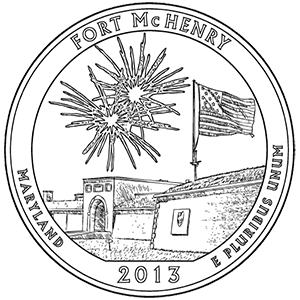
2013 · United States Mint image Official Mint coloring-page line drawing; reverse design by Joseph Menna. Design and artist source ↗
United States Mint quarter design · United States Mint. Open source ↗
- Quarter issue year
- 2013
- Retrieved
- 2026-10-30
- Image rights
- Image rights and source ↗
- Evidence
- Single source; not independently corroborated.
- Reuse
- Reverse designed by a Mint staff artist. Coloring-page graphic rights and any underlying third-party rights are not separately established. Do not imply Mint endorsement.
- Rights
- Reverse designed by a Mint staff artist. Coloring-page graphic rights and any underlying third-party rights are not separately established. Do not imply Mint endorsement.
Designation · National Park System directory. Open source ↗
- Information date
- Not supplied by the source
- Retrieved
- 2026-10-30
- Evidence
- Single source; not independently corroborated.
- Reuse
- Factual reference data; source attribution retained.
State or territory · National Park System directory. Open source ↗
- Information date
- Not supplied by the source
- Retrieved
- 2026-10-30
- Evidence
- Single source; not independently corroborated.
- Reuse
- Factual reference data; source attribution retained.
Battle of Baltimore Map - Fort McHenry National Monument and Historic Shrine · National Park Service, Harpers Ferry Center. Open source ↗
- Information date
- Not supplied by the source
- Retrieved
- 2026-10-30
- Source scope
- Fort McHenry National Monument and Historic Shrine
- Download
- Official map PDF ↗
- Evidence
- Single source; not independently corroborated.
- Reuse
- Public domain; NPS map
- Rights
- Public domain; NPS map
History of Fort McHenry · History of Fort McHenry — National Park Service. Open source ↗
- Information date
- Not supplied by the source
- Retrieved
- 2026-10-30
- Source page last updated
- April 22, 2026
- Evidence
- Single source; not independently corroborated.
- Reuse
- NPS-authored U.S. government material is generally public domain; third-party content may have separate rights.
Battle of Baltimore · Battle of Baltimore — National Park Service. Open source ↗
- Information date
- Not supplied by the source
- Retrieved
- 2026-10-30
- Source page last updated
- May 27, 2022
- Evidence
- Single source; not independently corroborated.
- Reuse
- NPS-authored U.S. government material is generally public domain; third-party content may have separate rights.
The Star-Spangled Banner · The Star-Spangled Banner — National Park Service. Open source ↗
- Information date
- Not supplied by the source
- Retrieved
- 2026-10-30
- Source page last updated
- September 8, 2020
- Evidence
- Single source; not independently corroborated.
- Reuse
- NPS-authored U.S. government material is generally public domain; third-party content may have separate rights.
People · People — National Park Service. Open source ↗
- Information date
- Not supplied by the source
- Retrieved
- 2026-10-30
- Source page last updated
- March 15, 2024
- Evidence
- Single source; not independently corroborated.
- Reuse
- NPS-authored U.S. government material is generally public domain; third-party content may have separate rights.
James McHenry - Fort McHenry’s Namesake · James McHenry - Fort McHenry’s Namesake — National Park Service. Open source ↗
- Information date
- Not supplied by the source
- Retrieved
- 2026-10-30
- Source page last updated
- July 16, 2025
- Evidence
- Single source; not independently corroborated.
- Reuse
- NPS-authored U.S. government material is generally public domain; third-party content may have separate rights.
Francis Scott Key · Francis Scott Key — National Park Service. Open source ↗
- Information date
- Not supplied by the source
- Retrieved
- 2026-10-30
- Source page last updated
- July 16, 2025
- Evidence
- Single source; not independently corroborated.
- Reuse
- NPS-authored U.S. government material is generally public domain; third-party content may have separate rights.
Antietam Wounded and Captured · Antietam Wounded and Captured — National Park Service. Open source ↗
- Information date
- Not supplied by the source
- Retrieved
- 2026-10-30
- Source page last updated
- November 16, 2020
- Evidence
- Single source; not independently corroborated.
- Reuse
- NPS-authored U.S. government material is generally public domain; third-party content may have separate rights.
Gettysburg Prisoners of War · Gettysburg Prisoners of War — National Park Service. Open source ↗
- Information date
- Not supplied by the source
- Retrieved
- 2026-10-30
- Source page last updated
- August 13, 2020
- Evidence
- Single source; not independently corroborated.
- Reuse
- NPS-authored U.S. government material is generally public domain; third-party content may have separate rights.
Political Prisoners · Political Prisoners — National Park Service. Open source ↗
- Information date
- Not supplied by the source
- Retrieved
- 2026-10-30
- Source page last updated
- May 13, 2025
- Evidence
- Single source; not independently corroborated.
- Reuse
- NPS-authored U.S. government material is generally public domain; third-party content may have separate rights.
Fort McHenry in the Civil War · Fort McHenry in the Civil War — National Park Service. Open source ↗
- Information date
- Not supplied by the source
- Retrieved
- 2026-10-30
- Source page last updated
- April 22, 2026
- Evidence
- Single source; not independently corroborated.
- Reuse
- NPS-authored U.S. government material is generally public domain; third-party content may have separate rights.
World War I Hospital · World War I Hospital — National Park Service. Open source ↗
- Information date
- Not supplied by the source
- Retrieved
- 2026-10-30
- Source page last updated
- June 10, 2025
- Evidence
- Single source; not independently corroborated.
- Reuse
- NPS-authored U.S. government material is generally public domain; third-party content may have separate rights.
The Chesapeake Campaign · The Chesapeake Campaign — National Park Service. Open source ↗
- Information date
- Not supplied by the source
- Retrieved
- 2026-10-30
- Source page last updated
- September 30, 2024
- Evidence
- Single source; not independently corroborated.
- Reuse
- NPS-authored U.S. government material is generally public domain; third-party content may have separate rights.
Battle of North Point · Battle of North Point — National Park Service. Open source ↗
- Information date
- Not supplied by the source
- Retrieved
- 2026-10-30
- Source page last updated
- September 11, 2020
- Evidence
- Single source; not independently corroborated.
- Reuse
- NPS-authored U.S. government material is generally public domain; third-party content may have separate rights.
The Negotiation for Dr. Beanes · The Negotiation for Dr. Beanes — National Park Service. Open source ↗
- Information date
- Not supplied by the source
- Retrieved
- 2026-10-30
- Source page last updated
- May 7, 2024
- Evidence
- Single source; not independently corroborated.
- Reuse
- NPS-authored U.S. government material is generally public domain; third-party content may have separate rights.
The Bombardment of Fort McHenry · The Bombardment of Fort McHenry — National Park Service. Open source ↗
- Information date
- Not supplied by the source
- Retrieved
- 2026-10-30
- Source page last updated
- September 11, 2020
- Evidence
- Single source; not independently corroborated.
- Reuse
- NPS-authored U.S. government material is generally public domain; third-party content may have separate rights.
Baltimore Saved · Baltimore Saved — National Park Service. Open source ↗
- Information date
- Not supplied by the source
- Retrieved
- 2026-10-30
- Source page last updated
- January 9, 2023
- Evidence
- Single source; not independently corroborated.
- Reuse
- NPS-authored U.S. government material is generally public domain; third-party content may have separate rights.
The Great Garrison Flag · The Great Garrison Flag — National Park Service. Open source ↗
- Information date
- Not supplied by the source
- Retrieved
- 2026-10-30
- Source page last updated
- September 8, 2020
- Evidence
- Single source; not independently corroborated.
- Reuse
- NPS-authored U.S. government material is generally public domain; third-party content may have separate rights.
Fort Whetstone · Fort Whetstone — National Park Service. Open source ↗
- Information date
- Not supplied by the source
- Retrieved
- 2026-10-30
- Source page last updated
- January 30, 2026
- Evidence
- Single source; not independently corroborated.
- Reuse
- NPS-authored U.S. government material is generally public domain; third-party content may have separate rights.
People of the Civil War · People of the Civil War — National Park Service. Open source ↗
- Information date
- Not supplied by the source
- Retrieved
- 2026-10-30
- Source page last updated
- February 27, 2024
- Evidence
- Single source; not independently corroborated.
- Reuse
- NPS-authored U.S. government material is generally public domain; third-party content may have separate rights.
People of World War I · People of World War I — National Park Service. Open source ↗
- Information date
- Not supplied by the source
- Retrieved
- 2026-10-30
- Source page last updated
- November 9, 2020
- Evidence
- Single source; not independently corroborated.
- Reuse
- NPS-authored U.S. government material is generally public domain; third-party content may have separate rights.
Lead Up to Battle · Lead Up to Battle — National Park Service. Open source ↗
- Information date
- Not supplied by the source
- Retrieved
- 2026-10-30
- Source page last updated
- September 11, 2020
- Evidence
- Single source; not independently corroborated.
- Reuse
- NPS-authored U.S. government material is generally public domain; third-party content may have separate rights.
George Armistead · George Armistead — National Park Service. Open source ↗
- Information date
- Not supplied by the source
- Retrieved
- 2026-10-30
- Source page last updated
- February 26, 2015
- Evidence
- Single source; not independently corroborated.
- Reuse
- NPS-authored U.S. government material is generally public domain; third-party content may have separate rights.
Ecology · Climate Change and Natural Resources — National Park Service. Open source ↗
- Information date
- January 20, 2026
- Retrieved
- 2026-10-30
- Evidence
- Single source; not independently corroborated.
- Reuse
- NPS webpage text; U.S. government work generally public domain. Third-party material may have separate rights.
Plants · Plants — National Park Service. Open source ↗
- Information date
- January 20, 2026
- Retrieved
- 2026-10-30
- Evidence
- Single source; not independently corroborated.
- Reuse
- NPS webpage text; U.S. government work generally public domain. Third-party material may have separate rights.
Animals · Animals — National Park Service. Open source ↗
- Information date
- January 21, 2026
- Retrieved
- 2026-10-30
- Evidence
- Single source; not independently corroborated.
- Reuse
- NPS webpage text; U.S. government work generally public domain. Third-party material may have separate rights.
Wetlands · Wetlands — National Park Service. Open source ↗
- Information date
- June 26, 2024
- Retrieved
- 2026-10-30
- Evidence
- Single source; not independently corroborated.
- Reuse
- NPS webpage text; U.S. government work generally public domain. Third-party material may have separate rights.
Mammals · Mammals — National Park Service. Open source ↗
- Information date
- January 21, 2026
- Retrieved
- 2026-10-30
- Evidence
- Single source; not independently corroborated.
- Reuse
- NPS webpage text; U.S. government work generally public domain. Third-party material may have separate rights.
Paul S. Sarbanes Visitor and Education Center · National Park Service park structured data. Open source ↗
- Information date
- Not supplied by the source
- Retrieved
- 2026-10-30
- Evidence
- Single source; not independently corroborated.
- Reuse
- NPS-supplied text; NPS-authored U.S. government work is generally public domain, subject to third-party rights.
Physical Address · Official park structured information. Open source ↗
- Information date
- Not supplied by the source
- Retrieved
- 2026-10-30
- Evidence
- Single source; not independently corroborated.
- Reuse
- NPS-supplied text; NPS-authored government work generally public domain, subject to third-party rights.
Mailing Address · Official park structured information. Open source ↗
- Information date
- Not supplied by the source
- Retrieved
- 2026-10-30
- Evidence
- Single source; not independently corroborated.
- Reuse
- NPS-supplied text; NPS-authored government work generally public domain, subject to third-party rights.
Telephone · Official park structured information. Open source ↗
- Information date
- Not supplied by the source
- Retrieved
- 2026-10-30
- Evidence
- Single source; not independently corroborated.
- Reuse
- NPS-supplied text; NPS-authored government work generally public domain, subject to third-party rights.
Recreation visits · National Park Service Visitor Use Statistics. Open source ↗
- Information date
- 2025
- Retrieved
- 2026-10-30
- Methodology
- NPS reporting unit; annual total is the sum of 12 monthly recreation visit estimates.
- Reporting unit
- Fort McHenry NM & HS
- Evidence
- Single source; not independently corroborated.
- Reuse
- Factual reference data; source attribution retained.
